
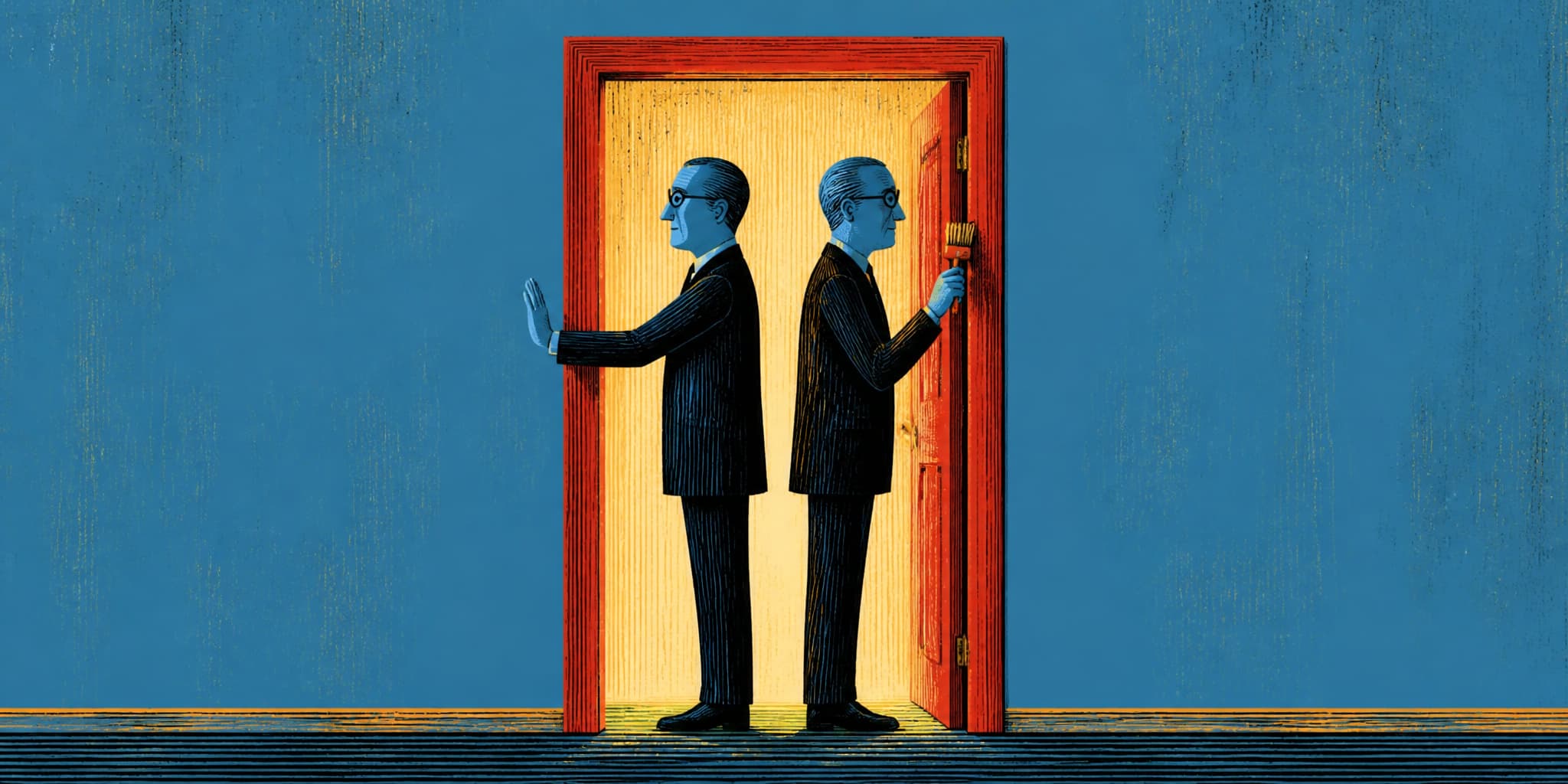
Design either owns the gate or renders it. Owning it means documented authority over launch review: the bar a model output has to clear before a customer sees it, plus the power to hold a ship date that misses the bar. Rendering it means designing the screen where a user meets what the model already did, after someone in another org decided it was good enough. Both are real work. Only one is the job you're trying to get.
I didn't invent that line. It's the NIST AI risk framework run as a hiring filter.
Meaningful oversight requires a named accountable person, a documented deployment decision, and working mechanisms for override and reversal. A role that touches none of the three has oversight language in the posting as decoration.
That filter is what the sweep applied to ninety days of appointments. It returned far fewer real instances than the volume of AI-executive news would lead you to expect.
1. Design gets the gate at the companies that never split it
No split announced inside the window came with public evidence that design gained authority over model launch. The clearest evidence of design holding a formal gate came from companies with no split at all.
At Vanta, the Head of Design role reports through CPO Jeremy Epling and carries, in writing, responsibility for defining design quality standards and launch-review frameworks. Source discipline: a posting is high-reliability for what a company says it wants and weak for what it actually hires. Even discounted, that sentence grants in one line what four executive reorganizations in this window did not.
- Epling, CPO. Tenure not confirmable from public signal. Contact path: cold, through the search itself. The mandate is a confirmed backfill, worked in the Vanta card.
- Narrative fit: Vanta wants someone to write the standard an AI feature clears before it ships. That is the Thermo Fisher problem. You built exception-first workflows in pharma where one human gate stays human, because a regulatory signature cannot be delegated.
Salesforce is the second instance and a named target. Kat Holmes holds AI, experience design, and trust in one remit, established by May 2025, roughly fifteen months in seat. One qualifier. Salesforce describes a separate AI Research function that measures and validates agent performance, so merged authority over experience is not merged authority over evaluation. Confidence: moderate. No public reporting line, no disclosed go/no-go.
- Holmes, EVP and Chief Experience Officer. Contact path: cold, anchored to her agent experience design byline and her public line about people being in the lead, not just the center. The media-page press address is not a candidate door.
- Narrative fit: she is arguing that agents need an experience discipline of their own. Alibaba.com is your proof that trust rules can become a working multi-surface system at $50B-plus GMV instead of a principles deck nobody enforces.
Do this: stop reading a new AI-executive appointment as a positive signal. Given two comparable openings, bet on the merged line. Order for the week: Capital One first (live role, evidenced door, design already holds the AI mandate), Vanta second (launch review written into the job), Socure third (86-day window, unresolved gate, so go ask). Atlassian and Adobe sit behind them on enterprise cadence.
Pre-empt one objection. In split-authority companies, the enterprise design director archetype wins the "translate the model into workflow" framing on org-size pedigree alone. Pedigree loses to production depth. You are working agent traces and governance in enterprise deployments this week. They are describing a translation problem they've read about.
2. The AI mandate points inward. Design keeps the customer.
This is the version of the split that works. AI leadership aims at internal workflow and adoption. Product and design keep the customer surface. Nobody is fighting over the same square foot.
Atlassian is the funded version. Avani Prabhakar's remit expanded to Chief People and AI Enablement Officer on April 27: 96 days in seat, four days outside the window, worth carrying anyway. Internal engineering, data science, and research fold into one transformation org. Chief Design Officer Charlie Sutton and Chief Product and AI Officer Tamar Yehoshua sit separately on the leadership page. Design's leverage there is infrastructural: encoding intent, accessibility, and interaction patterns into machine-readable context that people and agents both consume. Substantial power. Not a launch gate.
- Sutton, Chief Design Officer. Cold. Current hook: his Team '26 session on designing for modern work, where he argued design's job is protecting human agency. No candidate-facing address surfaced. Enterprise cadence, so follow up day 10 and again day 20. Silence here is process, not rejection.
- Narrative fit: Atlassian is trying to make design intent legible to agents. You've built both halves. Agentic Labs shows how an agent consumes and exposes intent; Alibaba shows trust rules running as a system at scale; and you debug the gap between what an agent did and what a user experienced every day in your current role.
Capital One inverts this, which is why it's first on your list. Daniela Jorge, SVP and Chief Design Officer, roughly two years in seat, owns the internal AI operating model for a hundreds-person experience design org. No AI executive is named above her. Design captured the inward mandate rather than ceding it. That is Pattern 1 evidence filed under Pattern 2. The door stays Patrick Dohan's hiring post, not the Workday form. Fully worked in the action payload.
Webflow is the same outward type, roughly 25 days in for both CPO Ben Haefele and SVP AI Transformation Kieran Boyle. That account and its outreach move belong to the Webflow card.
Do this: write to the design side. The AI executive is not your buyer here and cannot expand your scope.
3. AI owns the model. Design inherits the thresholds.
Socure, both appointments effective May 7, roughly 86 days in seat. FinTech Futures corroborated the company announcement. CPO Chung-Man Tam owns product management, design, roadmap, and the translation of AI capability into customer workflow. Chief AI and Innovation Officer Pablo Abreu owns data science, modeling, and the identity graph.
Read the verbs. One office owns the model and the core IP. The other translates it. Confidence: high on the scope split, moderate on how conflicts resolve. Nothing public establishes who approves launch thresholds, or who prevails when model performance and workflow requirements disagree. The tiebreaker is budget: Abreu's office is funded, not advisory. A Head of Data Science opening reports directly to him at $250–300K plus equity, wired into product and model roadmaps. Aura shows the same shape more cleanly, CPO under the CEO with design and Chief AI Officer under the CTO with the platform, on one company-issued source, uncorroborated.
- Tam, CPO. Cold LinkedIn, anchored to the appointment thread he replied in. Abreu: his July fraud-model post is a hook, not an invitation. Neither has published anything about the design org. Growth-stage cadence: nothing by day eight, one follow-up on a new signal, then move.
- Narrative fit: the hardest surface at Socure is the moment a fraud score becomes a decision a compliance officer signs their name to. That's the handoff the trust essay names, the one Alibaba proves at platform scale, and the one Carrier IQ demonstrates end to end with live agents in a regulated line of business.
Gusto is this pattern before it has a name. A Head of AI and Machine Learning Engineering search grants company-wide evaluation, deployment, monitoring, and quality-standard authority, running in parallel with a Head of Design search. No incumbent, no disclosed reporting line. Amy Thibodeau is the design-side door. She published Gusto's AI principles, including the commitment that customers keep the decision on consequential AI-proposed actions. Narrative fit: as automation absorbs the routine service path, human experts inherit only the ambiguous cases. That is exactly what exception-first design at Thermo Fisher was built for.
Act anyway. Don't deprioritize this type; change the sequence. Make the gate your first substantive question and use the split itself as the opening. You separated the model from the workflow. Who sets the threshold the workflow has to honor? Almost nobody else in the pipeline asks that. You'll ask it like someone who has had to answer it.
4. Sometimes neither one owns it. A committee does.
At Adobe, an AI feature clears standardized testing and a cross-functional AI ethics committee before release. Confidence: moderate. That is company self-description on a corporate responsibility page, with no independent corroboration of what the committee actually gates. Walk in assuming some of it is marketing. SVP of Design Eric Snowden has said design should act as the company's conscience and help decide whether a thing gets built. Influence claim. Not approval authority.
- Snowden, SVP Design. Cold. Hooks: his Adobe Design interview and his Behance presence. Enterprise cadence, same as Atlassian.
- Narrative fit: Agentic Labs and the trust essay speak directly to agentic creative control, and Alibaba proves you can make design intent enforceable across a platform instead of merely persuasive in a review.
Do this: where a committee approves, change the ask. Don't probe for authority you already know isn't there. Ask who staffs it, whether design holds a standing seat, and who writes the criteria it applies. Writing the criteria is the real power in a committee structure, and unlike approval authority, it is reachable from a Director seat.
5. The silences, and the one that corrected me
Only Webflow and Socure produced named split announcements inside the strict window. The AI-native cohort returned nothing usable. The growth-stage tier was quieter still.
| Target | What the 90-day window produced |
|---|---|
| Anthropic | Product and model news on the newsroom; no boundary change |
| Suno | A Series D in June |
| Stripe | No qualifying appointment on the newsroom |
| Abridge | A CTO, with no disclosed design-authority change |
| OpenAI | Product and infrastructure moved together under Greg Brockman |
| Ramp, Headway, Amplitude | No qualifying executive boundary change |
| Brex | Capital One acquisition completed April 7. Authority resolved, pre-IPO equity thesis ended |
Do this: read those as no split trigger, not no trigger. Amplitude's Head of Product Design and Ramp's Director, Product Design are both live, and a live posting is its own timing signal. Work them now, through the role and the named design buyer. Don't hold either account waiting on a structural announcement that isn't forming.
My prior going in was that the enterprise tier settled its design-versus-AI boundary years ago and therefore offered no window. Half right, and the wrong half is the useful half. Atlassian moved in April. Adobe's approval mechanism sits outside both functions entirely. Enterprise boundaries are being redrawn right now, in governance documents, not press releases.
One shape keeps getting mistaken for this pattern. Nubank named Carl Rivera CPO on May 18, roughly 75 days in, and kept Chief Design Officer Ethan Eismann as a CEO-level peer. Product and design separated. No AI executive named. Different animal. Do this: write to Eismann, not Rivera, and open on his own claim, that AI compresses production while design judgment moves upstream into product decisions. Narrative fit: you ran that upstream-judgment problem across both sides of a two-sided system at Allē, where 30M consumer members and 40K provider practices needed different decisions from the same product, and the redemption economics only worked when both sides got the right one.
The test to run before you write to anyone
Find the sentence that names who approves a model launch. It exists in the posting, in the executive's own published writing, or nowhere.
Names the design leader: that company goes to the top of the queue regardless of title, stage, or how much AI news it generated this quarter. Names an AI or engineering executive: you're being hired to render the gate, so negotiate scope and comp on that basis now instead of discovering it in month four. Names no one: ask in the first ten minutes. That question will do more for your candidacy than whichever case study you were planning to lead with.
- Brex changed hands in April: Chief Design Officer Matt Bango still says design reports directly to the CEO and publishes his own recruiting email, which makes the Staff Product Designer, AI role one of the cleanest role-to-portfolio matches on the board even with the equity thesis gone.
- Vanta already wrote its gate down: the company describes task-specific evaluations, reviewers calibrated with governance experts, and real-workflow thresholds in its published account of how it builds AI products — read it before the Epling conversation, because it is the standard the Head of Design would inherit and revise.
- HackerOne separates agentic from unsupervised: its Director, AI Product Design search sits directly on top of a public position that agentic behavior is not unsupervised behavior, with scoped and progressive permissions as the mechanism, which gives you the company's own vocabulary for the Watch-Verify-Delegate ladder.
- NIST names the measurable version: the framework's Measure playbook recommends tracking overrides, exceptions, escalations, and adjudication outcomes, which is the concrete answer to give when a buyer asks what a trust mandate would actually produce in six months.