

Every company on your target list right now says it wants an AI design leader. Capital One's Director, Product Design — AI in Experience Design. OpenAI's Product Design Leadership, Growth. Gusto's Head of Design, Unified Service Platform. Headway's Staff Product Designer, Provider CRM.
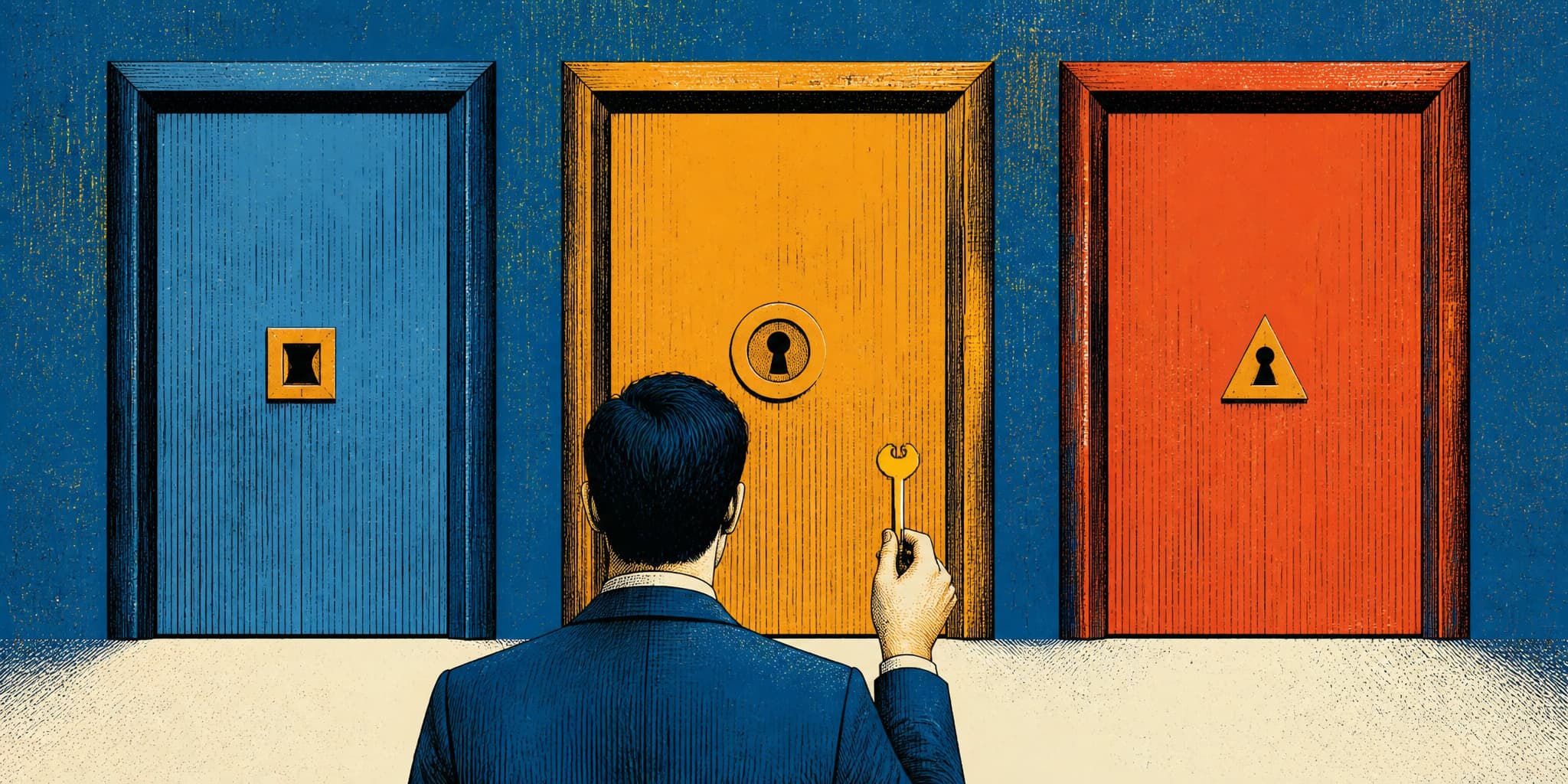
If the same opening paragraph could go to all four, you haven't identified which buyer you're facing. Jorge, Silber, and Thibodeau have each given recent interviews that reveal what they actually screen for. Those interviews update the model below.
Archetype 1: The Enterprise Transformation Buyer
Who this is: Daniela Jorge, Chief Design Officer at Capital One, leading a several-hundred-person Experience Design organization. She has been at the company since 2023. She has senior designers who built what currently works. She is not building from scratch, and she is not evaluating product-design craft in the usual sense.
What the posting says: Technical AI expertise, change management, tooling roadmaps, adoption metrics, risk management.
What Jorge actually screens for: Three interviews reveal a leader who filters on organizational navigation first and technical credentials second.
In a 2022 long-form interview, she describes being pulled into cross-functional disagreements because colleagues trust her to act for the customer rather than for a function's ownership claim. She says she spends as much or more time building relationships with cross-functional peers as with her own team. When asked what senior leaders need to develop, she names patience, influence, and measuring progress in small increments.
In her first months at Capital One, she centered on listening, learning, understanding partners' priorities, and identifying how to support work already underway. Her analogy is a blueprint where the leader decides which rooms to build now and which can wait.
In a 2026 interview, she says a major challenge is helping designers explain recommendations in business terms rather than aesthetic language.
Read those together. She is asking: Will this person listen before they prescribe? Can they earn credibility with designers who have been here longer? Do they have the business fluency to frame a recommendation in terms that product, engineering, and risk will accept?
Tells that reveal this filter is active:
- She asks about a time you changed something in an organization where people disagreed. She's listening for how you handled the disagreement. The change itself is secondary.
- She asks what you'd do in your first 90 days. "Listen and learn" passes. "Install my framework" fails.
- She probes business context. If you default to craft vocabulary when explaining a design recommendation, you've signaled the exact problem she says her org already has.
What wins: Demonstrating you've earned trust from skeptics by being useful to them before asking them to change. Showing judgment about pace — which rooms to build now. Proving you can be technically credible on AI while exercising restraint about where to apply it.
What loses: Leading with your product-design portfolio when the job is organizational. Presenting a transformation framework as though it's been proven at this scale. Treating the existing org as a problem to fix. The Capital One Opportunity Brief covers the complete engagement package; this piece is the buyer psychology that determines how it lands.
Narrative fit: Your Alibaba work — navigating cross-functional sprints across homepage, search, and PDP on a $50B+ GMV platform — earns the conversation by proving you've operated at organizational scale. Trust essay and Agentic Labs then demonstrate the AI methodology Jorge is actually hiring for.
Competing candidates (confidence: moderate):
- Enterprise design director (Salesforce/Adobe pedigree): Likely outperforms you on org size managed. Underperforms on AI-native credibility. Counter: your TinyFish production experience with agent traces and governance is currency they can't match.
- Internal promotion candidate: The most dangerous competitor here. They already have the organizational trust Jorge values. Your counter: an internal candidate may lack the outside perspective and AI-native depth the mandate requires. But recognize that this is the hardest competitor to displace at a company where the buyer explicitly prizes patience and relationship capital.
- AI-native design leader: Likely underperforms on the patience and cross-functional relationship skills Jorge explicitly values. Your vulnerability is the same — you need to demonstrate you won't arrive with a tempo that breaks trust.
Archetype 2: The AI-Native Buyer
Who this is: Ian Silber, Head of Design at OpenAI. In an August 16 podcast, he laid out a frame that inverts most of what design hiring usually rewards.
What the posting says: Curiosity, prototyping, systems thinking, AI fluency. He says previous AI-company experience is not required.
What Silber actually screens for: His strongest signal is a directive to his team: "just do less." Reuse an existing system or component. Extend an existing feature. Decline to build the feature when new interface is unnecessary. His systems criterion is specific: underlying primitives should compose into a coherent product rather than produce one-off siloed experiences.
He warns against becoming precious about work when the technical substrate is still changing — model capability, latency, and required controls can shift within a month. And he endorses humility, criticizing the posture of pretending to have AI figured out.
The inversions are clear enough to act on. A portfolio of features you added demonstrates the opposite of what he values. A polished framework for AI design presented as settled methodology signals the preciousness he warns against.
Tells:
- He asks about a design decision where you chose not to build something. He's evaluating judgment about restraint.
- He probes how you think about systems and primitives. A portfolio organized by product features rather than underlying patterns reads as the siloed thinking he's trying to eliminate.
- He builds teams with complementary strengths rather than expecting one designer to cover everything. He's assessing what you're specifically excellent at.
What wins: Thinking in composable primitives. Comfort with instability — making good decisions when the ground is moving. Prototyping ability that proves you think through building.
What loses: A feature-additive portfolio. A settled AI design framework presented as proven. Overclaiming mastery of a field that changes monthly.
Narrative fit: Your forward-looking visual design artifacts — interaction models, mental models, user flows at the primitive level — are the lead. Agentic Labs apps serve as production proof. Trust essay as conceptual framework. Case studies as secondary enterprise credibility.
Those forward-looking artifacts need to be published and linkable at junochen.com before outreach. As of the last portfolio audit, they remain a build dependency.
Competing candidates (confidence: moderate to high):
- AI-native IC (current Anthropic/OpenAI designer): Outperforms you on brand pedigree and internal context. Underperforms on enterprise scale proof and published frontier design thinking. Your forward-looking artifacts, once published, are a differentiator they structurally lack — they design internally, not publicly.
- FAANG Staff designer: Likely outperforms on craft depth signals within established design systems. Underperforms on AI-native credibility and comfort with instability. Your TinyFish production experience with agent infrastructure is a direct counter.
- Your vulnerability: Silber doesn't require AI-company experience, but the growth posting still asks for hands-on leadership in an AI-native context. Your bridge narrative — product role at TinyFish to build AI-natively, returning to design to apply that depth — needs to land cleanly or it reads as a gap rather than a deliberate move.
Archetype 3: The Growth-Stage Platform Buyer
Who this is: A design leader at a company where AI is being embedded into workflows that carry real consequences for people who didn't choose to interact with it.
The instances: Amy Thibodeau at Gusto; Jake Poses at Headway. The shared problem is delegation with asymmetric consequence. Headway's Provider CRM role explicitly asks what happens when an AI assistant communicates on a provider's behalf and is uncertain or wrong — with a patient affected. Gusto's Unified Service Platform role assigns responsibility for uncertainty, graceful failure, human escalation, and deciding when AI output can proceed without review.
What's sharpened since Issue #2 and Issue #7 is the evidence about how these buyers screen.
What the postings say: AI design skills, product leadership, systems thinking.
What they actually screen for: The titles imply strategic seniority — Head of Design, Staff Designer — but the filter that determines the hire is production proximity. Thibodeau has published the clearest candidate-rejection signal in this tier. In a public hiring post, she wrote that someone working exclusively in frameworks or strategy documents was not a fit — the person would spend most of their time shipping customer-facing product. That was a different role, but the preference is consistent with everything else she's published since: Gusto then pushed every designer to ship a pull request, and when the initial effort didn't sustain new behavior, they added tooling, peer champions, office hours, and repeated practice until it stuck. Her AI principles begin with the customer problem rather than the technology, preserve customer control over consequential actions, and say AI should not be built when its added value cannot be explained.
Poses hasn't published a design-candidate scorecard. His account of his own Headway hiring process — a VP Product search — reveals what the company used at the executive level: business comprehension, customer proximity, product judgment, and the quality of questions asked during informal time. That's a product-leadership screen, not a design-candidate screen, but it's the closest public evidence of what Headway values in senior hires.
Tells:
- They ask you to walk through a design decision where automation could cause harm. They're listening for whether you designed the exception path or only the happy path.
- Portfolio presentations heavy on frameworks and light on production artifacts trigger Thibodeau's documented rejection pattern.
- They ask about escalation design — what happens when the AI is wrong and a human needs to take over. They want specifics, not principles.
What wins: Showing you've designed for consequential automation — decision gates, escalation paths, human override. Demonstrating you ship and build, not just direct. Proving you think about who bears the consequence when an agent acts.
What loses: Framework-only leadership. Portfolio presentations that stop at the strategy layer. Treating AI as a feature to add rather than a responsibility to design around.
Narrative fit: For Headway, Carrier IQ leads — it's a regulated-industry agentic system where the consequence design is visible across all five handoffs. For Gusto, Thermo Fisher leads (Product Design Director at BCG Digital Ventures) — decision gates and compliance-first design in a consequential workflow. Trust essay supports both. The Gusto battlecard has the account-specific engagement package.
Competing candidates (confidence: moderate):
- Enterprise design director: Likely outperforms on org management scale. Underperforms on AI-native credibility and hands-on shipping proof — which is the specific gate Thibodeau screens for.
- AI-native IC: Likely outperforms on pure AI design pedigree. Underperforms on regulated-context proof and consequence design. Your Thermo Fisher and Red Cross work (both as Product Design Director at BCG Digital Ventures) in regulated, high-stakes environments is a structural advantage here.
- Your vulnerability: the code-first culture at Gusto means they may weight technical building ability — shipping PRs, working in production — more heavily than your portfolio currently demonstrates. TinyFish production experience helps as currency, but it's not publishable proof.
Before You Draft Outreach
Ask which of these three filters you're writing into.
Jorge screens for organizational patience and political judgment. Lead with how you navigated complexity at scale.
Silber screens for restraint and composable thinking. Lead with primitives and systems. A feature-additive portfolio is a disqualifier.
Thibodeau screens for production proximity and consequence design. Lead with what you built and what you designed for when it broke.
The outreach that wins one of these buyers will lose another. Know which one you're facing before you write the first line.
- Capital One's renewed requisition: The August 21 repost under R249772 proves renewed promotion but not whether it's a new seat or a slate reset of the earlier R243245 search — outreach should probe that distinction before assuming a fresh start.
- Forward-looking artifact status: The last portfolio audit found no separately verified public URL for the planned interaction models and mental models, which means the OpenAI lead evidence described above remains a build dependency rather than linkable proof until publication is confirmed.
- Headway's three-role cluster: Provider Onboarding, Provider CRM, and Group Practices each surface a different AI accountability problem — onboarding conversion, patient-facing error, and multi-role permissions — and Roland Tiangco is the most scope-specific contact for all three.
- Portfolio disclosure boundary: Private TinyFish material remains deliverable through client-side gating on junochen.com, and the standing portfolio-safety guidance says that boundary must be repaired before directing hiring traffic to the site.