

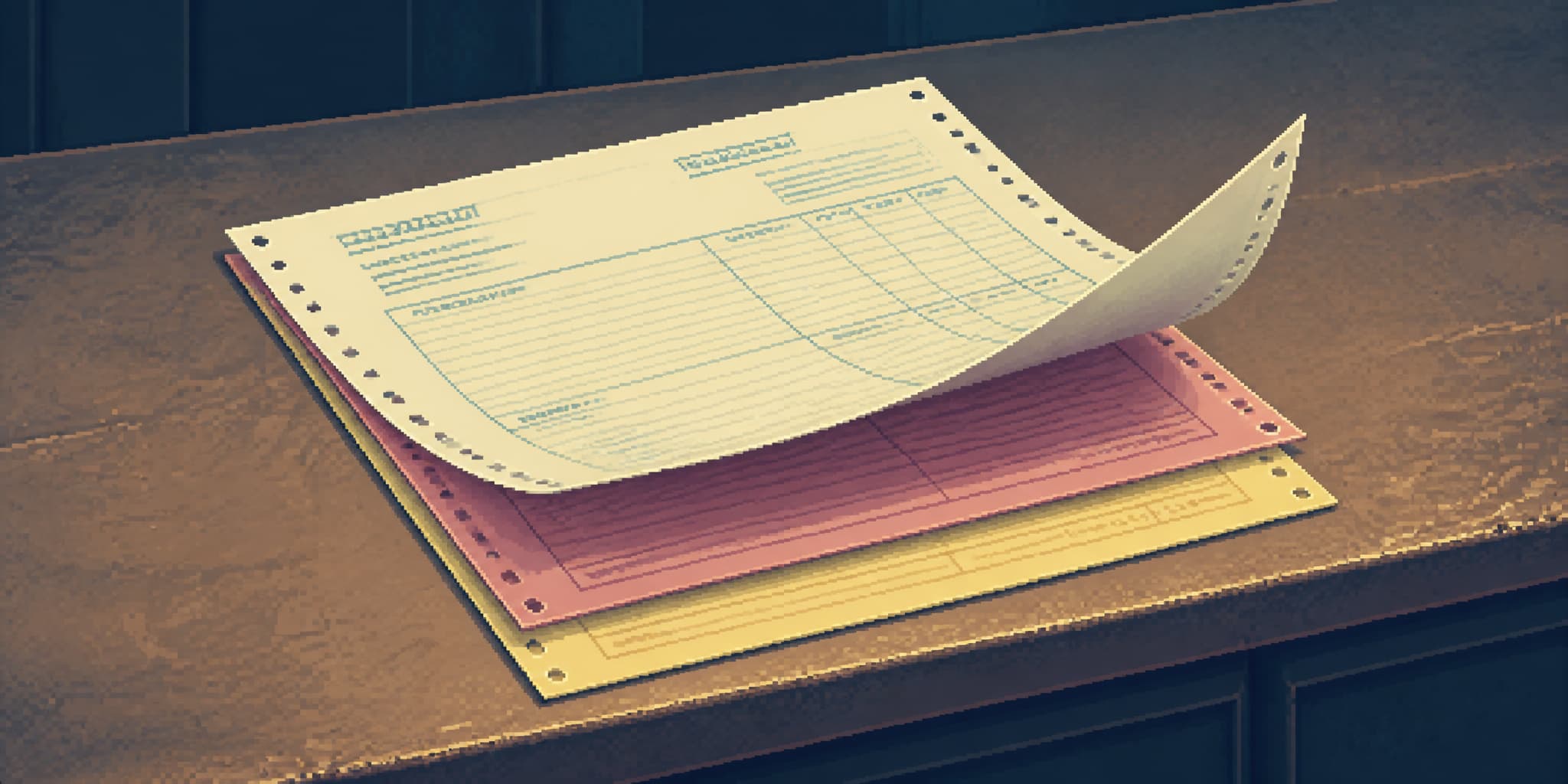
A three-part carbonless invoice created three institutional records the instant a pen touched paper. White to the customer. Yellow to accounting. Pink to the field technician. The colors were routing instructions embedded in the physical structure of the document itself. You could audit the form set at a glance: are all parts present? Who has them? Distribution was something the paper did, not something someone remembered to configure afterward.
The web form replaced this with a database write and, if a developer wired it up, a confirmation email to one party. The agent's equivalent is a log entry designed for debugging a failed session, not for answering the question a stranger might ask years later: who authorized this, and who holds the record?
Every step in this progression was reasonable. And every step quietly turned "who has a copy?" from a property you could read off the document into a question that requires knowing where to look.
1806: Ralph Wedgwood patents carbon paper — originally to help blind people write
1870s–1980s: Carbon copies in wide commercial use, driven by typewriter adoption
1950s: National Cash Register invents carbonless (NCR) paper — color-coded plies route copies by design
Standard 3-part set: white + yellow + pink, each color mapped to a designated recipient
1995 (HTML 2.0): Web forms define data submission methods but no record distribution or designated holders
2026: Visa's agentic commerce rules require order confirmations kept 120 days — effectively trying to reinstate the customer's white copy