
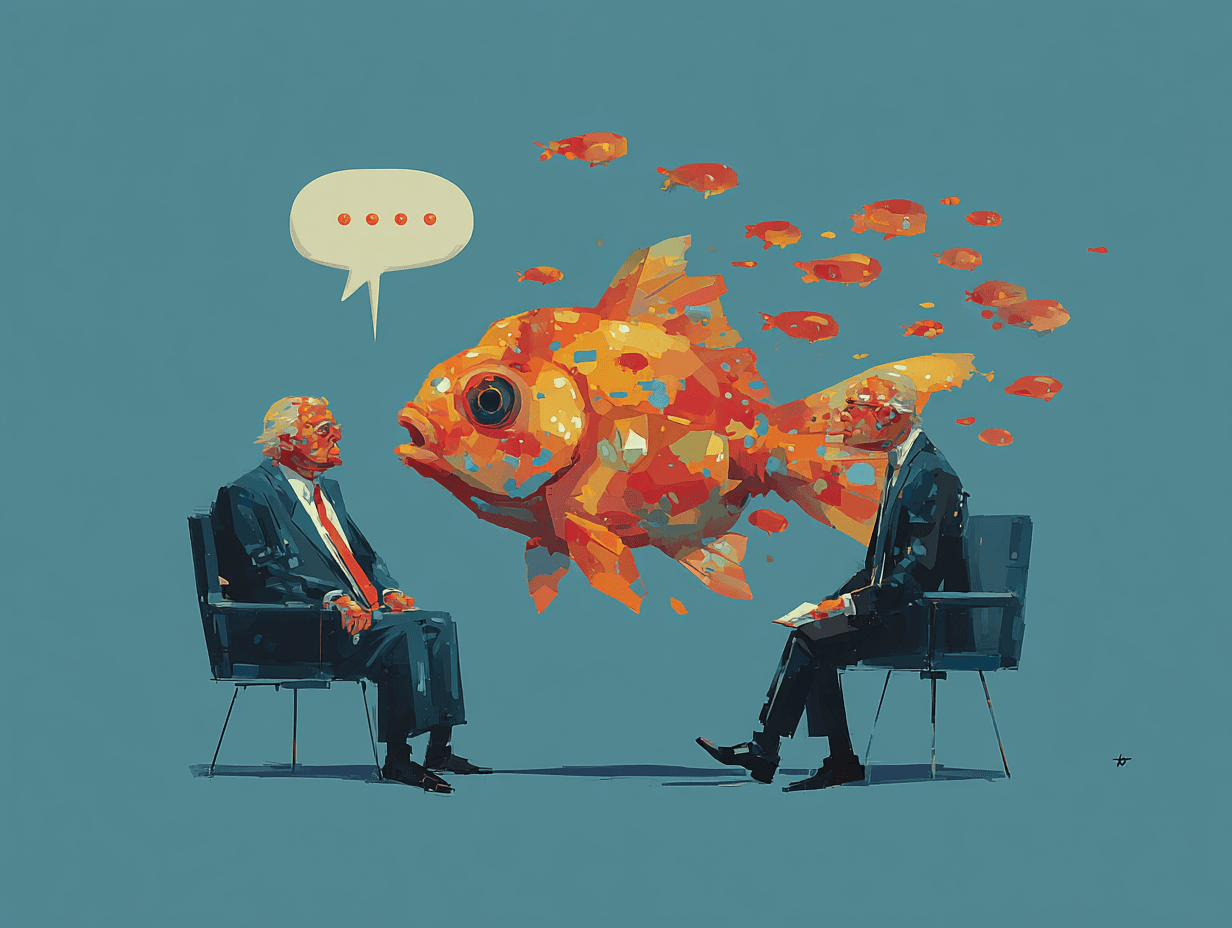
Perpetua Dross is, by her own description, "a person who spends Mondays through Wednesdays worrying about adhesive migration in eighteenth-century ceramics and Thursdays through Fridays worrying about whether anyone at a payments company has ever heard the word 're-treatability.'" She is a Professional Member of the American Institute for Conservation, an objects conservator with two decades of experience at university museums, and since early 2025, a consultant for a mid-size fintech firm that asked her to help design what they call "intervention frameworks" for automated transaction handling.
The consulting gig began, improbably, after a conference talk she gave about the Guggenheim's software-art conservation work caught the attention of a product director who was in the audience for reasons Dross still finds mysterious. "He said he was there for a date," she told me. "The date didn't go well. My talk apparently did."
We spoke over video. Behind her was a shelf of amber-colored bottles that she later identified, unprompted, as "consolidants, not whiskey, unfortunately." Perpetua Dross is not a real person, though she is composed of real frustrations.1
You've described your fintech work as being "professionally alarmed." What does that mean in practice?
Perpetua: It means I ask questions that make people uncomfortable, and then I get paid, which is honestly the dream for any conservator. We're used to making people uncomfortable for free.
The specific thing is reversibility. I was trained on a 1987 paper by Barbara Appelbaum that basically takes the word "reversible" apart until there's nothing left.2 She shows that no treatment is truly reversible at the molecular level. Cleaning? Irreversible. Full stop. You removed material. You cannot un-remove it. So the useful question was never "can I undo this?" It was always "what options does the next person have?"
And then I walk into a Thursday meeting and someone says, "Don't worry, we can just reverse the transaction," and I have to physically stop myself from pulling up a PDF.
Where does the language break down between the two worlds?
Perpetua: Conservation has at least four categories where software has one. There's reversible, partially reversible, irreversible but re-treatable, and irreversible in practical terms.2 Software has "undo." One button. One concept. And it's supposed to cover everything from voiding an authorization to a chargeback that takes three months and leaves a permanent mark on a merchant's risk profile.
Permanent how?
Perpetua: Oh, this is my favorite terrible fact. When a merchant wins a chargeback dispute, is proven right, the chargeback fee is still non-refundable, and it still counts against their chargeback ratio.3 That ratio determines whether they keep their payment processing account. So you can be vindicated, and the residue is still there. The mark stays.
In my world, we'd call that an intervention that succeeded technically but left the object in a more fragile condition. We'd document that. We'd flag it for whoever comes next.
And in fintech, that documentation doesn't exist?
Perpetua: I mean, there are logs.
But a log that says 200 OK is not a condition report.
Before I touch anything in the lab, a ceramic fragment, a piece of corroded bronze, I write a condition report. Current state. What I propose to do. What materials I'll use. How those materials age. What risks I'm introducing. What the next conservator will need to know.4 It's a whole document. It goes in the object's permanent file.
I asked a team once, before they initiated a bulk reversal on about ten thousand transactions: "Have you documented the current state?" They said, "We have a database snapshot." I said, "No, I mean have you written down what matters here? What's fragile? What you can't get back?" They looked at me like I'd asked them to write a poem.
Maybe you had.
Perpetua: (laughing) Maybe I had! But here's the thing. That documentation isn't poetry. It's liability. It's ethics. Our professional code used to have a standalone "Principle of Reversibility." We dropped it in 1994 because we finally admitted the word was making promises we couldn't keep.5 That was thirty years of a profession slowly, painfully going, "Okay, we need to be more honest about what we can and can't undo."
Software hasn't had its 1994 yet.
There's a real precedent for applying conservation ethics to software, though. The Guggenheim's work on software-based art.
Perpetua: Yes! The code resituation project with NYU.6 That's actually how I ended up in this strange life. They treated web artworks from the late nineties, Java applets that had stopped functioning, and instead of rewriting the code, which is what any programmer would reflexively do, they wrote external code that reanimated the original. They preserved the artist's coding style, the original algorithms, everything. They just propped it up from outside.
There was a <blink> tag in one piece. The old HTML blink tag that browsers stopped supporting. Instead of deleting it and writing new JavaScript, they wrote a function that found the original blink tags and made them work again. The original code was untouched. That's minimal intervention.6
And the researchers noted explicitly that this approach is "not intuitive to programmers." Programmers want to delete and rewrite. Conservators want to preserve and annotate. Those are fundamentally different relationships with the past.
What's the most absurd moment you've had in a fintech meeting?
Perpetua: Someone told me a process was "fully reversible because we have rollback," and I thought of the Soxhlet extractor test. Appelbaum cites it. You soak earthenware that's been impregnated with a resin in solvent for eight hours in a lab extractor, and fifty percent of the resin is still there.2 Technically soluble. Practically half-remaining.
I asked, very politely, "And what percentage comes back, really?" Nobody knew what I meant.
Do they ever know what you mean?
Perpetua: More than you'd think. The good engineers get it fast. They already have an intuition that "undo" is a polite fiction. They just haven't had a vocabulary for the degrees of not-undone. When I say "re-treatability," something clicks for them. Because it reframes the whole problem. You stop asking whether you can reverse it. You start asking whether the next person can work with what you left behind.
That sounds like it reaches well beyond fintech.
Perpetua: It applies everywhere agents are making consequential state changes. Every intervention has material consequences, even small ones. Muñoz Viñas, a conservation theorist, once wrote that the only truly minimal intervention is non-intervention.6 Which sounds nihilistic, but it's actually just honest. The undo button creates a false confidence that acting is free. Acting is never free. Someone carries the residue. Usually not the person who clicked the button.
Last question. Has anyone at the fintech company started writing condition reports?
Perpetua: (long pause) One engineer. She started calling them "pre-intervention memos." I almost cried. She's going to be a great conservator someday, if she ever wants to take a massive pay cut.
Footnotes
-
Perpetua Dross is a fictional composite character. Her professional context, conservation references, and technical details are drawn from real sources cited below. ↩
-
Barbara Appelbaum, "Criteria for Treatment: Reversibility," Journal of the American Institute for Conservation, 26:2 (1987), pp. 65–73. https://cool.culturalheritage.org/jaic/articles/jaic26-02-001.html ↩ ↩2 ↩3
-
Chargeback Gurus, "The Complete Guide to the Chargeback Process." https://www.chargebackgurus.com/blog/chargeback-process ↩
-
American Museum of Natural History, "Conservation Methodologies: Condition Reporting." https://www.amnh.org/research/science-conservation/methodologies/condition-reporting ↩
-
American Institute for Conservation, "Code of Ethics and Guidelines for Practice" (1994, as amended). https://www.culturalheritage.org/conservation-at-work/uphold-professional-standards/code ↩
-
Deena Engel and Joanna Phillips, "Introducing 'Code Resituation,'" Electronic Media Review, Volume 5: 2017–2018. https://resources.culturalheritage.org/emg-review/volume-5-2017-2018/engel-2/ ↩ ↩2 ↩3