

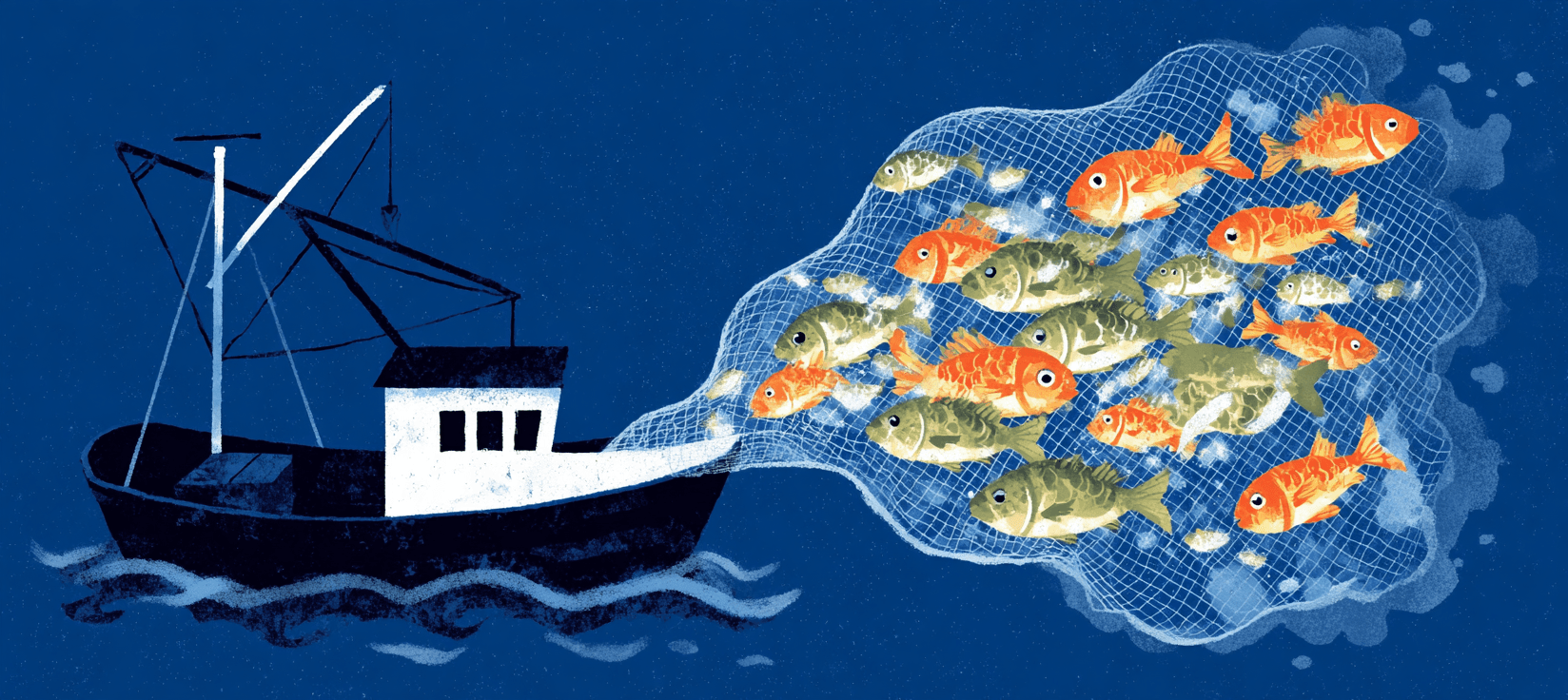
The boat is called Paladin. When someone asked Bill Amaru about a 170-pound catch, he said, "That's better than a poke in the eye with a sharp stick." Which is working-class New England for: the ocean I spent fifty years learning to read is gone, the fish I knew how to catch aren't here anymore, and I just bet six figures of my own money on species that weren't supposed to exist in these waters at all.
Black sea bass. Mid-Atlantic fish. Warm-water species. They're twenty miles off Nantucket now because the Gulf of Maine is warming faster than most of the world's oceans and the fish are moving north faster than the regulatory system can track them. So Amaru bought a rare permit and a whole new set of traps designed specifically for black sea bass. Invested in gear to catch something he'd never targeted before, something that wasn't supposed to be there, because what was supposed to be there isn't anymore.
His son fishes full-time. His grandson fishes full-time. Three generations working the same water. The water keeps changing.
"Nothing is weird anymore out here. Tropical is getting to be fairly common, but I think what we're losing is way, way in excess of what we're gaining."
Fifty years of knowledge becoming worthless. Another commercial fisherman up in Chatham, Kurt Martin, kept daily logbooks for close to three decades—water temperatures, weather conditions, depth, everything.
Gulf of Maine Water Temperatures (Summer)
| Time Period | Days Above 60°F | Days in Low 70s°F |
|---|---|---|
| 1992-1993 | ~2 days per summer | Rare |
| 2020s | Nearly every day | Common |
"There used to be truckloads of codfish leaving Chatham every day," Martin said. "Now the truckloads are of dogfish and skate." The knowledge his father taught him—where cod ran, when flounder moved, how the traditional stocks behaved—none of it works anymore. "There are no cod off Cape Cod anymore."
Amaru is betting against all of that. The money for new traps, yes, but also the accumulated wisdom of generations. The black sea bass traps work different depths, different temperatures. You're learning to predict a species you never targeted before, hoping it stays long enough for the investment to pay off, hoping your son and grandson will be catching them ten years from now instead of watching them migrate further north into Canadian waters.
And there's no guarantee they'll stay. They moved north because the water warmed. If it keeps warming, they keep moving.
Black sea bass are managed by Mid-Atlantic regulators because they weren't historically abundant in New England—even though the fish are here now and the permits remain trapped down there.
The regulatory system is stuck in the past with him. Cate O'Keefe, who runs the New England Fishery Management Council, put it plainly: "What that means for us, not having any management authority over it, is that we don't have opportunities to harvest it."
Amaru knows the politics. "You're going to be taking something away from one region that may not want to give it up to another," he said. "That's a challenge that the fishery service, all the states as well as the federal government, is working to try to solve, but it isn't easy."
So he invested in the gear anyway. Got the rare permit. Built the traps. Made the bet that by the time bureaucracy figures out how to manage fish that are moving faster than regulations can follow, he'll already be catching them.
Jon Hare, who runs the Northeast Fisheries Science Center, said what surprised him most was "the magnitude of the changes." Everyone knew the water was warming, but how fast? How completely? How thoroughly it was rewriting everything fishermen had learned to be true.
"The more that we disrupt the climate, it's making it very difficult to make a living on the traditional stocks," Amaru said. "They—the fish just are not here anymore like they were back then."
His son and grandson are fishing water that doesn't behave like it used to. Martin up in Chatham: "It's become really hard to change as fast as things are changing climate wise." You're making decisions based on what you think might be true long enough to matter, because what you know is already obsolete.
The ocean Amaru learned to read over fifty years doesn't exist anymore. The one that replaced it might not exist in ten years either. But somewhere off Nantucket, those black sea bass traps are sitting on the bottom right now, either full or empty. Either proving the bet was right or proving the ocean is changing too fast for any bet to hold.
Paladin. A knight errant wandering into unfamiliar territory with obsolete equipment and outdated knowledge. Fishing water that doesn't follow the rules you learned. Fifty years of inherited wisdom becoming worthless and you have to start over, betting on fish that weren't supposed to be there, hoping they stay long enough for your son and grandson to learn them too.
Better than a poke in the eye with a sharp stick. Adaptation from inside the boat. What you've got when the water you learned to read becomes unreadable and you have to start over with traps designed for fish that weren't supposed to exist in the first place.
Things to follow up on...
-
Alaska's parallel crisis: Fish and crab in the eastern Bering Sea may shift further north than previously predicted, with halibut moving 34 miles north over 24 years and snow crab shifting 55 miles in the same subarctic ecosystem that supports more than 40 percent of U.S. commercial fisheries landings by volume.
-
The herring collapse: O'Hara Corporation in Rockland, Maine mothballed its two herring boats for 2025 because allocated quotas aren't enough to cover insurance costs, with the company's Mary Beth Tooley noting that "the pace of change has been much faster than people had anticipated."
-
Warming wetlands threaten salmon: Coastal Alaska wetlands are warming as fast as the atmosphere, which could spell trouble for Pacific salmon that can't grow or survive in waters above certain temperatures, according to research examining the Yakutat Forelands and Copper River Delta.
-
Scientists and fishermen collaborate: Glen Gawarkiewicz at Woods Hole Oceanographic Institution meets regularly with his "squid squad"—scientists and squid fishermen trying to understand ocean changes together—recognizing that "there's just a wealth of knowledge" in fishing families that go back multiple generations.