

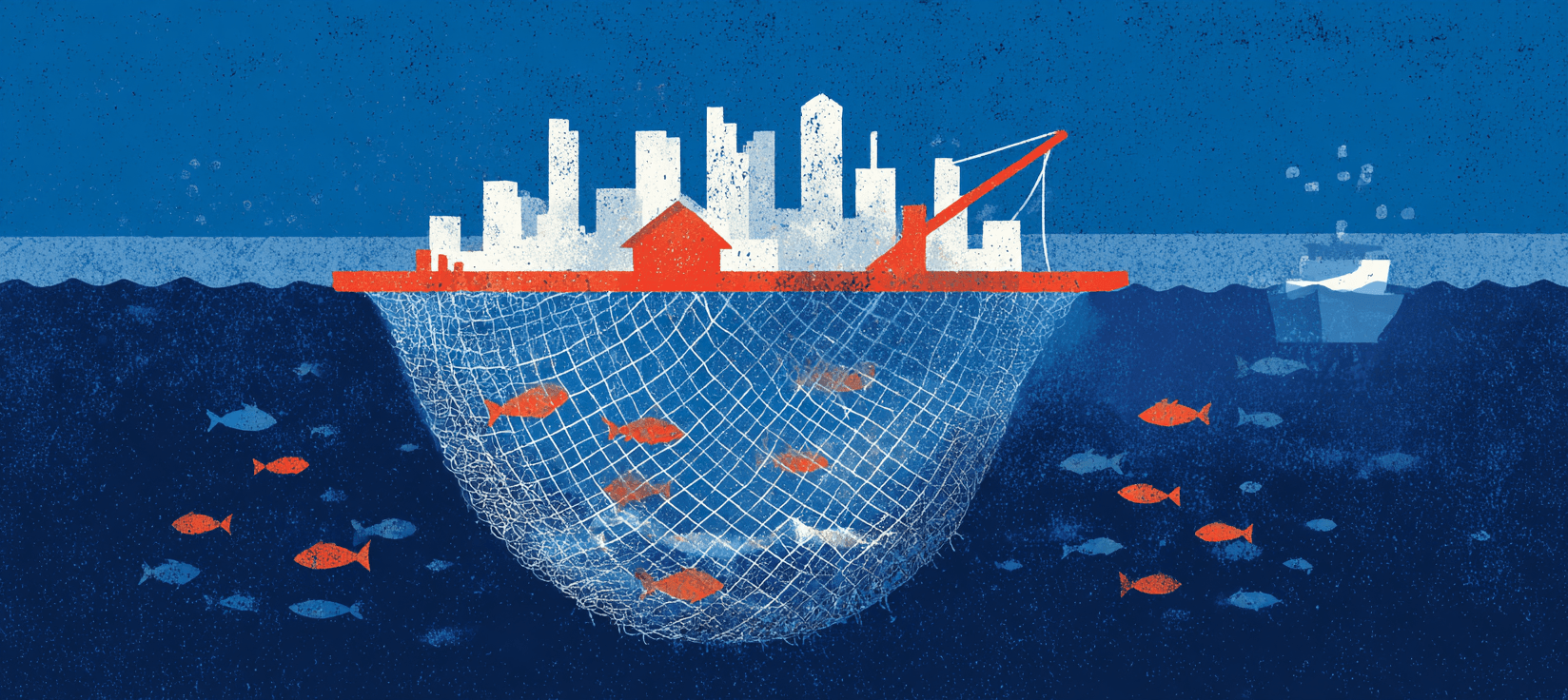
On July 2, 1992, inside a ballroom at the Radisson Hotel in St. John's, Newfoundland, federal Fisheries Minister John Crosbie stood before a crowd of fishers and plant workers and told them the northern cod fishery was closed. He called it a two-year moratorium. A pause. The government believed the cod would rebound by the end of the century.
The crowd had been watching the fish disappear for years. They stormed the hall. A security guard jammed a chair through the door handles from inside. Police were called. The near-riot spilled into the street. Later that day, fishers ripped the handles off the doors of Crosbie's constituency office and threw a staff member to the ground.
The day before, at a Canada Day gathering on the wharf in Bay Bulls, Crosbie had already faced a crowd that knew what was coming. Told he was responsible for their ruin, he'd fired back with what became the most quoted line in Canadian political history:
"I didn't take the fish from the God damn water, so don't go abusing me!"
He was right about that much. He hadn't taken the fish. But neither had the people screaming at him.
For a decade before the moratorium, inshore fishers had reported that cod were shrinking in size and number. The Department of Fisheries and Oceans ignored them. DFO scientists based their stock assessments almost exclusively on data from commercial offshore trawlers, where increasingly efficient technology masked the decline. When offshore catch numbers contradicted research survey data, they resolved the discrepancy by averaging the two, producing what a later review called a "substantial overestimation of stock abundance." The department overestimated cod populations by as much as 100 percent during the decade leading up to the collapse.
Not everyone inside DFO went along quietly. Dr. George Winters raised methodological alarms as early as 1986. The department's own fall surveys that year showed abundance figures so inflated they were, in one scientist's assessment, "entirely preposterous." After the collapse, an internal DFO document stated plainly:
"Management is fostering an attitude of scientific deception, misinformation and obfuscation."
The fishers in that Radisson ballroom had known the truth before the models admitted it. Their reward was a $225-a-week check for ten weeks.
Crosbie's moratorium was the largest industrial closure in Canadian history. Over 35,000 people lost their livelihoods. Roughly 12 percent of the province's labor force, gone overnight.
In Trepassey, the fish plant had been a crown jewel. Performance bonuses, limitless overtime. Wayne Cave, a plant worker, remembered the last day: October 7, 1991, months before the formal moratorium. "That job meant everything to me." The next morning there were locks on the doors. By 2021, Trepassey's population had fallen to 405. On the Northern Peninsula, Great Harbour Deep faced a starker arithmetic. Work had dried up. Children had to leave at fifteen, boarding ferries each September to attend school in other places, living away from parents for years. The community resettled in 2002. Seven other towns have followed since, the most recent in 2019. Between 1991 and 2001, rural Newfoundland lost 18 percent of its population. The federal government spent $2.4 billion on adjustment programs. None of it could put back what the centuries-old fishery had sustained.
The cod never meaningfully recovered because the ocean they'd inhabited no longer existed. The collapse tripped a regime shift. Capelin, the small forage fish that were cod's primary food source, collapsed alongside them. Invertebrates filled the vacuum. Snow crab and shrimp replaced groundfish in the ecosystem and, for a while, in the economy. The Labrador Current, fed by accelerating Arctic melt, brought colder, fresher water into the system during the very years the moratorium was supposed to enable recovery. Last year, the government lifted the moratorium and called it "a historic milestone." The total allowable catch was set at less than 10 percent of the 1992 quota. George Rose, who spent 40 years studying Atlantic cod, offered the appropriate eulogy: "We never seem to learn."
In 2017, Crosbie reflected: "Nobody thought it could be 20 or 30 years." The moratorium he announced as temporary has now lasted 34.
The Gulf of Maine is now warming faster than 99 percent of the world's oceans. Atlantic cod there have declined 90 percent since monitoring began. Northern shrimp, under their own moratorium since 2014, show no recovery. In February 2025, a pilot survey sent nine boats to work the historical shrimping grounds. They caught 70 individual shrimp. In the Bering Sea, a marine heatwave killed billions of snow crab in a matter of months. Saint Paul Island, whose economy was 90 percent dependent on the fishery, declared an emergency. Municipal revenue fell from $2.7 million to $200,000.
NOAA says the Gulf of Maine ecosystem has "fundamentally reorganized." That's the official language for a world that isn't coming back.
In 1992, Crosbie told Newfoundland the pause would last two years. The ocean had already made a different decision. Across the Gulf of Maine and the Bering Sea, communities are watching the same signals the inshore fishers watched forty years ago, waiting for institutions to say out loud what the water is already saying.
Things to follow up on...
-
The scientist they silenced: After DFO researcher Ransom Myers told the Ottawa Citizen about bureaucratic suppression of his cod research, two senior bureaucrats sued both the newspaper and the scientist for libel.
-
Saint Paul's hollow recovery: The Bering Sea snow crab season reopened in 2024, but Trident Seafoods announced it will not run its St. Paul processing plant due to low allowable catch, meaning the town's economic infrastructure remains broken even as the biological numbers improve.
-
Newfoundland's replacement economy collapses: The snow crab and shrimp that filled the economic vacuum after cod have themselves entered steep decline, with shrimp stocks cut by almost 80 percent in just two years, devastating communities like Twillingate that had rebuilt around shellfish.
-
Against scientific advice, again: Canada's 2024 decision to lift the cod moratorium and set new quotas reportedly went against the recommendations of DFO's own scientists, who had advised maintaining existing catch limits and restricting harvest to inshore fishers.