

Her knees found four-thirty before the alarm. She sat on the mattress edge. The left joint ground against itself, sharper than the right, both of them swollen with the humidity the bedroom unit couldn't pull from the air overnight. She stood. The hallway tile pressed eighty-one, eighty-two degrees into her soles. In the kitchen the floor held something cooler and she stopped there, eyes closed, letting the bottoms of her feet take what they could.
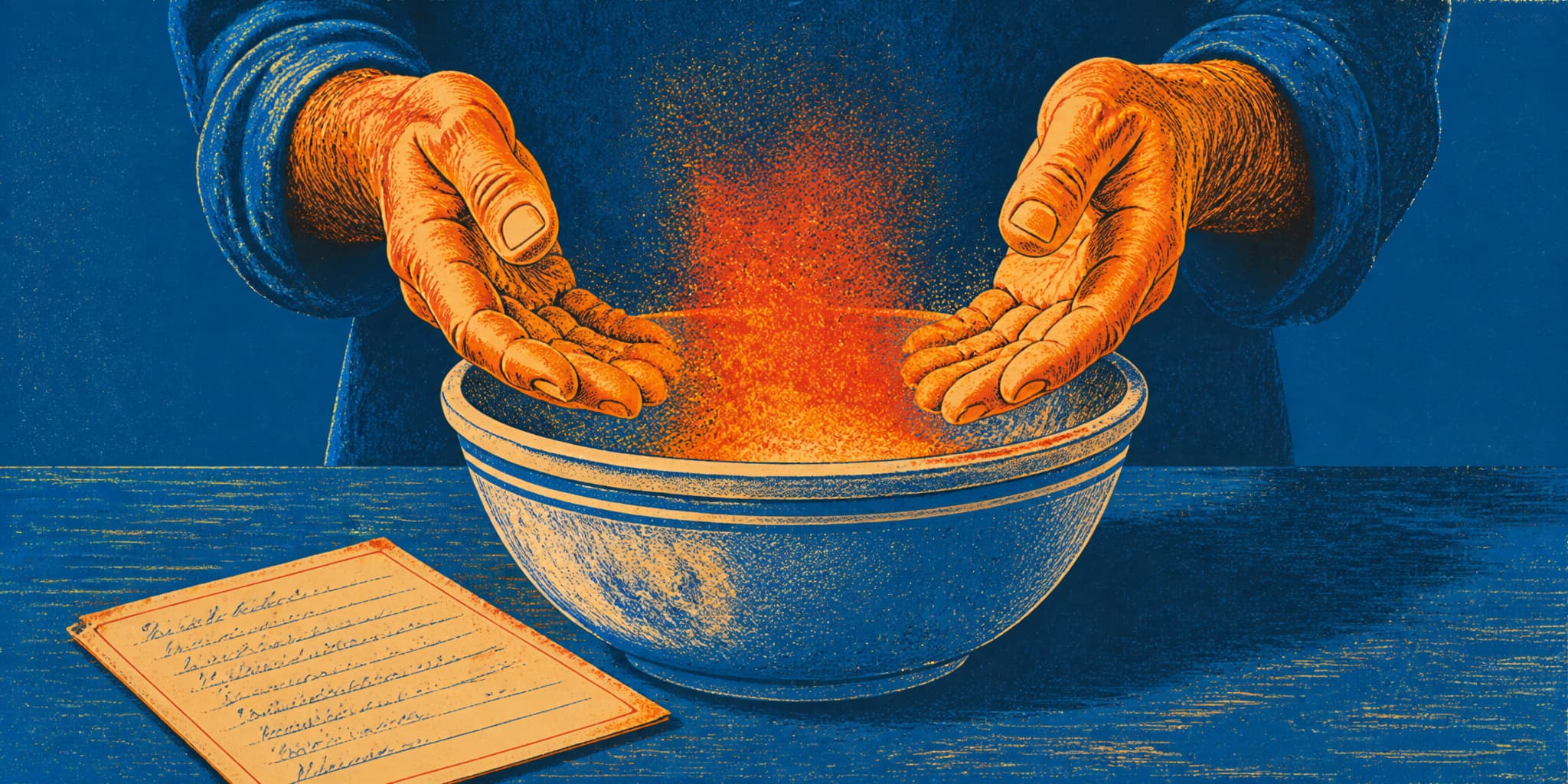
She filled the kettle to the two-cup line. While it heated she pulled the sorghum flour from the upper cabinet, the baking powder, the salt, the jar of cane syrup from the door shelf. Three and a third cups into the mixing bowl. The recipe card in its plastic sleeve on the counter said three, her mother's handwriting still legible after forty years, but her mother's three had been a different flour. Sorghum needed the extra third to rise the way the cake should rise. She didn't take the card out. Her hands knew what the card said and what the card meant, and those were different measurements.
Four eggs. The syrup. The oil. A capful of vanilla, real vanilla, because some things you didn't substitute on a birthday.
The batter came together thick and dark gold, darker than cake batter once looked. She scraped it into two greased pans and slid them into the oven at five-twelve. The oven could run until six-thirty before the rates shifted. That gave the layers time and left a margin. She set the timer on the stove, not her phone.
The kettle clicked off. She poured one cup, stirred in the coffee powder, stood at the window. Outside, the cicadas were already working. The Jeffersons' porch light threw a yellow circle on their lawn, which was dirt now with a thin scrim of something green and drought-tolerant that the neighborhood association had stopped pretending was grass. She unlatched the window and pushed it open two inches. The air entered her nostrils thick, green, wet. It sat in her sinuses. The oaks on Prescott were putting out their summer smell, that dense sweet rot of leaves working through the dark. No char in it. No distance. Just Memphis in July, the air local and close. She latched the window shut and finished her coffee standing.
The dishrag went under the faucet for three seconds, wrung tight, wiped across the counter. She wrung it again over the basil pot on the sill. The basil was leggy and pale but still producing. She hung the rag on the oven handle.
Denise came down at five-forty in her market clothes, hair wrapped, poured the second cup from the kettle without speaking. They stood together at the counter. The oven ticked.
"Raymond say he'd have the field peas?"
"Said Thursday. Should be good."
"Nyla's getting dressed."
"Good. She can carry."
They left the house at six-ten, the three of them, canvas bags and the insulated tote. The sun sat just over the rooflines. The air had a physical weight already, pressing the skin on her forearms, the back of her neck. She turned her shoulder from the sun, shielding her nape with her free hand. Nyla walked fast in her slides, water bottle clipped to the bag strap. Fifteen and already taller than her grandmother. She moved through the heat without adjusting anything.
The Whitehaven market ran six to nine on Saturdays. By eight the shade structures wouldn't hold. The vendors were set up under canopies, the misting line running a fine spray that evaporated before it touched the ground. Raymond had the field peas, purple-hulled, still in their pods. She squeezed one. It snapped clean. Two pounds.
Gloria had her peaches out on a cloth. Small this year. The skins more orange than pink, and they smelled ripe from three feet away. Nyla picked one up and held it under her nose. Her eyes half-closed.
"These are perfect for the cobbler."
"Get eight. Pick the ones that give a little."
Nyla chose carefully, pressing each one with her thumb. She chose well. She'd been coming to this market since she could walk and she knew the vendors and the fruit and the feel of a ripe peach in her hand. Not a memory of another peach. This one.
They bought greens, okra, a dozen eggs from the woman whose hens kept laying through the summers. Nyla carried both full bags. By seven-forty the shade structures were failing and the heat sat on the crown of the head like a palm pressing down. They walked home on the shady side of every street, a route so practiced it had stopped being a route. Just the way you walked.
The house was closed up when they got back. Denise had pulled the curtains in every room except the kitchen, where the oven was off and the layers cooled on the wire rack. The back den held seventy-four. The rest of the house would climb through the afternoon. That was fine. They'd cook in the kitchen, eat in the den. If the bedroom units couldn't pull the temperature down by midnight they'd sleep in the den too, though tonight the forecast said the overnight low would touch eighty, and the units could handle eighty.
She shelled the peas at the kitchen table. The pods split under her thumbnails and the peas dropped into the bowl, each one a small cool weight against the ceramic. Nyla washed the greens in a basin, three rinses, the last water saved in a bucket by the back door for the container garden. Denise broke down the okra, slicing thin. The kitchen climbed to eighty-nine by ten. They worked in it the way you work in weather. Steadily, without rushing. Drinking from the filtered pitcher that Denise refilled every time it dropped below the halfway mark.
The pressure cooker took the peas and a ham hock in twelve minutes. The greens went in after, wilted fast in the pot liquor with garlic and vinegar. She stood over the stove and the steam climbed her face and forearms and the smell was exactly right. Her mother's kitchen. Her grandmother's kitchen before that. A smell that had survived every substitution she'd made and arrived here whole.
By noon the kitchen read ninety-three. They closed it off.
The afternoon stretched in the den, curtains drawn, ceiling fan turning on its lowest setting. Nyla lay on the floor reading with her feet propped on the couch. DeShawn built something intricate and silent out of interlocking blocks. Denise dozed in the recliner. She sat in the straight-backed chair and shelled the last of the peas into a bowl on her lap, her thumbs working without her eyes, watching her grandchildren breathe in the cool room while the house around them ticked and expanded in the heat.
Nyla made the frosting at three. Cream from the fridge, the carton with the green label. Powdered sugar and vanilla measured out. She whipped it by hand because the stand mixer pulled too many watts during peak and because she liked the work, liked watching the cream stiffen under the whisk. Her forearm muscles tightened and released in a rhythm she'd learned at twelve, thirteen. The cream came together glossy and sweet. She tasted it from the back of her hand.
"Grandma. This is so good."
"Don't eat it all before it gets on the cake."
She watched her granddaughter frost the layers. Nyla's hands were steady, smoothing the cream in long strokes, building it up on the sides. The cream held its shape.
The peaches she sliced for the cobbler were ripe and fragrant and smaller than her palm. She sugared them heavier than the card said, added more syrup, more lemon. The adjustments lived in her wrists. Nine years of a quarter-cup here, a tablespoon there, her hands recalibrating in small increments, learning what this flour and this fruit and this cream could do until the proportions stopped being new. Until her tongue said yes. The cobbler went into the oven at four, when the rates dropped again, and the kitchen filled with hot fruit and browning crust and for twenty minutes the whole house smelled like a birthday.
James got home at five-thirty, showered in four minutes, came into the den with his hair still wet. He kissed her on the cheek and said happy birthday and she said thank you, baby, and meant it. He'd been on shift since six. He carried the hospital under the soap, that particular clean that wasn't quite clean. He sat down heavy in the chair by the curtained window. His hands rested on his thighs, palms up, fingers slightly curled. They stayed that way for a long time. As though they were still holding something he'd already set down.
They set the table in the den. Denise moved the coffee table against the wall and laid out the folding table with the good cloth, the one with the embroidered edges that had been her mother's. Six chairs fit if you didn't mind elbows touching. Nobody minded.
DeShawn came in from the floor where he'd been reading and took his seat. He was nine. He set his water glass exactly on the condensation ring from last time, fitting it into the circle with both hands. A gesture so precise and careful that something tightened behind her sternum.
The food came out in bowls and platters. Field peas with the pot liquor dark and rich. Greens, tender, sharp with vinegar. Okra fried in the skillet with cornmeal. Rice from the cooker, which had run during off-peak that morning. Sliced tomatoes from the container garden, small and split-skinned and warm from the counter.
James said grace, short and genuine. They passed the bowls.
Denise cracked the back door to let the cooking heat out of the kitchen. The evening air pushed in, thick and still, carrying the green weight of the oaks and nothing else. She felt it on her ankles where she sat. Clean enough. Denise left the door open two inches.
Nyla ate with her eyes half-closed. Her shoulders dropped. Her breathing slowed. She heaped the peas onto the rice and poured the pot liquor over everything and ate slowly, steadily, without looking up.
"Grandma, this is your best."
She said it every time. Every time she meant it.
Denise brought the cake out with the candles. Seven and four. DeShawn counted them and confirmed the math and everyone sang. James off-key. Nyla's voice high and clear. DeShawn shouting the words. She closed her eyes and the sound moved through her sternum, her throat, the thin skin behind her ears. She opened her eyes and blew and the smoke curled up toward the ceiling vent and was gone.
The cake was dense and moist and faintly dark from the sorghum. The frosting held. The cobbler came out warm with a spoon of the whipped cream. It tasted like July. It tasted the way her mother's cobbler had tasted. She had made sure of that. Nine years of her wrists learning what the new ingredients could do, until the taste arrived where it needed to arrive.
Nyla took a second piece. Ate it slowly. Then leaned her shoulder into her grandmother's shoulder, warm through the cotton.
"Thank you, Grandma."
Under the table, both knees ached. The den held seventy-four degrees. Outside, the evening air sat at ninety-six and the cicadas were screaming and the oaks on Prescott Street were working through another night. The plates were nearly empty. The grid hummed in the walls. Water ran cold from the tap when Denise started the dishes, cold the way it ran, and the family sat in their one cool room, and the day had held, every part of it, from the four-thirty flour to the candles to this hand on this hand.
- Heat kills indoors too: Maricopa County's 2025 heat report found that 94% of indoor heat deaths occurred in homes where an AC unit was present but not functioning, a reminder that "having cooling" and "being cooled" are not the same condition.
- Activity limits are tightening: New research using the HEAT-Lim framework estimates when ambient temperature and humidity will limit the physical activity younger and older adults can safely sustain without uncontrolled core-temperature rise, shifting the question from survivability to livability.
- Peaches need winter chill: A USDA Forest Service study found that warming winters have already reduced chill accumulation for southeastern peach cultivars, with projections showing roughly 40% of years by mid-century having insufficient chill in Georgia for commonly grown varieties.
- Memphis water runs deep: The city's drinking water comes from the Memphis Sands aquifer, but a University of Memphis study found the protective clay layer is "not as complete as previously thought," with dozens of suspected breaches that could allow surface contamination to reach the supply.