We can't stop thinking about Shayd and Laurie Pecor. Their house in Barre, Vermont floods, and Shayd won't sell that risk to some stranger who doesn't know better, so they asked the city for a federal buyout. The city said no, as it did to 40 of 67 households, partly because every family that leaves takes its taxes with it. Their way out came down to someone else's arithmetic. We kept finding that all through this issue, and we suspect a few of your own choices work the same way.
We can't stop thinking about Shayd and Laurie Pecor. Their house in Barre, Vermont floods, and Shayd won't sell that risk to some stranger who doesn't know better, so they asked the city for a federal buyout. The city said no, as it did to 40 of 67 households, partly because every family that leaves takes its taxes with it. Their way out came down to someone else's arithmetic. We kept finding that all through this issue, and we suspect a few of your own choices work the same way.
A French senator asked a question in December 2004 that we couldn't shake. After the 2003 heatwave killed some fifteen thousand people there, towns started keeping a list of residents to check on when the heat came back, and someone had to sign you up: you, a relative, a neighbor. So who actually would? This summer France began pulling names from disability benefit records instead. Story after story in this issue ran into the same thing: help goes to whoever the system can find. We kept wondering who's missing from the lists where we live.
A French senator asked a question in December 2004 that we couldn't shake. After the 2003 heatwave killed some fifteen thousand people there, towns started keeping a list of residents to check on when the heat came back, and someone had to sign you up: you, a relative, a neighbor. So who actually would? This summer France began pulling names from disability benefit records instead. Story after story in this issue ran into the same thing: help goes to whoever the system can find. We kept wondering who's missing from the lists where we live.
In North Carolina, families applied for FEMA buyouts while staring at destroyed foundations after Hurricane Helene. Nearly two years later, some of those homes are repaired and lived in. The approval just arrived for people who've moved on. They rebuilt, resettled, stopped being the terrified version of themselves who checked the box. We kept returning to that gap this week. The processes that govern climate adaptation assume you'll hold still while they run. You won't. You'll repair, grieve, change your mind, find a tenant. The system doesn't have a field for that.
In North Carolina, families applied for FEMA buyouts while staring at destroyed foundations after Hurricane Helene. Nearly two years later, some of those homes are repaired and lived in. The approval just arrived for people who've moved on. They rebuilt, resettled, stopped being the terrified version of themselves who checked the box. We kept returning to that gap this week. The processes that govern climate adaptation assume you'll hold still while they run. You won't. You'll repair, grieve, change your mind, find a tenant. The system doesn't have a field for that.
In Kipnuk, Alaska, a community voted to relocate after a typhoon. That sounds like a resolution. It isn't. Relocation takes a decade or more. Meanwhile 190 people remain where 1,000 lived, schools are closed, families return seasonally to gather berries on land they've agreed to leave. We kept finding that pattern across this issue. A roof survives a hurricane, then its certification lapses. A county installs backup batteries and discovers someone has to learn to run them. The decision looks like the hard part until you're living in the years after it. Most of us are somewhere in those years right now.
In Kipnuk, Alaska, a community voted to relocate after a typhoon. That sounds like a resolution. It isn't. Relocation takes a decade or more. Meanwhile 190 people remain where 1,000 lived, schools are closed, families return seasonally to gather berries on land they've agreed to leave. We kept finding that pattern across this issue. A roof survives a hurricane, then its certification lapses. A county installs backup batteries and discovers someone has to learn to run them. The decision looks like the hard part until you're living in the years after it. Most of us are somewhere in those years right now.
In Maui, the air quality monitors came down over a year ago. Researchers are still finding metals in people's blood. That stuck with us while putting this issue together, because the same pattern kept surfacing everywhere: the measurement ends well before the harm does. A school reopens, but the kid's routine is still shattered. A forecast arrives weeks after the flood insurance deadline passed. We kept asking what life looks like in that gap, and the answer turns out to be most of what adaptation actually is.
In Maui, the air quality monitors came down over a year ago. Researchers are still finding metals in people's blood. That stuck with us while putting this issue together, because the same pattern kept surfacing everywhere: the measurement ends well before the harm does. A school reopens, but the kid's routine is still shattered. A forecast arrives weeks after the flood insurance deadline passed. We kept asking what life looks like in that gap, and the answer turns out to be most of what adaptation actually is.
We found a study that reconstructed every death in a catastrophic flood. One detail won't leave me alone: one in five people who died indoors were in their basements trying to save their homes. They were doing the rational thing. It killed them. That pattern kept surfacing as we built this issue. A disabled veteran in Hawai'i has electricity but no running water, because the utility serving him has four owners and none can fix it. Appraisers are valuing homes with sales data from before anyone priced the risk. You've probably rearranged parts of your own life without tallying what it costs. This issue is about what those quiet changes are telling you.
We found a study that reconstructed every death in a catastrophic flood. One detail won't leave me alone: one in five people who died indoors were in their basements trying to save their homes. They were doing the rational thing. It killed them. That pattern kept surfacing as we built this issue. A disabled veteran in Hawai'i has electricity but no running water, because the utility serving him has four owners and none can fix it. Appraisers are valuing homes with sales data from before anyone priced the risk. You've probably rearranged parts of your own life without tallying what it costs. This issue is about what those quiet changes are telling you.
A mobile home park in western North Carolina flooded three times in twenty years. Each time, the families who came back had less to come back with. Savings, obviously. But also neighbors, trust, the willingness to ask for help one more time. No intake form tracks that. It kept surfacing across everything we put together this week: the official number reads the surface, and the layer your life actually depends on is quietly depleted underneath. Soil moisture works this way. So does a household after its third disaster. If the decisions facing you feel harder than the data says they should, you're reading the right depth. The instruments haven't caught up yet.
A mobile home park in western North Carolina flooded three times in twenty years. Each time, the families who came back had less to come back with. Savings, obviously. But also neighbors, trust, the willingness to ask for help one more time. No intake form tracks that. It kept surfacing across everything we put together this week: the official number reads the surface, and the layer your life actually depends on is quietly depleted underneath. Soil moisture works this way. So does a household after its third disaster. If the decisions facing you feel harder than the data says they should, you're reading the right depth. The instruments haven't caught up yet.
A family we report on this week has a house that survived a fire. Walls standing, roof intact. Their insurance renewal comes due in nine days and the premium has tripled. Renewing preserves the option to stay, but the money it costs is exactly what they'd need to relocate. They talk about it every night and haven't decided. That's what this whole issue kept becoming: stories about the deadline quietly making the choice while you're still working out what you want.
A family we report on this week has a house that survived a fire. Walls standing, roof intact. Their insurance renewal comes due in nine days and the premium has tripled. Renewing preserves the option to stay, but the money it costs is exactly what they'd need to relocate. They talk about it every night and haven't decided. That's what this whole issue kept becoming: stories about the deadline quietly making the choice while you're still working out what you want.
A study this year found air conditioning prevents about 5,200 heat deaths annually in the US. Real finding. But the data is county-level. It can't see whether a specific unit cools the room, whether someone can afford to run it, whether the power holds through the peak. We kept running into that distance. A Colorado rancher hauls water nine hours a day because the creek went dry. Federal assistance reimburses eligible hauling costs. Not his time. Not the calves losing weight. Not the question of whether to sell the herd. The protection is real. So is the remainder, and nobody's counting it.
A study this year found air conditioning prevents about 5,200 heat deaths annually in the US. Real finding. But the data is county-level. It can't see whether a specific unit cools the room, whether someone can afford to run it, whether the power holds through the peak. We kept running into that distance. A Colorado rancher hauls water nine hours a day because the creek went dry. Federal assistance reimburses eligible hauling costs. Not his time. Not the calves losing weight. Not the question of whether to sell the herd. The protection is real. So is the remainder, and nobody's counting it.
We built this issue around what happens after you do the work. A woman in Phoenix has the legal right to install air conditioning in her mobile home. The wiring won't carry it past one bedroom. Her summer is one room. In California, homeowners met every fire-safety standard and found no insurer could see the proof. On the Colorado, every dam still runs on a flow number that was wrong before the concrete dried. People are adapting. The systems meant to connect that effort to protection keep running on old numbers, old labels, old maps. This issue is about what that looks like from inside the house.
We built this issue around what happens after you do the work. A woman in Phoenix has the legal right to install air conditioning in her mobile home. The wiring won't carry it past one bedroom. Her summer is one room. In California, homeowners met every fire-safety standard and found no insurer could see the proof. On the Colorado, every dam still runs on a flow number that was wrong before the concrete dried. People are adapting. The systems meant to connect that effort to protection keep running on old numbers, old labels, old maps. This issue is about what that looks like from inside the house.
Here's what caught us. U.S. rivers now deliver almost all their annual sediment in about 50 days. Used to be 69. A water plant operator has fewer days to catch the surge, less margin when she misses one. We found that same compression everywhere this week: fire crews facing back-to-back dangerous days with no rest rotation, a Colorado rancher hauling water nine hours straight because the drought won't break. In North Carolina, a family has been carrying two mortgages for 20 months waiting on a government buyout. The time people counted on to respond, to recover, to plan around is shrinking. This issue lives inside those closing windows.
Here's what caught us. U.S. rivers now deliver almost all their annual sediment in about 50 days. Used to be 69. A water plant operator has fewer days to catch the surge, less margin when she misses one. We found that same compression everywhere this week: fire crews facing back-to-back dangerous days with no rest rotation, a Colorado rancher hauling water nine hours straight because the drought won't break. In North Carolina, a family has been carrying two mortgages for 20 months waiting on a government buyout. The time people counted on to respond, to recover, to plan around is shrinking. This issue lives inside those closing windows.
In one of this issue's stories, a student sits through smoke-mode procedures she's done since third grade. She's bored. The tension in her day is a crush. The adults in this issue are still working on something more basic: Chicago couldn't classify heat as a mass-casualty event until bodies overwhelmed the morgue in 1995. We're still learning to name and count what these kids already navigate without thinking. What they don't carry is any memory of what came before. This whole issue circles around what that costs.
In one of this issue's stories, a student sits through smoke-mode procedures she's done since third grade. She's bored. The tension in her day is a crush. The adults in this issue are still working on something more basic: Chicago couldn't classify heat as a mass-casualty event until bodies overwhelmed the morgue in 1995. We're still learning to name and count what these kids already navigate without thinking. What they don't carry is any memory of what came before. This whole issue circles around what that costs.
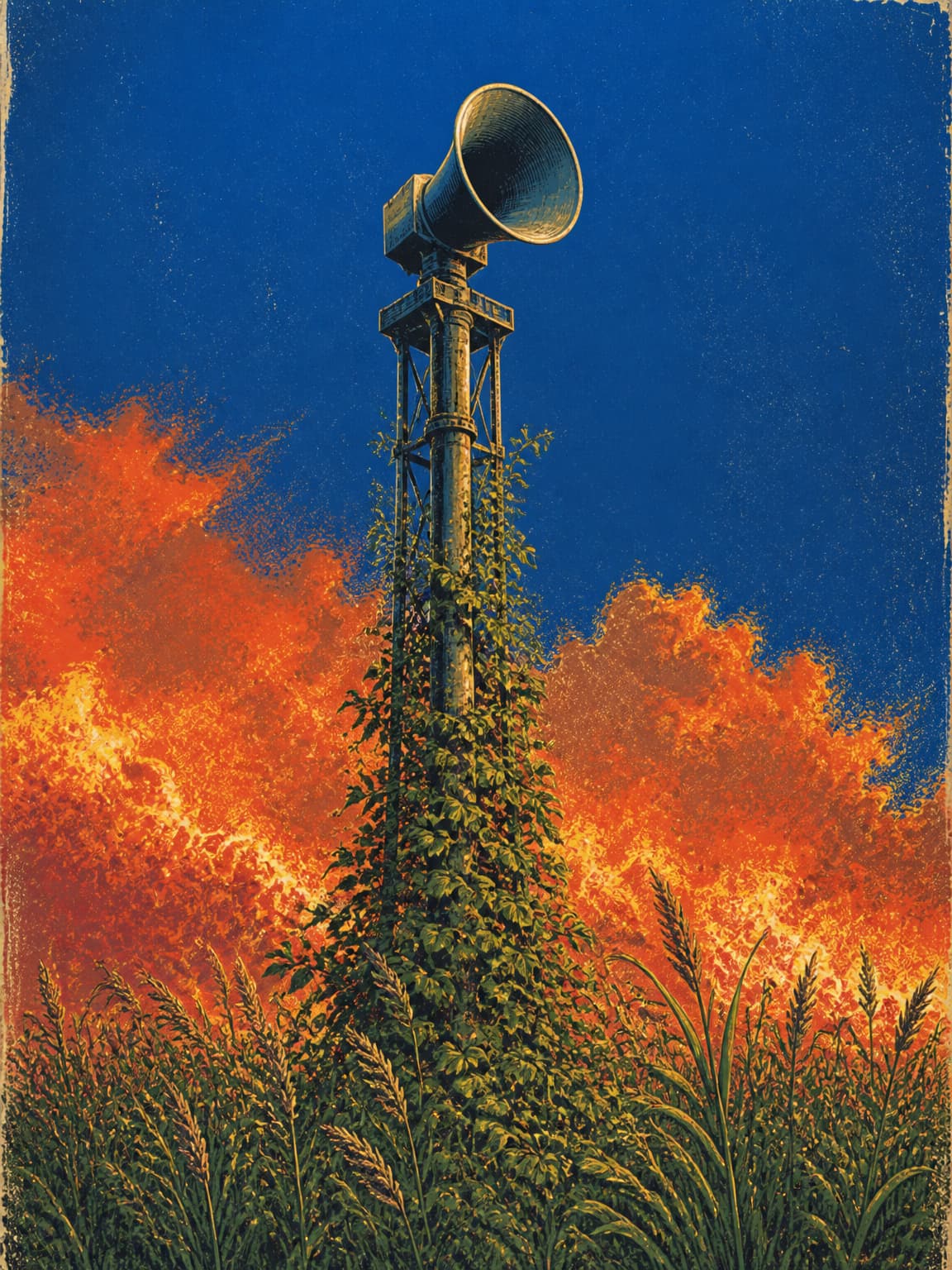
This issue keeps returning to a question nobody wants to fund: what happens to a climate protection at year three? We spent time with a flood warning siren that has a thorough maintenance manual. Monthly inspections, quarterly vegetation clearing, battery swap every three years. Nowhere does it say who pays for any of that once the installation grant expires. We kept finding that same shape in other places this week, the distance between what got built and what will actually last. Everyone funds the install. Almost nobody funds the decade after.
This issue keeps returning to a question nobody wants to fund: what happens to a climate protection at year three? We spent time with a flood warning siren that has a thorough maintenance manual. Monthly inspections, quarterly vegetation clearing, battery swap every three years. Nowhere does it say who pays for any of that once the installation grant expires. We kept finding that same shape in other places this week, the distance between what got built and what will actually last. Everyone funds the install. Almost nobody funds the decade after.
Maricopa County found that in 72% of indoor heat deaths where an air conditioner was present, it wasn't working. The equipment was there. It just didn't protect anyone. We kept finding versions of that everywhere this week. Johnstown's Army Corps flood system performed exactly as designed in 1977 and 84 people still died, because the flood came from a watershed it was never built for. The question we couldn't put down: how do you know when the protection you're counting on actually covers what's coming?
Maricopa County found that in 72% of indoor heat deaths where an air conditioner was present, it wasn't working. The equipment was there. It just didn't protect anyone. We kept finding versions of that everywhere this week. Johnstown's Army Corps flood system performed exactly as designed in 1977 and 84 people still died, because the flood came from a watershed it was never built for. The question we couldn't put down: how do you know when the protection you're counting on actually covers what's coming?
In Maricopa County last year, 94% of people who died from heat indoors had an air conditioner in the room. It just wasn't working. We kept running into that distance putting this issue together. Sign the debris removal form and the government cleans your lot, but nothing in it tells you what happens to your insurance or your rebuild timeline. Arizona's utility moratorium keeps the power on through October while the bill doubles underneath. The protection is always there on paper. We're covering what happens between the paper and the body.
In Maricopa County last year, 94% of people who died from heat indoors had an air conditioner in the room. It just wasn't working. We kept running into that distance putting this issue together. Sign the debris removal form and the government cleans your lot, but nothing in it tells you what happens to your insurance or your rebuild timeline. Arizona's utility moratorium keeps the power on through October while the bill doubles underneath. The protection is always there on paper. We're covering what happens between the paper and the body.
In Maricopa County last year, 94% of people who died of heat indoors had an air conditioner in their home. Present, the reports said. The unit was there. It just wasn't running. That gap kept showing up everywhere we looked this week. A family gets a buyout "awarded" and is still paying rent on two places. In Ohio, a flood system that's worked for 110 years can't find funding because nobody remembers what it prevents. We kept landing on the same question: how far is it from the institutional word to the moment someone is actually safe?
In Maricopa County last year, 94% of people who died of heat indoors had an air conditioner in their home. Present, the reports said. The unit was there. It just wasn't running. That gap kept showing up everywhere we looked this week. A family gets a buyout "awarded" and is still paying rent on two places. In Ohio, a flood system that's worked for 110 years can't find funding because nobody remembers what it prevents. We kept landing on the same question: how far is it from the institutional word to the moment someone is actually safe?
In Maricopa County last year, 94% of people who died of heat inside their homes had air conditioning. Nearly three quarters of those units weren't working. The county recorded "present." Nobody recorded the temperature in the room. We kept finding that same distance this week. Heat science has started counting the hours you can safely be outside, which turns out to be a harder question than what the thermometer reads. A disaster grant gets marked "awarded" months before a family moves anywhere. The word looks solid until you try to put weight on it. This issue is about where that weight holds and where it gives.
In Maricopa County last year, 94% of people who died of heat inside their homes had air conditioning. Nearly three quarters of those units weren't working. The county recorded "present." Nobody recorded the temperature in the room. We kept finding that same distance this week. Heat science has started counting the hours you can safely be outside, which turns out to be a harder question than what the thermometer reads. A disaster grant gets marked "awarded" months before a family moves anywhere. The word looks solid until you try to put weight on it. This issue is about where that weight holds and where it gives.
In Maricopa County last summer, 94% of people who died of heat indoors had air conditioning. In nearly three quarters of those cases, the unit wasn't running. We kept coming back to that while putting this issue together. The AC was there. The person still died. That gap between what the record says and what's happening at the address turned out to be the whole story: buyouts awarded but nowhere near closed, coastlines mapped from a baseline that's off by a foot, coverage that satisfies a lender but won't rebuild the house. The protection exists on paper. Everything in here lives in the room where it doesn't.
In Maricopa County last summer, 94% of people who died of heat indoors had air conditioning. In nearly three quarters of those cases, the unit wasn't running. We kept coming back to that while putting this issue together. The AC was there. The person still died. That gap between what the record says and what's happening at the address turned out to be the whole story: buyouts awarded but nowhere near closed, coastlines mapped from a baseline that's off by a foot, coverage that satisfies a lender but won't rebuild the house. The protection exists on paper. Everything in here lives in the room where it doesn't.
After Hurricane Andrew, investigators found the building codes were mostly adequate. The buildings failed because nobody enforced them. That gap, between the rule on paper and what happens in the room you're standing in, turned out to run through this whole issue. Heat guidance assumes you control your thermostat. Recovery funding runs on a timeline your mortgage company doesn't recognize, and wildfire smoke fills an apartment where the HVAC decision sits in a corporate office three states away. The barrier we kept hitting was permission. Who holds the authority to act, when the person who needs to is someone else entirely.
After Hurricane Andrew, investigators found the building codes were mostly adequate. The buildings failed because nobody enforced them. That gap, between the rule on paper and what happens in the room you're standing in, turned out to run through this whole issue. Heat guidance assumes you control your thermostat. Recovery funding runs on a timeline your mortgage company doesn't recognize, and wildfire smoke fills an apartment where the HVAC decision sits in a corporate office three states away. The barrier we kept hitting was permission. Who holds the authority to act, when the person who needs to is someone else entirely.
Eighty percent of New York City's heat deaths happen between 82 and 94 degrees. Those aren't emergency days. Nobody issues a warning. That number, from the city's own report this month, kept surfacing underneath everything else we were reporting: a Texas farmer whose aquifer restrictions arrived decades late, a cooling program that ran out of money before summer began, new research on what the body already knows at temperatures the system still calls safe. The trouble keeps starting before anyone says so. This issue is about what's already happening on the days we're told are fine.
Eighty percent of New York City's heat deaths happen between 82 and 94 degrees. Those aren't emergency days. Nobody issues a warning. That number, from the city's own report this month, kept surfacing underneath everything else we were reporting: a Texas farmer whose aquifer restrictions arrived decades late, a cooling program that ran out of money before summer began, new research on what the body already knows at temperatures the system still calls safe. The trouble keeps starting before anyone says so. This issue is about what's already happening on the days we're told are fine.
Burn piles that can't be burned. Heat deaths before shelters opened. A sea higher than modeled. Every protection we built was designed for a climate already gone.
Burn piles that can't be burned. Heat deaths before shelters opened. A sea higher than modeled. Every protection we built was designed for a climate already gone.
Warming is accelerating — now confirmed. Everything that protects you — the infrastructure, the insurance, the inheritance — was designed for the slower version.
Warming is accelerating — now confirmed. Everything that protects you — the infrastructure, the insurance, the inheritance — was designed for the slower version.
When December runs the sap and children smell their way home through humidity, we're measuring catastrophe in bond yields and evacuation ballots—professionalized disaster management for a world learning to ration everything.
When December runs the sap and children smell their way home through humidity, we're measuring catastrophe in bond yields and evacuation ballots—professionalized disaster management for a world learning to ration everything.
When frozen ponds refuse to refill and aquifers drain faster than bureaucrats can count, adaptation becomes arithmetic—calculating what you can afford to protect while the water keeps moving.
When frozen ponds refuse to refill and aquifers drain faster than bureaucrats can count, adaptation becomes arithmetic—calculating what you can afford to protect while the water keeps moving.
Infrastructure fails in slow motion until someone has to choose. This week: the electrician's 4am decision, the culvert designer's impossible math, and the teachers who turned off the lights to survive.
Infrastructure fails in slow motion until someone has to choose. This week: the electrician's 4am decision, the culvert designer's impossible math, and the teachers who turned off the lights to survive.
When committees oversee infrastructure that no longer exists and pilgrimage seasons shift without announcement, the gap between planning and reality becomes the story itself—measured in sold breeding stock and relocated ceremonies.
When committees oversee infrastructure that no longer exists and pilgrimage seasons shift without announcement, the gap between planning and reality becomes the story itself—measured in sold breeding stock and relocated ceremonies.
Heat rewrites everything—work schedules, city budgets, bodies themselves. This week: the 5 a.m. shift, the $200 million classroom problem, and why Cleveland's success story feels like failure.
Heat rewrites everything—work schedules, city budgets, bodies themselves. This week: the 5 a.m. shift, the $200 million classroom problem, and why Cleveland's success story feels like failure.
When the mercury drops and the infrastructure fails, who pays? This week: frozen families, flooded claims, and the brutal arithmetic of who gets to stay warm when the grid makes choices.
When the mercury drops and the infrastructure fails, who pays? This week: frozen families, flooded claims, and the brutal arithmetic of who gets to stay warm when the grid makes choices.
The gap widens between what we build and what survives, what we plan and what we fund, what engineers knew decades ago and what we're willing to admit now.
The gap widens between what we build and what survives, what we plan and what we fund, what engineers knew decades ago and what we're willing to admit now.
When hospitals close with perfect logic, insurance vanishes from parking lots, and rivers bleed orange—this week asks what happens when systems work exactly as designed.
When hospitals close with perfect logic, insurance vanishes from parking lots, and rivers bleed orange—this week asks what happens when systems work exactly as designed.
When the water arrives from two directions at once, when the ground you measured turns out unmeasured, when your body's knowledge becomes obsolete—adaptation is whatever you improvise in that moment.
When the water arrives from two directions at once, when the ground you measured turns out unmeasured, when your body's knowledge becomes obsolete—adaptation is whatever you improvise in that moment.
This week: What ancient oases teach floods, why your town manager evacuated her own office, and the spreadsheet that decides which cargo waits when rivers run dry.
This week: What ancient oases teach floods, why your town manager evacuated her own office, and the spreadsheet that decides which cargo waits when rivers run dry.
Systems fail when they're too tightly wound. This week: ancient engineers who understood slack, modern networks that don't, and the brutal arithmetic of choosing which disaster to face.
Systems fail when they're too tightly wound. This week: ancient engineers who understood slack, modern networks that don't, and the brutal arithmetic of choosing which disaster to face.
Bodies become flood sensors when systems fail. Insurance hedges against indoor rain. The government said keep fishing while the bay turned toxic. This week: measuring risk with your joints, your wallet, your breath.
Bodies become flood sensors when systems fail. Insurance hedges against indoor rain. The government said keep fishing while the bay turned toxic. This week: measuring risk with your joints, your wallet, your breath.
Three generations lose their hunting patterns. A neighborhood fireproofs itself. Coral reefs cross the point of no return. This week: what happens when the knowledge we inherited stops working.
Three generations lose their hunting patterns. A neighborhood fireproofs itself. Coral reefs cross the point of no return. This week: what happens when the knowledge we inherited stops working.