

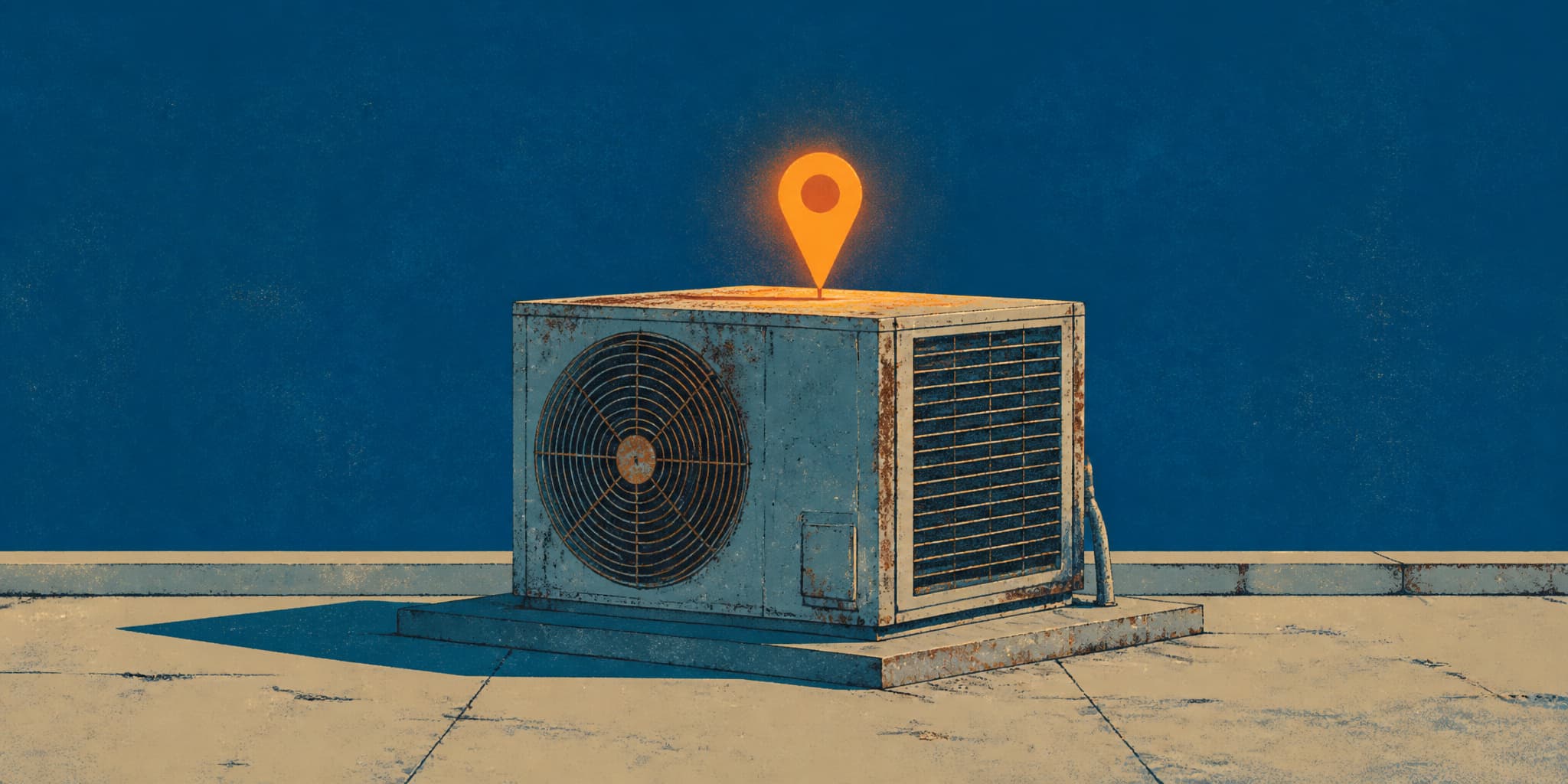
Pull up a cooling center in Maricopa County right now, mid-July 2026, and you get something like this:
Desert Sage Community Library 1234 W. Camelback Rd., Phoenix, AZ 85015 Indoor Cooling Center · Air-Conditioned · Hydration Available Hours: Mon–Sat 9:00 AM – 5:00 PM Pet-Friendly: Leashed pets welcome Transportation Assistance: Call 2-1-1
That's a composite, not a real entry. Built to represent the format, because this piece is about the format. But it's representative of what the Maricopa County Heat Relief Network delivers to someone searching its interactive map during the current season: a name, an address, a category, hours, a handful of service indicators. More than 200 locations across the county, launched May 1 and updated as partners sign up through September 30. Legible, useful. The kind of thing that fits on a phone screen while you're trying to figure out where to go and the asphalt is cooking through your shoes.
The listing does real work. It connects people to buildings. It also compresses. Every field in that entry is a word standing in for a physical system that either functions or doesn't, and the listing has no way to tell you which.
"Air-Conditioned"
MAG's partner standards require cooling centers to have "functioning air conditioning" and staff present to confirm it's working. The standard is binary: functioning, or you don't join the network. No public-facing inspection record behind it. No HVAC age, no maintenance history, no capacity rating relative to occupancy. The building says yes or it stays off the map.
I spent years writing reports about systems that were technically functioning. Technically functioning is a load-bearing phrase. It means the system runs. It does not mean the system does what you need it to do when you need it to do it.
The national building stock tells you what "functioning" looks like at scale.
A GAO report on public library facilities published December 2025 estimates roughly 1,800 public libraries across the country have HVAC systems in poor condition. That means the system needs repair or replacement beyond routine maintenance and is not functioning as required. Eleven percent of all public libraries. Thirty-eight percent had at least one building system in poor condition. Most libraries with poor-condition HVAC either had no planned repair within five years or had no funding allocated. One survey respondent reported building temperatures exceeding 95 degrees after an HVAC failure, forcing a month-long closure. A California library needed a new roof HVAC unit estimated at over $60,000 and hadn't identified the money. In Puerto Rico, broken air conditioning forced a newly renovated children's room to be repurposed as office space.
GAO also found that public libraries serve as cooling and warming centers during extreme temperatures. The report does not map which libraries serving as cooling centers have HVAC in poor condition. It establishes both facts and leaves the overlap unexamined, two columns in the same dataset that nobody has joined.
Schools carry a parallel number. GAO's 2020 K-12 facilities report estimated 41 percent of public school districts needed to update or replace HVAC systems in at least half their schools. Roughly 36,000 buildings. Officials at about half of the 55 schools GAO visited described HVAC-related problems: older systems that leaked and damaged flooring or ceiling tiles. Unresolved HVAC problems led to indoor air quality issues and mold and in some cases forced schedule adjustments. A third of districts hadn't conducted a facilities condition assessment even once in the prior decade. Most states don't conduct statewide assessments at all, leaving districts to evaluate their own buildings. The same report notes that public school facilities serve civic roles including as emergency shelters. The overlap between "needs HVAC updates" and "designated as shelter" is, again, established at the category level and never mapped building by building.
A person reading the listing sees: Air-Conditioned.
What that word is standing in for: the age of the unit. The last service date. Whether the compressor can hold temperature when 40 people are inside instead of 12. Whether there's backup power. Whether the ductwork leaks. Whether the building envelope holds conditioned air or bleeds it through gaps around windows that haven't been caulked since the building opened in 1997. The listing can't carry any of this. It was never designed to.
An HVAC system that is "functioning" at 8 a.m. on a Tuesday with six people in the building is a different animal than the one running at 2 p.m. on a Saturday with 35 people who have nowhere else to go. The compressor doesn't know it's been designated as a cooling center. It knows its load, its refrigerant charge, and the temperature differential it's being asked to maintain. The listing knows none of these things.
"Hours: Mon–Sat 9:00 AM – 5:00 PM"
Maricopa County's 2025 heat death report, the most recent complete season of data, documented 430 heat-related deaths. Seventy-four percent occurred outdoors. For the indoor deaths, 48 percent were discovered during welfare checks. Ninety percent of indoor victims were 50 or older.
No documented heat deaths occurred in or near designated cooling centers, as far as the public data shows. The network appears to function for the people who reach it. That distinction carries weight. The deaths cluster in private residences. Houses, apartments, mobile homes, RVs. The people who died indoors were overwhelmingly not at cooling centers. They were home.
The hours field is where you see the outline of who doesn't reach the network at all.
MAG requires cooling centers to operate on a consistent schedule during their stated hours and to allow visitors at least a two-hour stay. Many sites are libraries, community centers, places of worship. They close at 5 or 6 p.m. Some close earlier on weekends. MAG acknowledges that many sites change hours or have unexpected closures during the season.
Heat does not observe business hours. The ground is still radiating at 10 p.m. in Phoenix. The asphalt holds what the sun put into it and gives it back all night. The person who needs cooling after dark is not the person the listing was built for. The person discovered during a welfare check was, by definition, not at a cooling center. They were somewhere else, in a building with its own HVAC story, and nobody checked until it was too late.
2-1-1 Arizona operators are available 9 a.m. to 7 p.m. daily. Transportation assistance to heat-relief sites is available "based on eligibility." What eligibility means, operationally, is another compression.
Every word in a listing like this has a conversion step between what it says and what it delivers. "Open" has to be converted through awareness, transportation, hours that match your crisis, physical ability to get through the door, willingness to walk into a building full of strangers when you're already in trouble. "Call 2-1-1" has to be converted through a phone with charge, a language match, an operator who picks up, a ride that actually materializes in time. The listing is the first link in a chain. People talk about it like it's the last one.
The Field That Isn't There
The listing contains no indication of whether the building can protect you from wildfire smoke.
This matters because the Southwest's heat season and smoke season increasingly overlap. They're the same months now. And a building that cools you is not necessarily a building that filters what you're breathing. The two functions require different infrastructure. The listing format treats the second one as if it doesn't exist.
EPA's 2025 Best Practices Guide for public and commercial buildings during wildfire smoke events recommends MERV 13 or higher filtration, capable of removing at least 50 percent of smoke-sized particles per pass. EPA also says not all HVAC systems can accommodate MERV 13 filters. For buildings that can't, the guidance is to use the highest-rated filter compatible with the system, which may or may not be adequate. The guide calls for reduced outdoor air intake while maintaining positive building pressure, portable air cleaners where HVAC filtration falls short, building envelope assessment, and air sensors to compare indoor and outdoor pollutant levels.
EPA's fact sheet for schools serving as cleaner-air and cooling centers says those schools "should understand the capacity of their filtration and cooling systems before serving the extended community during heat or smoke events." It also notes that CDC and ASHRAE guidance may not always align and that the facility manager must decide what is best for the facility. Should understand. Not must demonstrate. Not must disclose.
There is no simple pass/fail standard, and EPA is honest about this. Smoke readiness is building-specific, dependent on HVAC design, filter compatibility, pressure management, envelope integrity, power reliability, and expert evaluation. All of it invisible to the person looking at a map pin on a day when the AQI has turned the sky the color of a bruise.
Whether a public building actually protects better than a private residence during a smoke event is a genuinely unresolved question, and the answer is less intuitive than you'd expect. EPA notes that some studies have found higher indoor PM concentrations in commercial and school buildings during smoke events than in residences, while also saying more studies are needed to determine whether the pattern holds broadly across the U.S. building stock. The mechanism makes sense once you think about it: commercial buildings are designed to pull in more outdoor air than homes. Ventilation codes require it. A residence may be leakier overall but exchanges air more slowly. A public building running code-compliant ventilation with MERV 8 filters during a smoke event is pulling outdoor air through filtration that was never designed for wildfire particulate, at volumes a house never approaches. The system is doing exactly what it was built to do. What it was built to do is the wrong thing.
A 2021 study measured a public library in New South Wales used as a cleaner-air shelter during a smoke event and found that air conditioning alone reduced outdoor PM2.5 infiltration to 30 percent, and HEPA cleaners brought it down further. One library, one event, one country. No equivalent audit of a U.S. cooling-center network exists in the published literature.
The Audit Nobody Has Done
The absence accumulates rather than announces itself.
No GAO report, state auditor investigation, municipal inspector general review, or peer-reviewed study in the available source set has systematically inspected the HVAC condition, filtration capability, or building-envelope integrity of buildings specifically designated as cooling centers or cleaner-air shelters. MAG sets partner standards. GAO documents building conditions nationally. EPA defines technical expectations for smoke readiness. These three institutional layers do not connect to each other. Nobody has walked the line from the pin on the map to the compressor on the roof and published what they found.
The gap is not proof that designated buildings are failing. Maricopa's 2025 heat death data suggests something closer to the opposite for the people who reach the network: deaths cluster overwhelmingly in private residences, in homes where AC was present but not working. The network may be doing exactly what it promises for the people inside it.
But the listing format can't tell you that, either. It can't tell you the building is fine. It can only tell you the building is listed.
What the Listing Holds
Maricopa County's Heat Relief Network is, by the standards of municipal heat response, a sophisticated system. It distinguishes cooling centers from respite sites from hydration stations. It requires partner orientation, visible signage, functioning bathrooms, staff presence, consistent schedules. It integrates with 2-1-1 for multilingual access. It notes which sites accept leashed pets, which is a real barrier for real people who will not leave an animal behind to die in a parked car. It is better than what most counties have, which is nothing or close to it.
And it is a directory.
In Maricopa County's 2025 heat death data, 94% of indoor deaths occurred where an AC unit was present. Among those, the unit wasn't working 72% of the time. The county refined its categories to capture the gap between "AC present" and "AC functioning," a split with a body count between them.
Maricopa County learned something important about private residences in recent years: that "AC present" and "AC functioning" are different categories with a body count between them. The county refined its data categories to capture that distinction, splitting "AC present" into functioning, nonfunctioning, turned off, and no electricity. That refinement changed what the data could see and therefore what policy it could support. Someone decided the old field on the form was too coarse for the bodies it was supposed to account for, and they split it. That's institutional self-correction. It's the kind of thing that happens when one person or a small team looks at the form and then looks at the room and decides the form has to change.
The public cooling-center listing still operates on the binary. Air-conditioned: yes. The building is on the map or it isn't. What happens between the pin and the person is infrastructure, maintenance, funding, staffing, filtration, power, and time of day. All of it compressed into a clean line on a phone screen, because that's what a listing can hold.
The listing is not a lie. It is a compression. And the distance between what it says and what the building can deliver on a given afternoon is filled with systems that are aging, budgets that are deferred, overlaps that nobody has audited, and hours that end while the heat keeps radiating off the ground. What the person standing in the sun finds when they walk through the door depends on infrastructure the pin was never built to show them. The pin shows you where to go. The building is what's there when you arrive.
- AC present versus functioning: Maricopa County's 2025 heat death report found that among indoor deaths where an AC unit was present, 72 percent of those units were not functioning, a distinction the county now tracks by splitting the field into functioning, nonfunctioning, turned off, and no electricity.
- School HVAC and shelter roles: GAO's K-12 facilities report estimated 41 percent of districts needed HVAC updates in at least half their schools while also noting that school buildings serve civic roles as emergency shelters, an overlap no public audit has mapped building by building.
- Houston's proposed cooling right: Local reporting describes a Houston "Right to Air Conditioning" proposal that would require landlords to provide working refrigerated air in rental units, though official council text and committee status need fresh confirmation before the July 28 hearing date.
- Smoke filtration in public buildings: EPA's 2025 Best Practices Guide recommends MERV 13 or higher filtration for public buildings during wildfire smoke events but acknowledges that not all HVAC systems can accommodate those filters and that some studies have found higher indoor particulate levels in commercial buildings than in homes during smoke.