
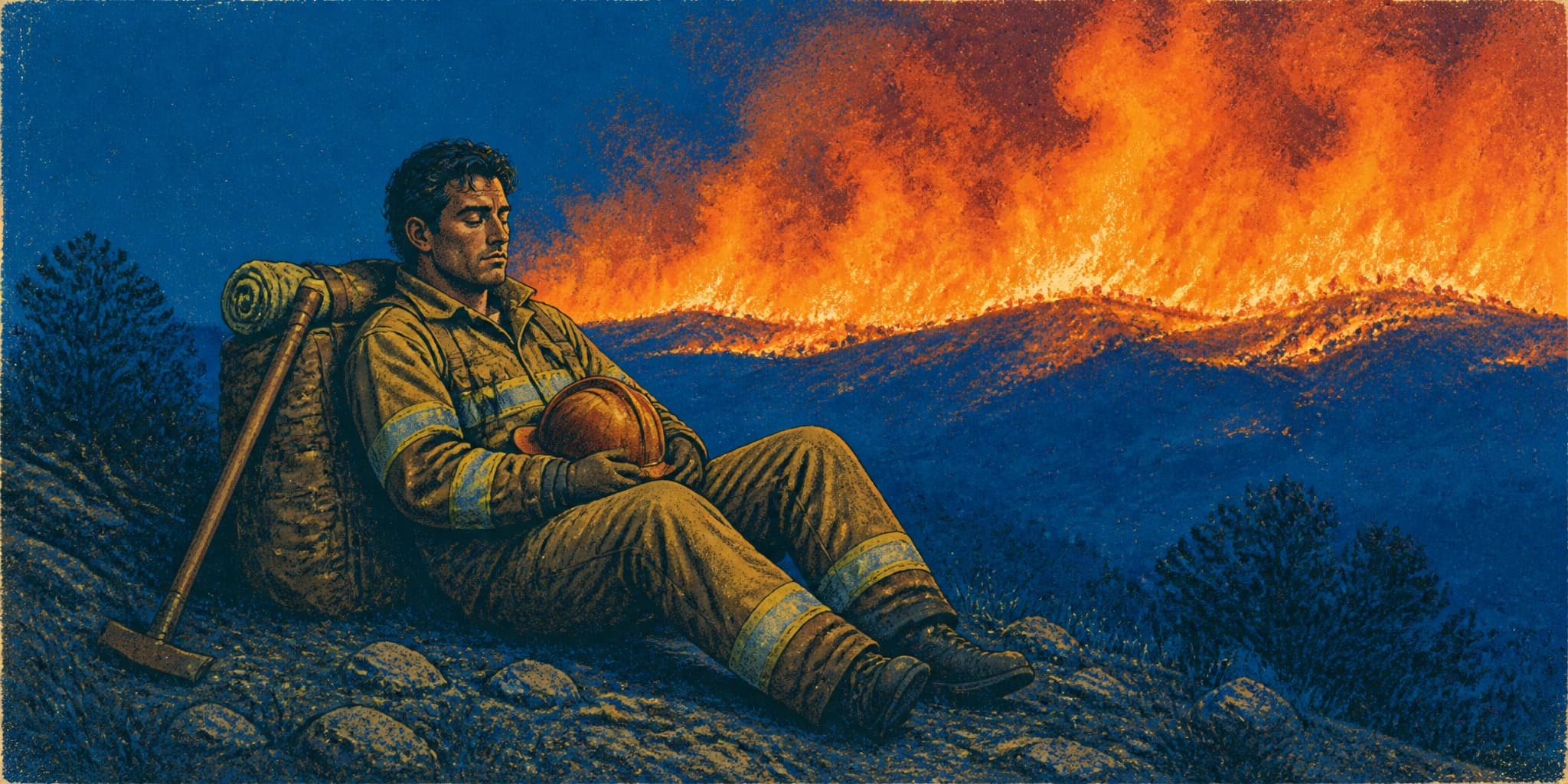
Wildfire management in North America was built around a daily rhythm: fires burn hard during the day, lie down at night. Overnight humidity recovery rehydrates fuels, temperatures drop, and the fire moderates. That window is when crews rotate, incident commanders reposition resources, and evacuation orders get executed against something other than a running flame front.
A peer-reviewed analysis of roughly 9,000 large fires across the U.S. and Canada finds that approximately one-third of active fire days from 2017 to 2023 exceeded 12 hours of burning. The driver is specific: relative humidity, the single strongest hourly predictor of active burning in the study's model, is failing to recover at night. Warmer overnight temperatures hold the air drier. Fuels that used to rehydrate by morning don't.
Run the operational math. When a fire burns 14 active hours instead of eight, the relief crew arrives to a working fire, not a quiet line. Structure protection that depends on lower overnight intensity may never get its window. During the Eaton Fire in January 2025, the fire ignited at 6:18 p.m. and by 4 a.m. over 52,000 residents were under evacuation orders. Parts of west Altadena didn't receive those orders until 3 a.m. The overnight lull that was supposed to let responders catch up never materialized.
The study models "potential burning hours," a weather-conditioned metric, not a direct measure of damage. But two prior studies documenting rising nighttime vapor pressure deficit and increasing overnight fire detections point the same direction. Spring and fall, seasons historically staffed lighter and watched less closely, show the sharpest increases.
The finding: About one-third of active fire days (2017–2023, fires >200 hectares) exceeded 12 hours of active burning. Fourteen percent of active days peaked in fire intensity at night. Source: Luo et al. 2026, Science Advances.
The mechanism: Overnight relative humidity recovery is weakening. RH is the single most important hourly predictor of whether active burning occurs, outweighing temperature, wind, or drought indices.
Where it's worst: Western mountain systems averaged 9.4 active burning hours per fire day. Arizona and New Mexico saw the largest trend increases on the continent.
Shoulder seasons hit hardest: Spring potential burning hours rose ~52–57% and fall ~47–58% over 1975–2024, versus ~24–29% for summer.
12+ hour fire days over 50 years: +86% in western mountain systems. +203% in boreal mountains.
A caveat worth reading: Potential burning hours are modeled from weather data, not a direct measure of fire damage or suppression difficulty. Conditions for overnight burning and actual overnight losses are related but not identical.