
The filter had been running six days. Nora tracked the hours by pitch: a clean hum when the pleats were new, dropping to a labored drone as they loaded up with smoke. She'd changed it Tuesday. Thursday and the frequency had already dropped a step. She lay in bed reading the machine through the wall the way she used to read a stream gauge, before her summer fieldwork became her summer of driving her mother to the Social Security office.
Jan was in the kitchen. Cabinet doors in a rhythm that meant reorganization, not cooking. She'd reorganized the kitchen three times since arriving in July of last year. Each pass relocated the cutting boards, realphabetized the spices, nested the pots in an order Nora had to admit was better than whatever she'd had before. Her mother had always been good at kitchens. It was the rest of the apartment that had no room for her.
Nora checked her phone. Air quality index, 189. It had been 174 when she fell asleep. The smoke came in waves, thickening when the wind died, sometimes thinning before dawn, and then the valley heated up and the inversion pressed it all back down onto the city like a hand. She had a thesis chapter open in her browser tabs. She hadn't scrolled past page two in three days.
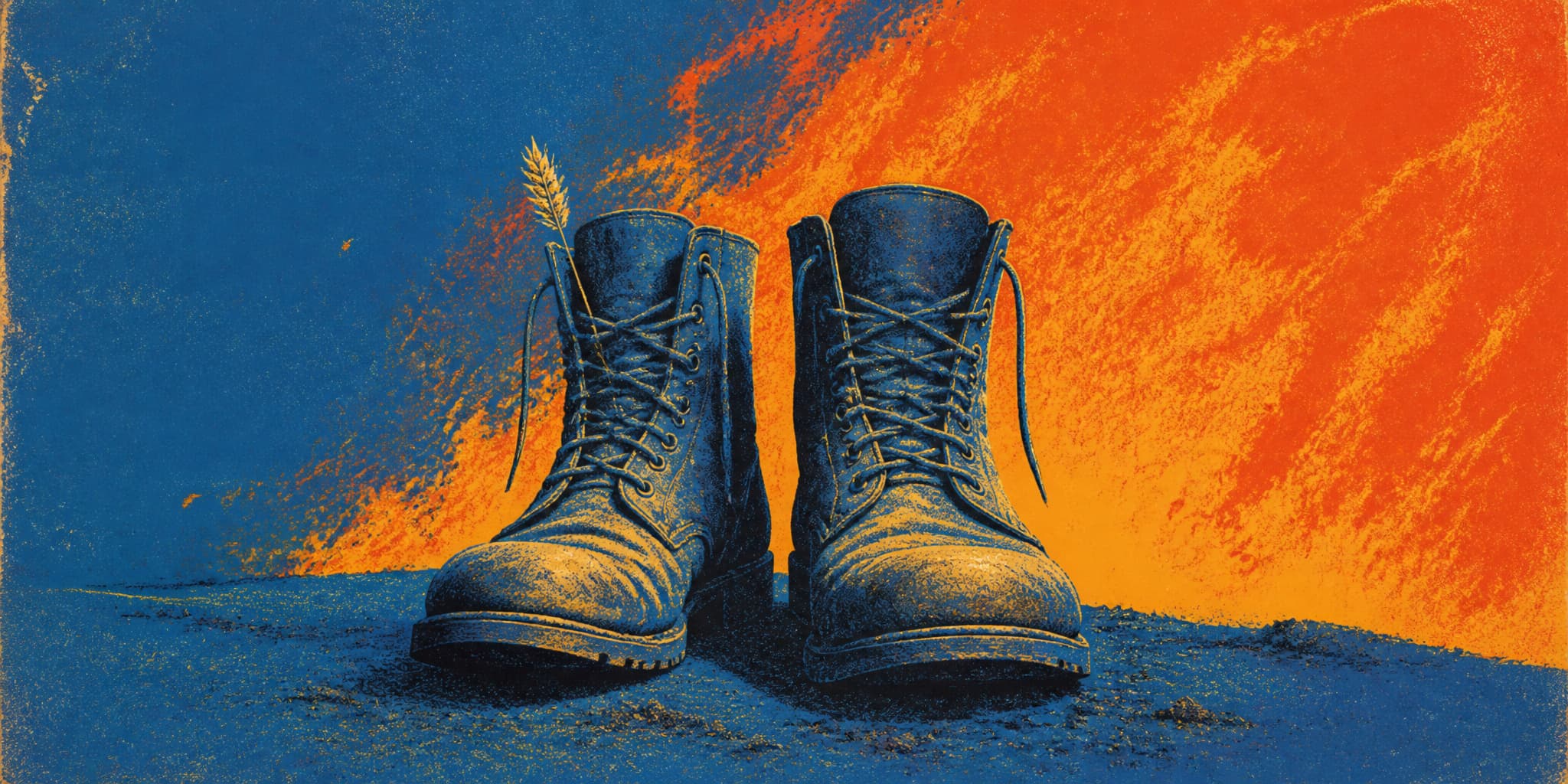
In the hallway her field boots stood against the wall where she'd set them in June. Dust on the toe caps. A grass seed still caught in the left lace eyelet from the last time she'd been up at Dry Creek, eleven weeks ago. She'd planned to run her summer transects in July. Then August. The measurement window opened and closed while she drove Jan to the DMV for an Idaho license, to the clinic for the prescription transfer, to the storage unit where three carloads of the Auburn house sat in plastic bins labeled in her mother's handwriting. Seasonal data has a window. You hit it or you wait a year.
"I made coffee," Jan called. "There's eggs if you want."
"Thanks." Nora filled a glass at the tap and drank it standing up. Boise pulled from the river and from wells in the same aquifer she was supposed to be modeling. She always knew where the water came from. It had yet to do her any good.
The kitchen had changed again overnight. Mugs had migrated from the cabinet above the coffeemaker to the one beside the sink. The dish rack was gone, replaced by a folded towel.
"It was molding underneath," Jan said. "You need one with a drip tray."
"Okay."
"I can pick one up. Is there a Target close?"
"Mom, it's 189 out there."
"I'll wear a mask."
"189 means stay inside."
Jan turned back to the stove and cracked an egg into the pan. The gas burner was going. Nora almost said something. The guidance was to avoid gas cooking when you couldn't ventilate, and they couldn't ventilate, because every window in the place was sealed with painter's tape. She bought a case of it every July now and went around the frames on the first Saturday the index broke 150. But the alternative was telling her mother she couldn't cook in the only kitchen available to her, in the apartment where she was a guest who had stopped being temporary without either of them saying so.
The egg popped in the oil. That smell would be here at dinner. It would layer into the recirculated air and stay, because the filter caught particles and did nothing whatsoever about anything that came off a stove, and Nora knew this the way she knew the tap water's source. Accurately. To no effect.
Dr. Okafor's email had come in Monday evening. Jan was washing the Labor Day dishes; she'd made a chicken she'd brined for two days, a holiday's worth of proof that she was still contributing. Nora saw the preview on the lock screen. Nora, I need to talk with you about spring. She turned the phone over. Four days later it was still unread.
She knew roughly what it said, because she knew the machinery it came out of. The progress form went to her committee in December. Her assistantship renewed on what that form showed. She had a chapter and a half of usable draft, a methodology approved in April, and a results section that required sixty days of streamflow and soil-moisture readings from the Dry Creek stations. Sixty days she had spent in a 740-square-foot apartment with the windows taped shut and her mother improving the kitchen.
She could pivot to fall data. Rain-on-snow started in November, if it started. But her model was built for baseflow recession, for the slow way a creek gives back water it took in months earlier, and switching to storm response meant rewriting the methodology, restarting committee review, spring at the earliest. Her funding would lapse before the new data existed. She could see the curve. She could always see the curve.
She opened the laptop at the breakfast bar. Page 14 of a chapter that needed to be 40. The cursor sat inside a sentence about hydraulic conductivity she'd written in May, back when the summer she'd planned was still available.
"You're working?" Jan stood in the doorway with a plate. Eggs, toast, apple slices fanned like she was plating for a restaurant.
"Trying."
"Eat first. You skip meals."
"I eat."
"You eat crackers and hummus at eleven at night."
Nora took the plate. The eggs were perfect. They were always perfect, thirty-two years of perfect eggs, and over fourteen months of cohabitation this had become a small daily problem. Refusing them refused something much larger. Accepting them meant her morning now included twenty minutes of somebody else needing to be needed, and there was no way to get those minutes back that didn't involve a conversation neither of them wanted.
She ate the eggs. She did not open the email.
Nora had measured the apartment during Jan's first week. One bedroom, one bathroom, a living room joined to the kitchen by the breakfast bar that served as her desk. Jan slept on the foldout. Her clothes hung on the left side of the hall closet and Nora's on the right, and the gap between them had been closing all year, the way a person's belongings expand to fill the time they didn't expect to be staying. Three suitcases, three weeks. That had been the plan in July of last year.
By afternoon the place was a submarine. Filter droning, thermostat stuck at 81 because the system was set to recirculate and the cooling couldn't keep up on inside air alone. Jan sat on the foldout, converted back to couch and sheets stowed by seven a.m. every morning, scrolling her phone. Nora sat at the bar with the laptop open.
She heard her mother's breath catch. Small sound. She didn't look up, because looking up meant asking, and asking meant the house. The Auburn house that was still standing. That hadn't burned. That Jan had lost to an insurance company's revised opinion about how likely it was to burn. The state plan premium that cost more than the old policy and would not have rebuilt the place. The buyer whose lender wouldn't accept the coverage limits. The mortgage still running every month on a house her mother couldn't live in and couldn't sell.
She heard Jan put the phone down, go to the refrigerator, open it, close it, fill the electric kettle.
"Tea?"
"Sure."
The kettle came up to a boil. The filter droned. Outside, the foothills had gone. In September when she was a kid you could stand at the north end of a parking lot and count the draws on the front range. Now she couldn't see the ridgeline she oriented by, which meant she couldn't see the watershed she was supposed to be studying, which was up there doing exactly what her model predicted it would do, generating her data, without her.
"I could look for a place," Jan said.
After dinner. Pasta with jarred sauce, because Nora had asked her not to use the gas burner again and Jan had looked at her for a second and then boiled the water in the electric kettle instead, in two batches, which took forty minutes. Neither of them mentioned it. They sat at opposite ends of the couch with the TV showing air-quality zones across the Northwest, red and orange from Medford to Missoula, sound off.
"Mom."
"I've been here over a year. That wasn't the plan."
Nora had run the numbers, more than once, the same way she'd run a gauge record. A one-bedroom in Boise was nineteen hundred if you could find one, and the vacancy rate hadn't cracked three percent in years. Jan's income was Social Security plus whatever the Auburn house generated, which was negative twelve hundred a month in mortgage and premiums. The voucher list was closed. No Idaho rental history, no local references, no pay stubs.
"With what?" Nora said, and heard how it landed.
Jan's face did something Nora recognized from her undergrad fieldwork. Not hurt. It was the look ranchers got when you showed them twenty years of water-table decline: they understood the curve perfectly well and they were going to keep running cattle, because the alternative was to stop being the person they had been their entire life. Nora caught herself making the comparison and couldn't decide whether that was insight or just the only way she knew how to look at anybody.
"I have savings," Jan said.
"Your savings are paying for a house you can't live in."
"I know what my savings are paying for, Nora."
"I'm not asking you to leave. I'm saying you can't afford to, and that's fine."
"You're not asking me anything. You haven't asked me anything in months. You sit there with your laptop and your air quality numbers and your face."
"My face."
"Like you're calculating something you don't want to tell me the answer to."
Nora nearly laughed. She was. She was always calculating something nobody had requested and wouldn't read. That was most of what her education had turned out to be.
"I want you to finish your degree," Jan said, watching the silent weather map. "That's the thing to ask me about. Whether it's happening. Instead of both of us pretending I can't see that it isn't."
The compressor kicked on, ran thirty seconds, shut off. Still 79.
"It's happening," Nora said.
Jan looked over.
"Slower than I planned."
"How slow?"
"I don't know yet."
Which wasn't true. She knew. But she'd written enough reports that went straight into a drawer to understand that the honest number is the one you hand over when the person across from you can carry it, and a sealed apartment at 79 degrees with the smoke leaning on the tape was not the room for it.
She opened the email at 11:40. Jan was asleep on the foldout with the sheets pulled up to her chin despite the heat, the way she'd slept in Auburn in August with no AC and the windows open to foothill air that smelled like pine and cheatgrass and, in the later years, smoke.
Nora, I need to talk with you about spring. I haven't seen new work since April. I can advocate for your assistantship renewal if I have a complete chapter and a revised timeline by October 15. Without that I don't have a basis. I know this year has been difficult. Please come see me when the semester starts. — Priya
Five weeks. A complete chapter meant results, and results meant data she had not collected. Or a different chapter, which meant the literature review, which meant the kind of long uninterrupted thinking that did not exist in 740 square feet with another person's breathing and competence and grief in every room of it. The methodology she'd written in April was becoming a historical document. A description of a study that had been possible in a life she no longer lived in.
She closed the laptop. AQI 162 and dropping. The front might come in early. Or it might stall over eastern Oregon and give them three more days of this.
In the living room Jan shifted and the foldout frame creaked. Nora listened to her mother breathe, slow and even, a woman who had raised a daughter alone on an office manager's salary in a house she bought in 1998 for a hundred and forty thousand dollars and held together for almost four decades and then lost to a probability estimate. Not to fire. To a model, run in an office she had never seen, not so different from the one Nora was failing to finish.
She went out to the hallway. The boots. The grass seed still in the left eyelet. She could pull it loose. She could put them on in the morning and drive up to Dry Creek and pull the data cards, stand in the watershed she'd picked because it looked like the country she grew up in, dry foothills and a seasonal creek and the whole thing balanced on a recharge rate that declined so slowly you had to measure it to know.
The smoke might clear by morning. The front might come in.
She left the boots where they were and went back to bed. Through the wall, the filter dropped another step in pitch. She lay there and listened to it and thought about the pleats loading up, and how she'd have to change it again on Saturday, and where the money for a case of filters was going to come from in October.
- Boise's persistent smoke seasons: The Treasure Valley recorded thirty-five unhealthy air-quality days in 2024, up from just one in 2019, with surrounding mountains trapping smoke in the valley for weeks at a time.
- Sealed homes and competing hazards: EPA guidance warns that closing windows to exclude wildfire smoke can create dangerous indoor heat without adequate cooling, forcing households to choose between breathing and overheating.
- Insurance nonrenewal and California's FAIR Plan: A homeowner whose standard policy isn't renewed can apply for the state's insurer of last resort, but the FAIR Plan covers a narrower set of perils at higher cost, and buyers whose lenders won't accept the coverage limits may walk away.
- Housing voucher waits in tight markets: Boise's Housing Choice Voucher list closed after a 2024 lottery drew 2,500 applicants, with the housing authority estimating two to two and a half years to work through the selected names.