Phoenix, 2049
All fall my dad and I talked through truck windows.
Practice ran from nine to eleven at night, and most nights I stayed after. If I asked, the custodian would leave one bank of lights on. I'd kick a bag of balls at the far goal off a little wire stand, walk down and pick them up, and kick them back the other way. I'd get home around one, which was about when my dad was backing out for his shift at the warehouse. He'd stop at the end of the driveway and roll his window down.
"How many?"
I'd give him a number. Twenty-two. Seventeen. It was usually close to true. He never asked how many I'd tried, and I never told him. Then he went to work and I went to bed.
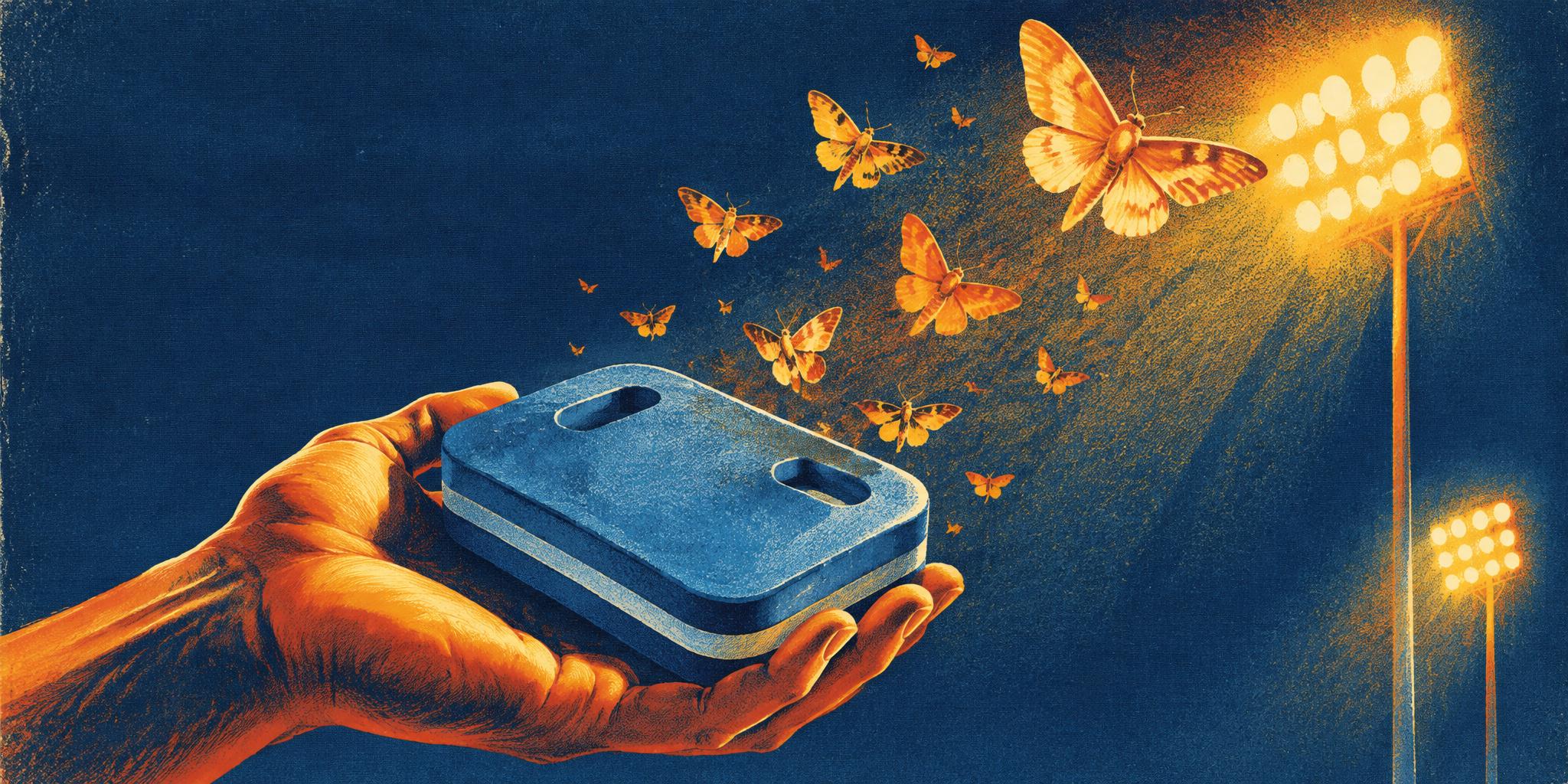
I was the backup kicker. At games that meant I carried the little rubber block our holder sets the ball on, and I ran the practice net for Ochoa, our starter. When our offense got past midfield he'd kick a few into the net to stay loose, and I'd fetch them and set them up again. I'd done that for two seasons. I had never kicked in a varsity game.
The state final was on a Wednesday, because Thursday was Veterans Day and nobody had school. Kickoff was midnight, like most games until around Thanksgiving. My dad got the night off and slept through the afternoon so he'd be awake for it. Before I left he asked if I thought I'd get in.
"If we're way ahead," I said.
He said he'd watch for me. He had his Army hat on, the dark blue one going white along the bill.
At ten till midnight we were still in the tunnel at the university stadium in Tempe. Out at the forty, Ms. Abernathy, our trainer, was crouched next to a heat meter on a tripod about knee high. It reads the heat and the humidity together. She'd read it and write on her clipboard and stand up and wait. The other school's trainer had his own meter ten yards away. Every few minutes they walked over and showed each other. Nobody plays until both of them say so. The officials stood along the sideline with their hands on their hips, like guys waiting on a tow truck.
The lights were full of moths. Big ones, with pink on the back wings when they opened them. Bats came through faster than you could follow. Coach Ruiz said there weren't moths in November when he played. He says that about a lot of things.
At midnight the announcer said it was officially Veterans Day and asked everybody to stand. We were already standing, packed in with our helmets in our hands. The whole stadium went quiet. Behind us the ice machine dropped a load into its bin and you could hear every piece land. I figured my dad was up on his feet in section 112. I couldn't see him from where I was.
We went out at 12:38.
The turf was still warm. You don't notice running on it. You notice when you kneel, the way a truck seat feels after it's sat in the sun all day and then in the shade a while.
We were down 13–7 at halftime. Their kicker had missed an extra point wide left, and I remember feeling a little bad for him, which tells you how involved I thought I'd be. Guys took turns in a metal cattle tank full of ice water that somebody's uncle had hauled in from out by Buckeye. Two at a time. Ms. Abernathy timed them on her phone and told whoever had been in longest to get out.
Ochoa kicked off to start the second half. Their returner came straight up the middle, and Ochoa did what kickers are told not to do and went to make the tackle himself. He made it. His right foot stayed in the turf and the rest of him kept going.
They got him to the bench and took his shoe off, and that was about it. Coach walked down the sideline and stopped in front of me and looked at me a second.
"Get ready," he said.
There was nobody at the net, so I set my own ball, kicked it, and went and got it. One rolled under and I had to go around the back for it. When I turned around after the third one, a freshman was standing there holding a ball out. One of the managers. I'd seen him filling coolers. I didn't know his name.
He stayed. I'd kick, and he'd have the next one ready, and I didn't have to move.
They scored. Then we scored, and the extra point was mine.
That's the short kick after a touchdown. Reese held for us. He kneels seven yards back, catches the snap, and sets the ball on the block. He was also the backup quarterback, so he'd done his share of standing around too. He put the block down and a moth was sitting on it with its wings flat. He flicked it off with two fingers like a crumb.
I took my steps. Three back from his hand, two to the left. I've done two left since eighth grade. I couldn't tell you why anymore.
It went through low and to the right. Somebody in the end zone seats caught it. 20–14.
Then I had to kick off, which I'd never done in front of anybody either. I hit it low. It went straight at one of their front guys, who wasn't supposed to be the one catching it, and he ran it back to midfield before we touched him. Coach didn't say anything when I came off. I'd have rather he did.
The fourth quarter was two tired defenses. The officials stopped the game halfway through so everybody could get water, and we stood around the coolers with wet towels on our necks. Ochoa had his foot up on a folding chair in a bag of ice. He asked how the extra point felt. I said okay.
"Looked okay," he said.
They kicked a field goal to go up 23–14. We scored with five minutes left, and my next extra point went straighter. 23–21.
Then it was forty-one seconds, fourth down, ball on their sixteen. A field goal would put us up one. Coach called our last timeout and turned around, and I was already walking out.
From the sixteen it's a thirty-three-yard kick. At school, if I'd missed a long one, I'd move the wire stand up to about thirty-three so I could make something before I put the bag away.
But these were the college's posts, almost five feet narrower than ours at home. Ochoa had mentioned it before the game. I hadn't figured it would come up.
Mostly I thought about my left foot. That's the one you plant beside the ball, and if it's in the wrong place it doesn't matter what else you do. A bat came down over Reese and went back up into the lights.
The snap came high. Reese came up off his knee to catch it, got it down, and turned the laces away from me. I was already moving. The ball started left and stayed left and went through about a foot inside the post. The two officials underneath put their arms straight up.
24–23. Somebody hit my helmet hard enough that I bit my tongue. I didn't notice until the bus.
My second kickoff went high and deep, the way it's supposed to. They caught it at their ten and got it to the twenty-five. Then a pass over the middle. Then one down the sideline. Timeout. Four seconds left, ball on our twenty-three.
Somebody said their kicker already had a college lined up. I'd watched him warm up. He walked back to his spot without looking down, like he'd paced it off a thousand times. This one was forty yards. I lost the ball in the lights for a second, and when I found it again it was coming down through the middle.
26–24.
In the handshake line he said nice kick. I said you too. There were people waiting for him at the end.
Ochoa was still on the bench. When I sat down next to him he said, "Narrow, right?"
"Yeah."
I still had the block in my hand. Reese had handed it back to me after every kick, same as all season. Over by the net the freshman was putting balls back in the bag.
Ochoa would graduate in May. Practice would start back up in August, nine at night like always, and unless somebody better showed up I'd be the kicker. I'd need somebody at the net. I figured I could find out his name before then.
The bus got back to school a little after four. My dad was in the lot with the engine running for the air conditioning. He'd driven straight from the stadium to beat us there. I put my bag in the back and got in and didn't ask how long he'd been sitting.
The diner on Baseline opens at four-thirty for people coming off nights. There was a paper sign taped by the register that said veterans ate free until eleven. He showed the woman his card, and she thanked him for his service, and he said sure. In the booth he took his hat off and set it on the seat beside him. I ordered pancakes because of my tongue.
He didn't bring up the score. He salted his eggs and ate a while, and then he said, "That first kickoff, though."
"I know."
He laughed. He doesn't do that much at four in the morning. Then he said the second one was better.
When we came out it was still dark and still warm. There were moths around the parking lot lights, not as many as at the stadium. A man in a work shirt was sitting on the curb waiting on a ride.
My dad got in and sat a second with his hands on the wheel. His hat was on the dash.
"How many?" he said.
I don't know if he meant it as a joke.
"Three," I said. "Out of three."
He nodded and turned the air down, and we went home.
-
Who reads the meter: Arizona's current sports-medicine policy already requires wet-bulb globe temperature readings on the playing surface every thirty minutes, with rest breaks and equipment limits that tighten as the number climbs.
-
Today's championship calendar: The 2026–27 Arizona football championship schedule puts this year's biggest finals in Tempe on the first weekend of December, at noon and in the evening, so a midnight final would be a long way from where things stand now.
-
Turf after dark: A Melbourne field study of artificial turf found surfaces that hit 71.6°C in daytime peaked at 31.6°C overnight, which is still warmer than grass but a very different ground to kneel on.
-
Why moths find lights: A field experiment in the Peruvian Amazon found that white LEDs drew far more insects than amber- or yellow-filtered lamps, which suggests that what crowds around stadium lights depends partly on what color those lights are.
