A Future Tense story
Every April the water district bought Nell Varga a bag of ice.
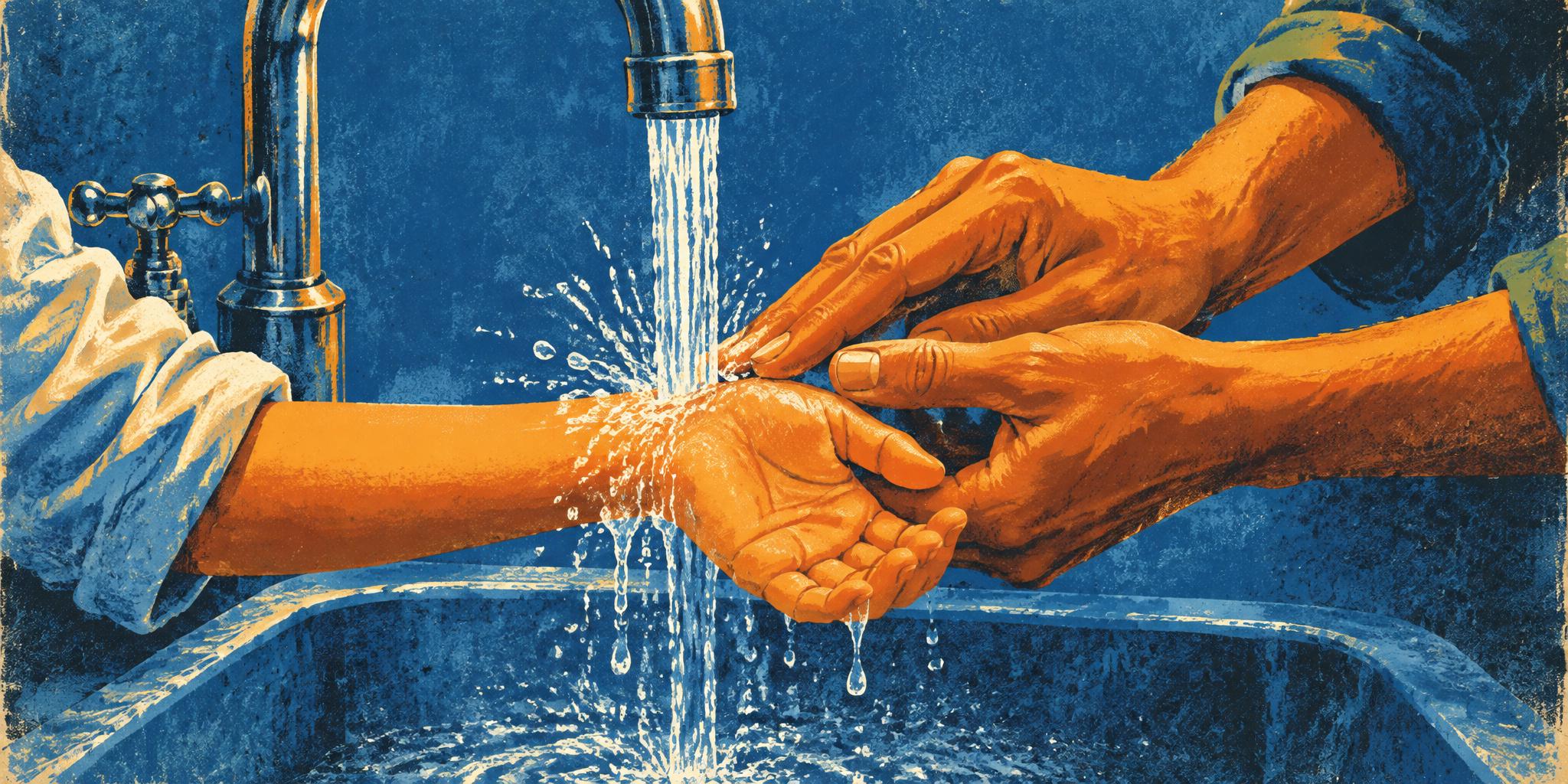
The engineer picked it up at the gas station where the highway leaves the valley, the last stop before her road. Twelve pounds, cubed, in a plastic bag printed with a penguin. He set it on the floor of the passenger side, and by the time his tires reached her gravel the bag had sweated a dark oval into the mat. In her kitchen she tore it open over an enamel basin and ran the tap until the cubes lifted and knocked together. Then she sat down, put both hands in past the wrist, and waited.
The cold came first. She called that the easy part. After it an ache climbed through the small bones of her hands and up into her forearms, and her fingertips went white and stopped reporting. When she lifted her hands out and laid them on a dish towel they were mottled, and within a minute the blood came back into them and they burned.
She talked while they burned, and that was when the snow came.
The receipts are in the district's files with the rest of her paperwork. The first is dated April 2061. There is one for every spring after it and one for this September, each initialed by the engineer and coded to witness expenses. They were paid out of the fee the district charges per acre to everyone who takes water from the canal, so every one of us who farms in this valley put a few cents a year toward Nell Varga's ice.
It started with where the district had put its instruments.
The snow that waters this valley falls in the mountains, and the district keeps its sensors up there, in clearings among the firs where snow lies all winter and comes back in nearly the same shape every year. Nobody ever put one on the valley floor. Down here snow was a visitor. It came some winters and skipped others, lay a few weeks, ran off into the ditches and the river, and was gone before anyone thought to measure it.
When the district rebuilt the program it uses to forecast each season's water, the engineers found the low ground almost blank. The program learns from the past. It studies old winters and the water each one became, and from those it guesses what this winter will become. For the mountains it had decades of numbers. For the valley floor it had a single weather station at the airport, a pole in a mown field, and a map of estimates too coarse to see the shade of a windbreak or the north wall of a barn. Those were the places snow had lingered longest, and nobody had written them down.
So the district put a notice in the grange newsletter asking for anyone who remembered the valley floor under snow. Sixteen people came to the hall that first spring. Our parents remember the folding chairs pulled into a circle, the coffee in paper cups, the arguments about which winter was which. The engineer, Daniel Ochoa, was twenty-nine. He had grown up on the coast and had never watched snow fall. He penciled their places onto a map.
Nell, in that circle, gave him only a little, and slowly.
She had been nine the winter the old people called the big snow, the one that began after Christmas in 1996. Her parents grew pears on thirty acres off the canal road. Her father shoveled a path to the chicken house, and its walls came up to her waist, and the cut faces held the flat shine of the shovel blade. Snow licked from the porch rail tasted of rust. Her mittens froze into the curve of her grip, and when she took them off by the stove they stayed curved on the rail. The snow lay on the open ground into February. Along the canal road, in the shade of the poplar windbreak, a strip of it stayed longer, gray and gritty, packed with leaves.
"Until when?" Ochoa asked.
She looked past him at the hall's window. "Before the pears bloomed. I think." She waited. "My mother would have known."
He drew a pencil line under the poplars and wrote before pear bloom (?). His notes from that spring are in the file too. In them he had set her account beside the airport's record, which showed twenty-one inches on the ground that January. On a nine-year-old, twenty-one inches comes to mid-thigh. But the walls of a shoveled path stand higher than the snow around them, since whatever the shovel lifts lands on the banks, and hers could well have reached her waist. Everywhere he could check her, she held. So the program took her gray strip and learned from it how long snow had once hung on in the valley's cold corners, how much water those corners had once given the river in March, and what they might give now.
Every year fewer came to the hall. Some died. Some went to live with their children in other states. By the twelfth spring there was only Nell, close to seventy by then, and Ochoa drove out to her.
What happened in her kitchen after that is on the recordings. What isn't on them, Ochoa has told us since, a piece at a time, at the Legion breakfast and the feed store.
She was paid by the visit.
The contract ran one page. Its middle sentence said the district paid for her time and did not purchase her knowledge. The district's lawyer had asked Ochoa to read that sentence aloud each April, and he did, and she listened with her chin lifted, checking it against last year's. The fee arrived in May. She put it toward the summer electricity, when the unit in her front window ran from noon until well after dark.
His was the only car that came up her gravel in April. She wiped the oilcloth before he arrived and set out two cups, and when he left she rinsed both, though he never drank from his.
The session form also ran one page. At the bottom it asked: New information provided? Y / N.
For the first two of those Aprils she had new things. The dog that refused to go out and wet the porch mat instead. The chains on her father's truck, a bright jingle on the plowed road. The first morning after the big fall, when the valley was so quiet she could hear the blood moving in her ears.
After that she had told all of it. One April Ochoa sat with his pen over the form while she said the waist-high path, the rust, the mittens, and she heard her own voice slide over the words without catching anywhere. He checked N without looking at her, capped the pen, and asked about her hip.
He checked N the next spring, and the one after.
That third spring, before he had his jacket off, she said, "Bring ice next time."
He thought she wanted it for drinks.
The budget meeting comes the week of Veterans Day. That year it fell on the day itself, in the evening, after the Legion breakfast in the same hall. The flags still stood along the front of the stage in their weighted bases. The long tables still wore the paper cloths from the eggs.
Nell came to the breakfast every November for her husband. Frank Varga had served on a destroyer before he came home to plant pears, and the Legion read his name each year with the others. She stayed afterward to fold. Her hips preferred standing to the metal chairs. She was at the back of the hall with an armful of paper when the board reached the line for the witness fee.
One of us asked about it, from the back half of the hall.
Water in this valley goes by age. The farms holding the oldest claims on the river take theirs first. In a short year the newest claims are cut first, at the headgates, where canal water turns into each farm's ditch. Most of us in the back half hold the newest claims. Each April the board votes what share of a full season we'll receive, and the vote follows Ochoa's forecast.
The forecast had come in low three springs running, our share had been cut to half, and what, exactly, were we still getting for the money? A dry year makes a question like that sound reasonable. The chair read the bottom line of each form aloud. N. N. N. Someone near the front laughed at how it sounded.
The board kept the line, four votes to three.
Nell folded the last cloth and carried the stack to the bin by the kitchen door. Those of us sitting near the back remember her walk. She set each foot down flat and put her weight on it only once it had landed. We took it for her hips.
The next April, Ochoa brought the ice.
He sat across from her with the recorder and watched the skin over her knuckles go the color of candle wax. Pale lines showed across them, scars from the Januarys when her hands had split along every crease and bled into her mittens. He asked if it hurt. She said it was supposed to. When she took her hands out, the color came back in blotches, and her lips parted, and she began.
After a thaw and then a hard freeze, she said, the snow had grown a crust that held her weight. Her father showed her how to cross it: set the whole foot down flat, and don't trust it until it's landed, or you go through. She walked out on it, over the drifts, to the road. The drifts had buried the fence. The Larsens' heifers had walked straight over the wire and stood in the road steaming, and her father and Mr. Larsen drove them home with push brooms.
Ochoa checked Y.
The spring after, the walls of the path to the chicken house leaned in until they met overhead, and she walked to the hens under a roof of snow, the light coming through it the gray-white of a lampshade. The spring after that, the strip under the poplars outlasted the pear bloom. Then it outlasted the cherry bloom and lay there until the new cherries were the size of peas. Her sentences got longer. The pauses left them. She kept her hands in the basin longer each April, and the burning afterward went on longer, and the snow kept arriving inside it.
One spring, when she opened her freezer to put away the leftover cubes, he saw six trays of ice stacked on the shelves where food should have been.
Then she told about skating to town on the canal.
Ochoa wrote it down. Afterward he sat in the car with the engine running and the empty bag on the floor, cold air from the vents on his face. The district drains the canal every October so the gates and concrete can be repaired dry. It would have been empty that winter, like every winter. A pond, then. A low field that flooded and froze. He wrote canal on the form and nothing after it.
The same spring she told about the heifers, the chair began playing her recordings at the April meeting, before the vote on the season's water.
That first year he played one minute. Our hall has a dropped ceiling and vents beneath the windows. Those sitting near the vents keep their jackets on, while those in back fold their agendas into fans. We came in from the orchards with salt dried white along our hatbands. Her voice came out of the speakers above the board table, rougher than we'd expected, and said heifers, and we laughed. Then it said the crust held her, and we stopped.
Most of us have never stood in snow. We know cold from the freezer aisle, and from the river in June, when it still comes down off the mountains and takes your breath at the swimming hole. When Nell's voice walked out onto the crust, a man two rows from the front put his palms flat on his thighs and pressed down, slowly, testing. A woman held the backs of her fingers against her closed eyes. When the roof of snow closed over the path, the room went quiet enough that we heard the vent fins ticking.
The next year the chair played five minutes, the year after fifteen, and after that all of it, while the vote waited. We clapped at the end. Some of us sent the file to our children. One of us played the heifers for a fourth-grade class, and the children asked if a cow could really walk on top of a fence, and the teacher said yes, in the old winters.
Those of us with the newest claims listened hardest.
The April she told about the canal, Ochoa asked to speak before the recording played.
He stood at the front with the projector warming one side of his face and the valley on the screen in colored squares. He said he had set the program's sense of how long snow used to last in the valley's shade by her first account and the airport. He said her recent accounts were longer. He said, choosing each word, that there was nothing to check them against. The windbreak had been cut down forty years ago. The chicken house was gone.
"If I tell the program the old shade held snow until the cherries set," he said, "it will believe that shade is still holding water now. It will count water that isn't there. It will promise more in March and April than will come. You'll vote on that number. Then we find out in August."
He put two figures on the screen. Set by her first account, the newest claims would get forty-five percent of a full season. Set by her latest, seventy.
The chair grew pears on the oldest ground in the valley and would get his water either way. He asked whether Ochoa was saying Mrs. Varga wasn't truthful.
"I'm saying the airport wrote things down the same day."
"She was there," the chair said. "The airport is a pole in a field."
Most of us clapped. When it stopped, one woman stood and said she would rather know in April than in August, and sat down again, and the chair went on to the vote.
The board directed the program to use Nell's latest account and set our share at seventy. Ochoa's objection went into the minutes in two lines. He changed the setting that afternoon. It took a few minutes. That night, alone in his kitchen, he played the roof of snow once more through his headphones before bed. He had never been inside snow either.
The river came in short by July. In the first week of August, the ditch rider, who drives the canal road and works the gates, began closing ours.
The gate wheels are steel and stand in full sun. By afternoon nobody can hold one bare-handed, so he wore welding gloves. He turned each wheel until the gate seated, ran the chain through the spokes, and snapped the padlock shut. On the far side of the closed gate the canal kept moving, brown and slow, past us toward the older farms, which were still owed theirs.
In the afternoons our leaves folded along the center vein and turned their pale undersides to the sky. Pears on the west side of each tree went brown and soft where the sun sat on them. Some of us ran hoses off our wells until the pumps drew air. Some of us pulled the young trees we had planted that spring on the strength of seventy percent and stacked them at the ends of the rows with their roots up, drying.
One of us, coming home from the gate at four in the afternoon, drove past Nell's house. The unit in her front window was dripping onto the gravel, and a dark spot spread beneath it. The curtains were drawn.
In September the chair sent Ochoa back out to her. "Get it on the record," he said, "which winter she stands behind."
Ochoa stopped at the gas station on the highway and bought the ice. The canal beside the road had a hand's width of water in it, the concrete above the waterline crusted pale.
The bag was half water by the time he carried it in. Nell had the basin out already. She tipped the cubes in, ran the tap, and put her hands under before he'd sat down. He set the recorder on the oilcloth with the form beside it, and did not read her the contract.
She held them under a long time. Her shoulders came up toward her ears and stayed there. When she lifted her hands out, he passed her the towel, and she didn't take it. She held her hands in the air above the basin, dripping, the color coming back into them in patches, and her breath went short.
"When I came in," she said. "After the snow. My mother."
He waited.
"She ran the tap. She held her wrist under it first, the inside, here." Nell turned one burning hand over to show him. "Never hot, or it takes the skin off. She held my hands under, and it hurt worse than outside had, and I tried to pull them out. She put her hip against me to keep me at the sink. I kicked her shins. She kept hold of my wrists."
Her hands shook above the basin. Ochoa looked at them, and at the tap.
"Would you," she said.
He got up and ran it. He held the inside of his wrist under the stream the way he used to check his daughter's bath, and waited until it ran neither warm nor cool against his skin, and stepped back so she could reach.
She put her hands under the water. She didn't say which winter, and he didn't ask.
In the car he filled in the form. Date. Fee. Expenses: ice. At the bottom he checked Y.
The breakfast was this week, on Veterans Day, in the hall. The budget meeting is tonight. The witness line is on page four.
The flags are up along the stage again. Nell came early and sat at the end of the long table nearest the kitchen door, and when they read Frank's name she put her fork down and laid both hands flat on the paper cloth until the next name came. Afterward, while the coffee went around, one of the Larsen grandsons asked Ochoa if he still had the heifers on his phone.
He did. He held the phone up beside the coffee urn with the volume all the way up. Her voice came out small and tinny into the noise, and the hall quieted to hear it: the crust, the buried fence, the heifers standing in the road, her father and old Larsen with the push brooms. We laughed at the brooms. The Larsen boy laughed hardest. At the end of the table Nell laughed too, one hand pressed flat to her chest, her shoulders moving under her cardigan.
Then she stood to fold.
The paper cloths are long, and it takes two people. Nell took the near corners. The Larsen boy took the far ones, and they lifted the cloth off the table and walked toward each other down its length. Nell set each foot flat on the linoleum and put her weight on it only once it had landed. Halfway down the cloth, the boy was walking that way too. They met in the middle. Nell took his corners into her hands, folded them over her own, and held out her arms for the next length.
The winter of 1996–97 was real: Yakima's airport recorded 21 inches on the ground that January. Mountain snow sensors seldom sit on valley floors. The valley, its district and its witness are invented.
-
Paying for time, not knowledge: Gita Laidler's Ice, Through Inuit Eyes research worked with Elders and hunters in three Nunavut communities and paid a $60 honorarium per interview as compensation for their time rather than as purchase of what they knew.
-
When observers and models disagree: A September 2026 perspective by Claudine Hauri and colleagues describes Alaska observers reporting a later 2019 freeze-up than an Arctic Ocean model predicted, and how researchers used that gap to find the model's shortcomings.
-
How forecasts become percentages: Reclamation's March 2026 Yakima water-status presentation walks through how expected runoff, return flow and reservoir contents produced an early 44 percent estimate for junior water rights, within a range of 31 to 68 percent.
-
Snow recovered from diaries: British researchers rebuilt historical precipitation from personal diaries and estate records, including a record of snow lying at Trentham from December 1819 into January 1820, and checked each account against overlapping sources instead of taking any single one on faith.
