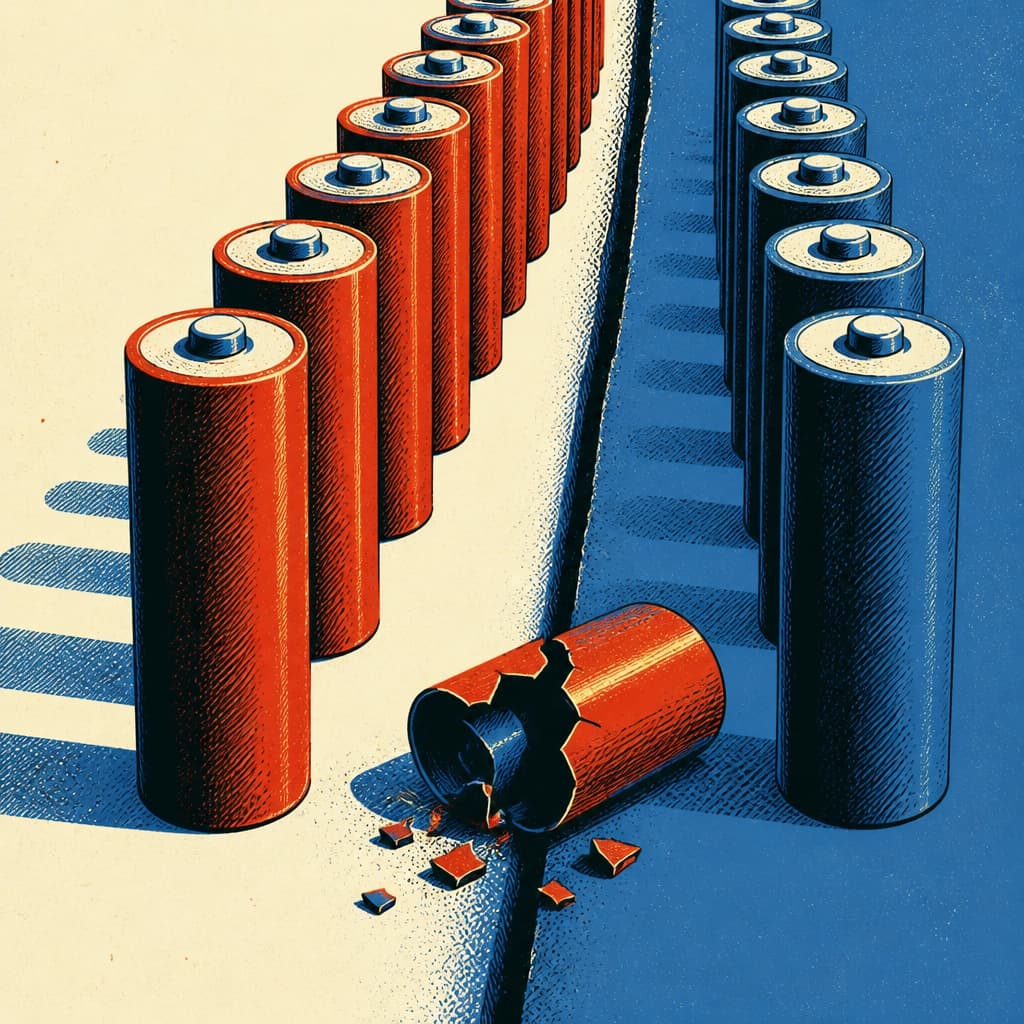
Feedstock Geography

Which recycling rung your city can compete for depends on which feedstock class concentrates near it.
Manufacturing scrap from gigafactories — off-spec cells, electrode trimmings, production rejects — accounts for roughly two-thirds of recyclable battery material and is expected to remain the primary source through approximately 2033. Collection radius is tens of miles, often contracted directly with the factory. Li-Cycle processes scrap at Ultium Cells in Lordstown. Aqua Metals and American Battery Factory proposed co-locating a recycling plant beside ABF's Tucson facility in February 2026.
End-of-life consumer EV packs are further out. EPA's April 2026 Battery Collection report states used EV batteries "are just beginning to enter the waste stream." The September 2025 elimination of federal EV tax credits cut U.S. EV sales roughly 36% by Q4 2025, delaying the retirement wave by the 8-to-12-year battery lifespan. Industrial scrap metals track a third geography entirely — the Midwest manufacturing corridor and its established processor networks.
Map your city against these feedstock geographies before evaluating processing tiers in the feature.
Two Battery-Recycling Rungs Land in Tier-3 Markets. The Permit Framework Isn't Finished.

Two rungs of the battery-recycling supply chain have tier-3 facility comparators: mechanical processing and hydrometallurgical recovery. Three rungs are out of scope. The two viable rungs carry attribute gates that most sector coverage skips, including RCRA destination-facility determinations, fire-suppression standards with no recycling-specific code behind them, water-discharge loads that can exceed 100,000 GPD, and a black-mass classification rule EPA has not yet proposed. The Section 45X critical-mineral credit phases down starting 2031, which means a facility breaking ground in 2027 may see two full-credit years before the reduction begins.
Two Battery-Recycling Rungs Land in Tier-3 Markets. The Permit Framework Isn't Finished.
Two rungs of the battery-recycling supply chain have tier-3 facility comparators: mechanical processing and hydrometallurgical recovery. Three rungs are out of scope. The two viable rungs carry attribute gates that most sector coverage skips, including RCRA destination-facility determinations, fire-suppression standards with no recycling-specific code behind them, water-discharge loads that can exceed 100,000 GPD, and a black-mass classification rule EPA has not yet proposed. The Section 45X critical-mineral credit phases down starting 2031, which means a facility breaking ground in 2027 may see two full-credit years before the reduction begins.