

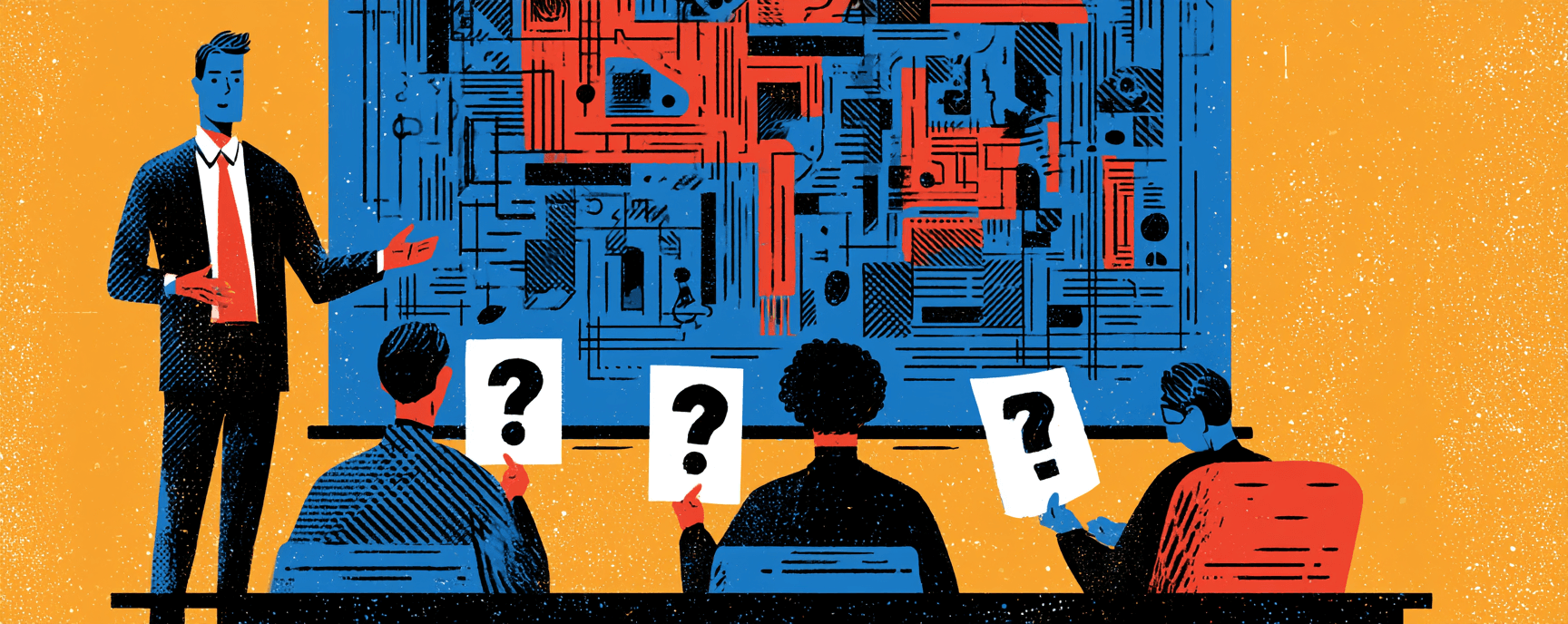
Your portfolio answers questions. The room asks questions. When those are different questions, the buyer sees what you chose to lead with and measures it against what they need. The mismatch becomes a judgment inference: she doesn't understand what this role requires. That costs more than a content gap because it changes how they read everything that follows.
You already have the Buyer-Angle Map. This piece is about what happens when you apply it carelessly, or skip it because you're moving fast and the case you love is the case you lead with regardless of the room.
H2 headcount unlocks in roughly two weeks. The outreach you send July 8–10 lands in inboxes attached to fresh requisitions and new budgets. Get the matching right before those messages go out. The long weekend is your window to run this audit.
Four scenarios. Each one uses your actual published work. Each one shows the mismatch, the buyer's likely scorecard language, and the diagnostic question that catches it before you hit send.
Alibaba into an AI-native room
The room: OpenAI, Anthropic, any company where AI is the product surface. They're evaluating one thing: Does this person understand AI as a material with properties?
They want evidence you've designed for probabilistic output. That you've made real decisions about where agent autonomy ends and user control begins. That you understand an AI-native interface is a surface where the AI's confidence, uncertainty, and failure modes are the design material.
What Alibaba answers instead: Trust at enterprise transaction scale. A buyer committing six months of inventory on the strength of a screen. Genuinely sophisticated work. But the trust problem in Alibaba is deterministic. The data is known, the transaction is binary, the interface makes the buyer confident in information that is accurate. The design job is clarity under high stakes. The room needs calibration under uncertainty.
The scorecard reads:
"Strong platform background. Understands high-stakes decision surfaces. No evidence of design for probabilistic output. Pass for now."
That "for now" is polite. It means no.
Diagnostic before sending: Does this room's product generate deterministic output or probabilistic output? If probabilistic, Alibaba is one sentence of scale context. Lead with Carrier IQ's confidence scoring and the Trust essay's Watch-Verify-Delegate framework. Those answer the question the room is asking.
Agentic Labs into a governance room
The room: Capital One, a health-tech platform under FDA oversight, any regulated financial-services company integrating AI into customer-facing workflows. They're evaluating: Does this person treat domain constraints as the design material?
They want to see constraint dissolution. Compliance embedded into the interaction flow so seamlessly it accelerates the user rather than interrupting them. The regulatory requirement is the design brief.
What Brand Pulse, Retail Velocity, and Carrier IQ answer instead: Speed, taste, genuine AI-native design instinct. 76 live signals into one decision surface. 247 venues audited through one agent. Carrier quotes with confidence scores in minutes. All built solo, fast, in an environment where the only governance was your own judgment.
The scorecard reads:
"Strong AI builder. Unclear on regulated-environment experience. Concerned about process discipline."
That last line is the real damage. In a governance room, "solo" and "fast" register as warning signs. The buyer pictures you shipping something that triggers a compliance review after the fact.
Diagnostic before sending: Does this company's product operate under external regulatory oversight? If yes, lead with Thermo Fisher, where five agents monitored batch status, exception flags, and partner delivery performance while QA regulatory release remained a human gate. That's constraint dissolution in practice: the agents accelerated monitoring without removing the human from the decision that carried regulatory weight. The Agentic Labs work becomes evidence of AI fluency, not your lead proof. And do not emphasize speed. Emphasize the decision architecture that kept humans in the loop where the domain required it.
Allē into a growth-stage AI room
The room: Ramp, a Series C vertical SaaS company shipping agentic features, any growth-stage company where AI is collapsing old product boundaries faster than the design team can redraw them. They're evaluating: Can you ship at our speed without breaking trust?
They want evidence your default mode dissolves constraints into the product rather than layering process on top. They want proof you've designed for a product surface that changes weekly because the underlying AI capabilities change weekly.
What Allē answers instead: A dual-surface loyalty redesign across consumer iOS and provider backoffice for 30M+ members and 40K+ practices. The outcomes are real: 3.2× redemption, 47% reactivation. The design problem is genuinely complex. But the complexity is organizational and systemic, not velocity-driven. It reads as a careful, multi-surface redesign executed over a meaningful timeline with a team of three product designers, UX research, and brand.
The scorecard reads:
"Solid execution leader. Proven at scale. Concerned about adaptability to AI-native product velocity."
The word "adaptability" is the tell. They've already categorized you as someone who needs to adjust to their environment rather than someone native to it. You're playing defense for the rest of the conversation.
Diagnostic before sending: Is this company's product surface stable or actively being reshaped by AI capabilities? If the latter, lead with Agentic Labs to establish AI-native fluency, bridge to the Trust essay's framework to show you've systematized the learning, then use Allē to prove you can do all of this with a team at scale. The sequence matters as much as the selection.
Trust essay into a room that wants shipped product
The room: Any company that has already committed to AI-native product development and is hiring a design leader to ship. They're evaluating: Has this person actually built AI products, or do they have opinions about them?
What the Trust essay answers instead: The Watch-Verify-Delegate trust ladder, the five handoffs in agentic workflows, the upstream design job. It proves deep thinking about the design problems AI creates. A framework, though, lives at a different altitude than a shipped feature. At Director+, everyone has frameworks.
The scorecard reads:
"Thoughtful. Clearly understands the problem space. No evidence of shipped AI work. Unclear if she can build or only advise."
The word "advise" is the killer. The differentiator at this level is having built through the opinions and come out the other side with live systems.
Diagnostic before sending: Is this room evaluating my thinking or my building? If building, lead with the Agentic Labs projects. The Trust essay becomes connective tissue proving the builds were applications of a systematic framework, not lucky experiments. Use the essay to link the projects together, not to open the conversation.
The pre-send habit
One question before every outreach message, every portfolio presentation, every cover letter: What is this room actually evaluating, and does my lead case answer that specific question?
If you can't answer in one sentence, you haven't decoded the room. If your lead case answers a different question, the buyer reads it as a judgment error. Because it is one.