

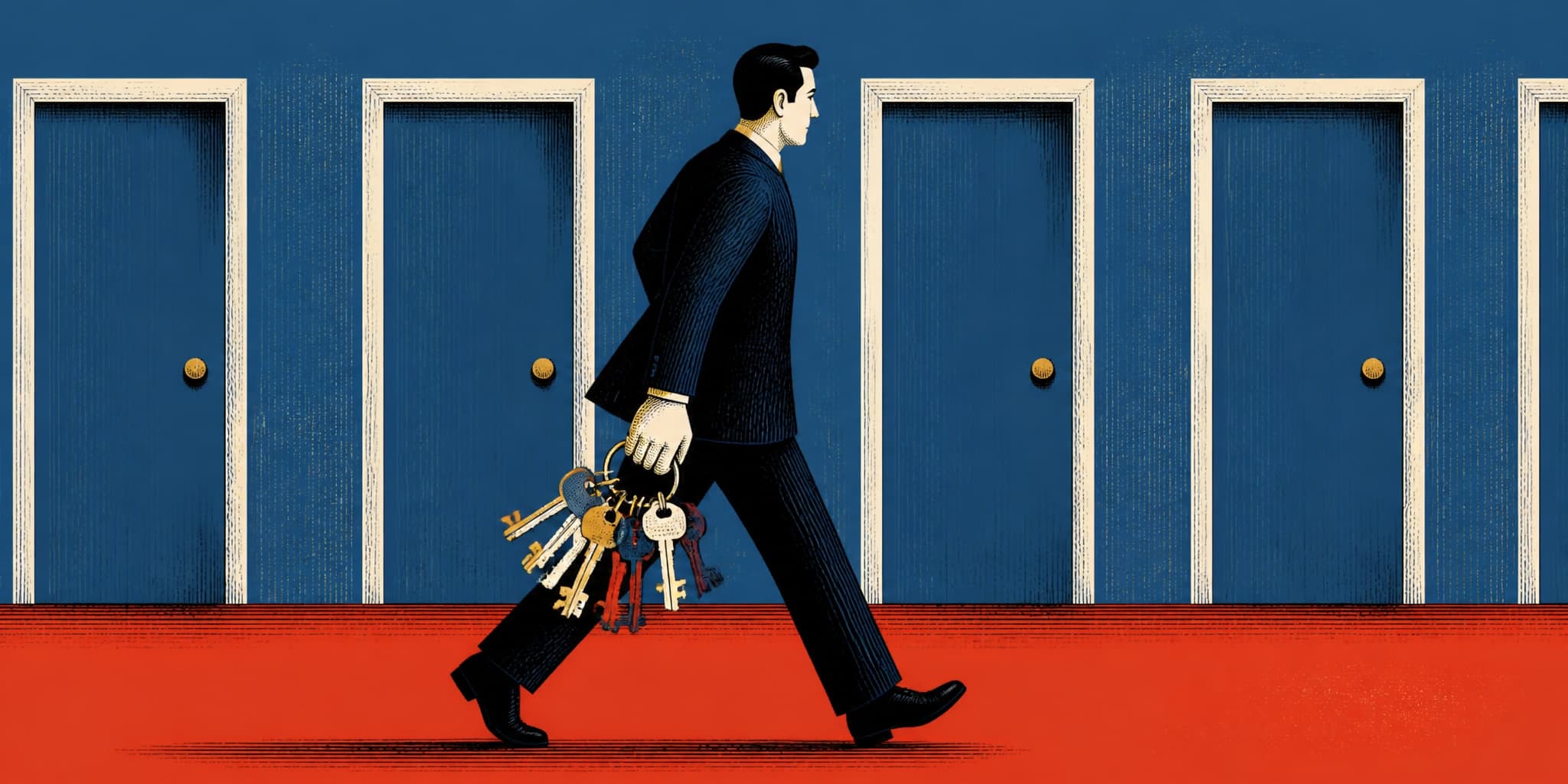
The prior map organized your lead case by company tier. Frontier AI got the Trust essay. Regulated platforms got Thermo Fisher. Enterprise got Alibaba. That was an outreach framework. It fails in the room.
Two weeks of posting language show you why. Amplitude wants someone to "define how agents and humans work together in the same workflows." Gusto is hiring around "AI wrongness, exception movement between systems and teams." Salesforce describes "behavioral architecture for how Employee Agents communicate, hand off work, use memory." Ramp, Headway, Suno, Adobe each surfaces its own version. Vanta and Capital One never use the phrase "human-agent coherence," but their domains demand it: Vanta's compliance attestation requires agents that prove their work to auditors; Capital One's financial controls require agents that surface exceptions before they become losses. Different companies, different verticals, one underlying anxiety. Human-agent workflow coherence: how humans and agents share decisions, surfaces, and accountability.
High confidence: every company on your target list is expressing this problem. But the buyer in the room determines which version of your answer they need to hear first. A CPO at Ramp and a CPO at Suno share more evaluation patterns with each other than a CPO and a VP Design at the same company. Sort by the buyer, not the company category.
The lead case answers the buyer's anxiety. The supporting case neutralizes the objection the lead creates. That principle holds. The sorting key changes.
Quick-Reference Matrix
| Buyer | Lead | Support | Hold in Reserve |
|---|---|---|---|
| Founder-CEO | Trust essay + TinyFish context | Thermo Fisher (0→1 build) | Alibaba scale metrics |
| CPO / VP Product | Alibaba (product outcomes) | TinyFish context + Trust framework | Org design, team topology |
| VP / Head of Design | Alibaba (craft decisions) | Agentic Labs (current craft) | TinyFish product title |
| Design Panel (Senior ICs) | Agentic Labs (hands-on work) | Alibaba or Thermo Fisher (design decisions) | Scale metrics, team size |
| Cross-Functional Panel | Thermo Fisher (trade-off reasoning) | TinyFish context (product fluency) | Trust essay, design philosophy |
Same company, different panel, different first slide. Identify the buyer, match their anxiety, select the lead.
Founder-CEO
Who this is. Suno, and any target where the founder still controls the leadership hiring decision. Final screen, sometimes first. Controls the offer.
What they're actually evaluating. Whether your mental model of the product problem is close enough to theirs that delegation becomes safe. Executive hiring research confirms the pattern: founder-CEOs at growth stage evaluate for stage-specific need, complementarity, and talent leverage. They are not reviewing your portfolio for craft. They are testing whether you already see what they see. Moderate confidence on this archetype for design-leader evaluation specifically. The pattern is well-documented for engineering and product executive hires. Thinner for Head of Design.
Lead with the Trust essay's five-handoff framework, grounded in TinyFish. Suno's posting implies defining how humans interact with AI-generated output. The founder hears a structural product problem: what is the interaction architecture for agent-human collaboration? Your intent-setting → in-progress → output review → decision gate → loop feedback sequence answers that directly. TinyFish proves you're building it commercially right now, not theorizing. Don't present the framework abstractly. Ground it: "I'm building this daily. Here's where agent workflows actually break."
Support with Thermo Fisher. The founder's follow-on anxiety after "does she see it?" is "can she build from nothing?" Thermo Fisher is 0→1 in a domain with real operational stakes. Six partners committed. $20M+ in recovered margin. Twelve months.
Cut or hold. Alibaba's scale metrics. A founder at a 200-person company does not need to hear about $50B GMV. That number triggers a different anxiety: "Is she too enterprise for us?" Keep it available for Q&A only.
IC+manager frame. Tilt hard toward IC product instinct. Founders at this stage want a design leader who moves design upstream. Show the Trust essay's design reasoning. Not the team that executed it.
Landmine. "Why are you Head of Product, not Head of Design?" You moved to product to build AI-natively from zero. Shipped three products in three months. You're returning to design to apply that technical depth to a specific, high-stakes design problem. The product detour is the credential. Don't apologize for it.
CPO / VP Product
Who this is. Amplitude, Ramp, Gusto, Headway. Hiring manager or hiring manager's boss. Controls headcount, scope, and reporting line. First or second round.
What they're actually evaluating. Whether design under your leadership accelerates product velocity or creates drag. Product leadership frameworks confirm: product executives evaluate cross-functional execution and whether the design function generates product direction or only executes on someone else's. The coherence anxiety hits this buyer as an execution question. Amplitude posts about defining how agents and humans work together in workflows. The CPO is asking: can you make this decision and ship it, or will you need six months of research first? Gusto describes AI wrongness and exception movement between systems. The VP Product is asking: can you design the error architecture without me specifying it?
Lead with Alibaba. Product outcomes, business metrics, cross-functional sprint structure. +20% daily transactions, -47% buyer security concerns. Alibaba answers the CPO's version of the coherence anxiety because it proves you drove product direction through design judgment at speed. You named the gap. Built the research case. Secured the mandate. Shipped three sprints. Emphasize the structural diagnosis (25% of traffic generating 80% of transaction value, platform built for consumers not procurement) and the velocity of the response.
Support with TinyFish current-role context plus the Trust essay's framework. TinyFish tells the CPO you are building AI products commercially right now. The Trust essay tells them you have a systematic framework for the agent-coherence problem their posting describes. Together they neutralize the objection Alibaba creates alone: "Impressive, but that's not AI-native."
Cut or hold. Team topology, org design philosophy, design-function maturity narratives. This buyer does not evaluate whether you can build a design org. They evaluate whether you can move product.
IC+manager frame. Balanced, tilted toward product judgment. The Alibaba diagnosis-to-mandate arc is the proof.
Landmine. "How do you prioritize when product and design disagree?" Frame it as a decision-quality question. "I bring the user evidence. If the evidence is strong enough, it changes the roadmap. If it's not, I ship and learn. The Alibaba homepage sprint was a case where the evidence was unambiguous and the team moved in two weeks."
VP / Head of Design
Who this is. Adobe, Salesforce, Atlassian. Hiring manager or senior peer. Controls the craft-bar evaluation and cultural-fit judgment. Mid-rounds, often runs the portfolio review.
What they're actually evaluating. Whether you raise the function's bar or need to be managed. Adobe's interview guidance confirms interviewers assess how much voice design had in the organization, whether design generated new projects, and what would not have happened without the candidate's leadership. The coherence anxiety reaches this buyer as a craft-discipline question. Salesforce posts about behavioral architecture for how Employee Agents communicate and hand off work. The VP Design is asking: can you define what this new design discipline is and hold the craft standard while building it?
Lead with Alibaba, but shift emphasis from product outcomes to craft and leadership decisions. The B2B credibility framework above the fold. The gaze-tracking research that informed card-level trust signals. The decision to put Trade Assurance in the primary scan zone. Go deep on one or two design decisions rather than rushing through metrics. Atlassian's guidance confirms: portfolio reviews assess core problem framing, design choices, specific contribution, and how you shaped the result.
Support with Agentic Labs. Brand Pulse, Retail Velocity, Carrier IQ. Frame as frontier exploration, not team output. These demonstrate you are actively designing agent interactions right now. The VP Design needs to see that your hands are still in the work.
Cut or hold. Lead with TinyFish context sparingly in this room. The "Head of Product" title triggers a specific anxiety in design leaders: has she left design? Agentic Labs answers that concern more cleanly than explaining the product detour. Keep TinyFish available for the direct question. Don't volunteer it as a credential here.
IC+manager frame. Tilt toward leadership leverage. Show team composition, how you built and supported the team, what roles you hired. Pair it with one craft-depth moment so they know you evaluate work, not just assign it.
Landmine. "Your Agentic Labs projects are solo builds. Can you lead a team doing this?" Reframe: "Those are my research prototypes for a design problem nobody has solved yet. The team evidence is Alibaba and Thermo Fisher. The labs prove I'm not waiting for someone to hand me the brief on agent interaction design."
Design Panel (Senior ICs)
Who this is. Two to four senior designers, often with a whiteboard exercise or deep portfolio review. They control the craft-bar recommendation to the hiring manager.
What they're actually evaluating. Whether you still do the work. Senior ICs evaluate taste, judgment, and evidence that you make design decisions rather than approve them. Secondary question: can they learn from you? This pattern is consistent across Adobe's guidance on portfolio depth, Atlassian's craft-skills assessment, and Figma's VP of Product Design emphasizing that candidates need to solve user problems and show craft even when using AI tools. I should flag: the formal evidence on how senior IC panels specifically evaluate Director+ design leadership candidates is thin. The pattern here is accumulated from practitioner guidance and recruiting observation, not controlled research.
Lead with Agentic Labs. Brand Pulse, Retail Velocity, Carrier IQ. The coherence anxiety hits senior ICs as a craft problem they live inside every day: what does the human need to see when an agent acts? Your labs are direct, hands-on answers. Show interaction-level decisions. Show the design reasoning. This is the room where the Trust essay's framework becomes concrete through the labs.
Support with one deep dive into Alibaba or Thermo Fisher design decisions. Not the business case. The design decisions. Pick whichever maps to the company's domain.
Cut or hold. Scale metrics, team size, org influence, business outcomes. This panel does not evaluate whether you drove $20M in margin. They evaluate whether you can see what they can't see in a design. Every minute on business metrics is a minute not spent proving craft judgment.
IC+manager frame. Full IC tilt. This is the one room where you are evaluated purely on whether you can do the work. Show the work.
Landmine. "These labs are interesting, but they're small. How does this translate to a complex product with millions of users?" Answer with Alibaba's complexity: 200K+ suppliers, 25M+ desktop sessions, three simultaneous sprint workstreams. The labs show you're exploring the frontier. Alibaba shows you've shipped at scale.
Cross-Functional Panel
Who this is. Engineering VP, PM leader, or data science lead. One to two people evaluating whether you can partner. Mid-to-late rounds at companies with triad structures.
What they're actually evaluating. Whether you reason through trade-offs without becoming a bottleneck or a black box. Moderate confidence: the evidence suggests cross-functional panelists evaluate AI fluency as collaboration capacity, not engineering competence. They want to know you can discuss feasibility, constraints, and system architecture without needing translation. Gusto describes exception movement between systems and teams. The engineering lead on the panel is asking: does she understand how these systems actually connect, or will I be explaining infrastructure to her every sprint?
Lead with Thermo Fisher. Five-module architecture, exception-first design logic, bidirectional KPI framework. "Exceptions surfacing at the delivery gate cost 3–5× more than if caught a week earlier" is a system-design argument. It proves you think in constraints and costs. Thermo Fisher answers this buyer's version of the coherence anxiety because it demonstrates you designed a human-system workflow where exception routing, accountability, and decision gates were the architecture. Not afterthoughts.
Support with TinyFish context. You are Head of Product at an enterprise AI company. You ship product. You work with engineers daily. You reason through agent traces, auditability, and attribution. This is operational fluency, not theoretical.
Cut or hold. The Trust essay and design philosophy. This panel does not evaluate your design framework. They evaluate whether working with you will be efficient or painful. Abstract frameworks in this room read as process overhead.
IC+manager frame. Balanced, emphasizing operating rhythm. How do you run a sprint? How do you handle scope disagreement? How do you make a call when data is ambiguous? Thermo Fisher's 12-month build and TinyFish's three-products-in-three-months pace are the evidence.
Landmine. "You're a designer who became Head of Product. Are you going to try to own product decisions?" Reframe: "I moved to product because I wanted to build AI-natively with full ownership. I'm returning to design because the design problems in agent interaction are harder than the product management problems. I don't want to own your roadmap. I want to own the interaction architecture that makes the roadmap work."
Tier labels still work as shorthand for targeting. But when you're preparing for a specific room, the anxiety determines what to say and the buyer determines how to say it. The tier is just an address.
- Amplitude's CPO is new: Gab Menachem started as CPO in April 2026 overseeing product, design, and growth, which means the Head of Product Design hire is his first design-leadership build and the mandate is still being shaped.
- Atlassian's design-system-as-context-engine work: Their team reported up to 52% accuracy improvement on agent tasks when AI tools consumed structured design-language context, which is the infrastructure side of the coherence problem every buyer on your list is trying to solve.
- Figma's hiring bar shifted: Noah Levin now expects candidates to demonstrate AI-tool fluency alongside craft, confirming that design panels will increasingly evaluate whether you can use AI to prototype at high fidelity, not just whether you can design without it.
- Anthropic is still builder-stage: Their current design-adjacent posting is a Design Engineer for Education Labs buying technical prototyping and production shipping, not people-management design leadership, so keep monitoring but don't spend outreach cycles there yet.