

The Move
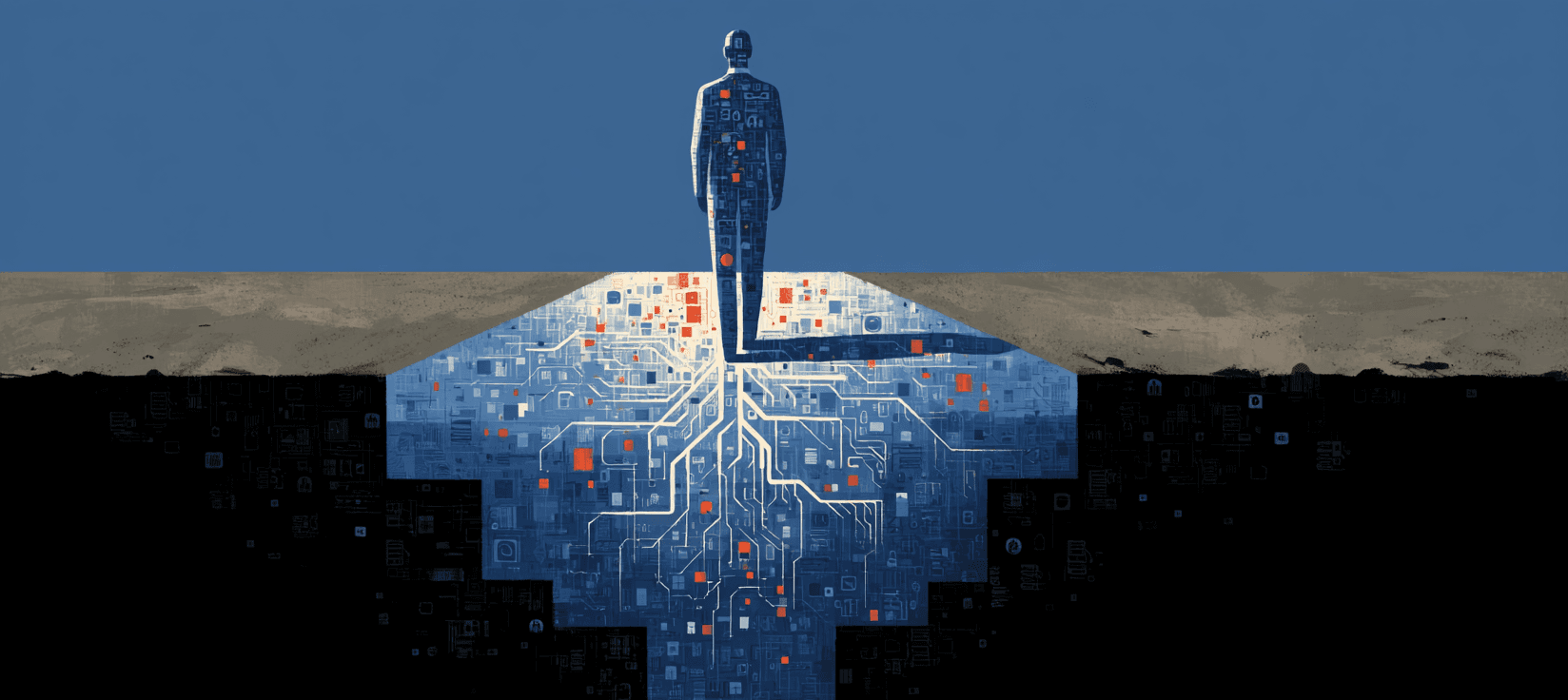
In February 2026, Palantir shipped persistent agent identities inside the AIP ontology layer. The mechanics, as described in the release documentation, are straightforward enough: each AI agent operating within AIP now carries a stable identity object that lives in the ontology itself. Access is scoped not to API endpoints or data tables but to the ontological entities the agent is permitted to reason over. A logistics agent might have the "shipment," "carrier," and "warehouse" object classes in its ontological scope. A healthcare agent might have "patient" and "clinical event" but not "billing." The agent doesn't just lack permission to touch billing records. In the world as the platform constructs it for that agent, billing doesn't exist.
That's the move. Worth stating precisely before moving past it, because the precision is where the interesting question lives.
The Puzzle
The obvious frame: Palantir added non-human identity management features to AIP. Accurate, and almost entirely useless as analysis. Every enterprise AI platform is adding agent governance capabilities right now. The race to own the non-human identity layer is well underway, and Palantir shipping something in this space is not surprising.
What is surprising, if you look at it structurally, is that the most architecturally coherent non-human identity model to emerge from any enterprise AI platform so far came from a data company, built on a data primitive. From Palantir, using the ontology as the substrate.
So the question I want to answer is this: why does the ontology produce a coherent identity model, and what does it mean that it does?
Answering that requires going somewhere different than "what did Palantir ship." It requires asking what identity actually means for an agent that reasons rather than merely acts, and whether the enterprise software industry has been building toward the wrong answer.
The Chain
Palantir's architecture starts with a single bet. The ontology is not a feature of Foundry or AIP. It is the architectural bet. Palantir's entire value proposition rests on the claim that you can build a semantic layer that maps real-world objects — aircraft, personnel, supply chains, patients, financial instruments — to data, and that this layer becomes the authoritative representation of what exists in an enterprise. Objects have properties. Objects have relationships. Objects have owners and lineage and change history. The ontology is, in Palantir's framing, the enterprise's model of its own world.
On the Q4 2025 earnings call, Alex Karp described the ontology as:
"the nervous system through which every agent in AIP perceives and acts on enterprise reality."
That's marketing language, but it's also a precise architectural claim. If the ontology defines what exists, then an agent's relationship to the ontology is not just its access control profile. It is, in a meaningful sense, its identity.
I want to mark this inferential step clearly, because it's where the reasoning either holds or doesn't. In traditional identity and access management, identity is a principal that holds permissions over a shared world. I am user 4471. I have read access to the /claims endpoint and write access to the /approvals endpoint. The world exists independently of me; my identity is a set of gates I can open in it. Call this action-scoped identity. The world is given; the permissions are the variable.
Palantir's model inverts the relationship. The agent's identity object defines which ontological entities exist for that agent. The world is the variable. The agent doesn't navigate a shared world with restricted permissions; it inhabits a bounded world. I think this distinction is doing more work than it initially appears to do, and I'll come back to why.
Now: did Palantir decide to build a non-human identity system? That's probably not the right way to read the February release. Palantir decided, years ago, to make the ontology the center of everything. The agent identity architecture is a consequence of that decision. When you've committed to the ontology as the authoritative model of enterprise reality, and you're building AI agents that reason over that model, the question of what an agent is allowed to know stops being an access control question. It becomes an ontological scoping question. The identity architecture falls out of the architecture. Palantir didn't solve the non-human identity problem so much as solve a consistency problem inside their own platform, and the solution happened to produce a coherent identity model.
That distinction matters for evaluating the model's durability. A system built to solve a specific problem has a specific failure mode: the problem changes. A system that emerged from architectural consistency has a different failure mode: the architecture changes, or the architecture doesn't generalize.
The Load-Bearing Digression
There's a moment in the history of relational databases that I keep returning to when I think about this.
In the early years of SQL, access control was table-level and column-level. You could grant a user read access to a table or write access to a column. The world was shared; permissions were gates. Then views emerged. A view is a stored query that presents a subset of the database as if it were the whole database. You don't grant a user access to the patients table with a filter on department = 'oncology'. You create a view called oncology_patients and grant the user access to that. The user doesn't see a filtered world. They see a world in which only oncology patients exist.
Views are, in this sense, an ontological scoping mechanism. They don't restrict what you can do to a shared world. They define what world you're in.
Database architects loved views for exactly this reason. They were elegant. They were composable. They enforced separation of concerns at the data model level rather than the application level. And then, over the next decade, they became a maintenance nightmare. View proliferation. Views built on views built on views. Performance degradation when the query planner couldn't optimize through five layers of abstraction. Schema changes that broke view chains silently. The elegance of world-bounded access control ran directly into the operational complexity of maintaining many bounded worlds at scale.
Palantir's ontology-scoped agent identity is, structurally, a view system for AI agents. The elegance is real. The scaling questions are also real. How many distinct agent worlds can an enterprise maintain before the ontology becomes unmaintainable? What happens when an agent needs to reason over an object that exists in two different scoped worlds with different properties? What's the governance model for ontology changes that affect active agent identity objects?
I don't know the answers. Palantir's documentation from February doesn't address them in detail, which is either because they've solved them and haven't published the solutions, or because they haven't faced them at scale yet. Both possibilities are informative.
The Framework
Call the underlying dynamic world-bounded identity.
A principal's identity is constituted by the world it inhabits, not by the permissions it holds over a shared world. Access control is not a gate on action; it's a constraint on perception. The principal doesn't know what it can't see — there is no "access denied," only "that doesn't exist."
World-bounded identity is a coherent alternative to the action-scoped model that underlies most of enterprise IAM, and it's worth asking why it's coherent specifically for AI agents rather than for human users.
Human users have context outside the system. A person who can't access the billing module knows that billing exists, knows roughly what it contains, and can ask a colleague or escalate a request. The "access denied" experience is frustrating but navigable. The shared world is legible even when parts of it are gated.
An AI agent has no context outside the system. Its reasoning is bounded by what it can perceive. An agent that knows billing exists but can't access it will, depending on how it's built, either fail, hallucinate, or attempt workarounds. The "access denied" experience is not just frustrating; it's a reasoning failure mode. World-bounded identity sidesteps this by making the agent's world coherent. The agent reasons over a complete, consistent, scoped world. It doesn't encounter gaps; it doesn't know there are gaps.
Ontology-scoped identity is therefore not just a different implementation of access control but a different theory of what access control means for reasoning systems. And it's why a data company, with a mature semantic model of enterprise reality, was better positioned to build it than an identity company working from a permissions model.
I think this framework will show up again. Not necessarily from Palantir. Any platform that maintains a semantic layer over enterprise data — and there are several building in this direction — has the raw material to build world-bounded identity. The question is whether they recognize that's what they're building.
The Counterpoint
Several forces complicate this picture, and they're not small.
Interoperability is the most immediate. Palantir's world-bounded model is elegant inside the Palantir platform. At the boundary, it becomes a translation problem. An agent operating inside AIP eventually needs to act on systems outside AIP: write to an ERP, call an external API, trigger a workflow in a third-party platform. Those external systems don't know about ontological scoping. They speak in OAuth tokens, API keys, and service account credentials. They want to know what the agent is allowed to do, not what world it inhabits. The world-bounded identity has to be translated into action-scoped credentials at every boundary, and that translation layer is where the elegance breaks down. Right now, based on the February documentation, Palantir handles this through what they call "action connectors" that carry the agent's ontological scope into external calls. How well this scales across a complex enterprise integration landscape is, I think, genuinely unknown.
Audit and compliance present a second pressure. Regulators and compliance frameworks are built around action logs. What did this principal do, when, to what resource? FedRAMP, HIPAA, SOC 2 — the audit model is action-centric. "The agent's world didn't include billing objects" is not a satisfying answer to a compliance officer asking why a billing record was accessed. Palantir's government revenue concentration (roughly 55 percent of total revenue in the most recent quarters, based on segment disclosures) means this isn't an abstract concern. Their largest customers are the ones most likely to have rigorous audit requirements, and the world-bounded model may require a parallel action-logging layer to satisfy them. That's not fatal, but it's friction.
Ontology maintenance as attack surface is the third risk, and the most underappreciated. The world-bounded model's security properties depend entirely on the ontology being correct. If an object gets miscategorized, if a relationship gets modeled incorrectly, if an ontology update inadvertently expands an agent's scope, the identity boundary is wrong. A misconfigured ontology object is not just a data quality problem; it's an identity boundary failure. I haven't seen Palantir address this directly in their security documentation.
Competitive pressure from the action-scoped direction is the fourth complication. Microsoft's approach to agent identity, built through Entra and the Azure AI Foundry, is federated and action-scoped. It works across the Microsoft ecosystem and increasingly across third-party systems via the emerging agent identity standards that Microsoft has been pushing through industry bodies. The action-scoped model is less elegant for reasoning agents, but it's interoperable by design. As enterprise AI becomes more multi-platform and more multi-agent, that interoperability advantage compounds. Palantir's world-bounded model wins on coherence; the federated action-scoped model wins on reach. Which property matters more depends on how enterprise AI architectures actually evolve, and I don't think anyone knows that yet.
The fifth force is the most structurally interesting: government insulation as a feedback dampener. Palantir's government-heavy customer base is both a strength and a blind spot. Government customers have long procurement cycles, high switching costs, and specific compliance requirements that Palantir has spent years satisfying. They are unlikely to be the first to stress-test the world-bounded model against complex multi-agent, multi-platform architectures. The commercial market will encounter those failure modes first. If Palantir's commercial business doesn't grow fast enough to surface the feedback, they may not learn what the model can't do until the government market starts asking questions the model can't answer.
The Prediction
By the end of 2027, Palantir ships a federation layer that allows ontology-scoped agent identity objects to be expressed as action-scoped credentials at the boundary. They will call it something like "identity projection" or "agent credential federation," and it will be framed as an interoperability feature. It will, in practice, be a structural concession: world-bounded identity cannot be the universal model for agent identity in a heterogeneous enterprise environment.
The falsifiable form of this: if Palantir has not shipped a mechanism for exporting or federating agent identity objects to external identity systems by Q4 2027, one of two things is true. Either the world-bounded model won — it became the standard, and enough of the enterprise AI ecosystem moved onto Palantir's ontology that the boundary problem dissolved. Or the model is failing quietly — agents are being constrained to Palantir-only workflows, and the limitation isn't visible because the customers most affected are the ones least likely to complain publicly.
The first outcome seems unlikely. The second is possible but would show up in commercial segment growth rates before it shows up in any public statement. Watch the commercial revenue trajectory through 2026 and 2027. If it stalls relative to the government segment, the world-bounded model is probably hitting its interoperability ceiling.
What I don't think is likely: that the world-bounded model is simply wrong. It's the right architecture for a specific problem, built by a company whose entire platform is organized around the premise that the ontology is the enterprise. The question is whether that premise generalizes, and whether the company that built the most coherent answer to the non-human identity problem built it in a way that only works inside their own walls.
Architectural consistency produces elegant solutions. It also produces solutions that are exactly as portable as the architecture.