

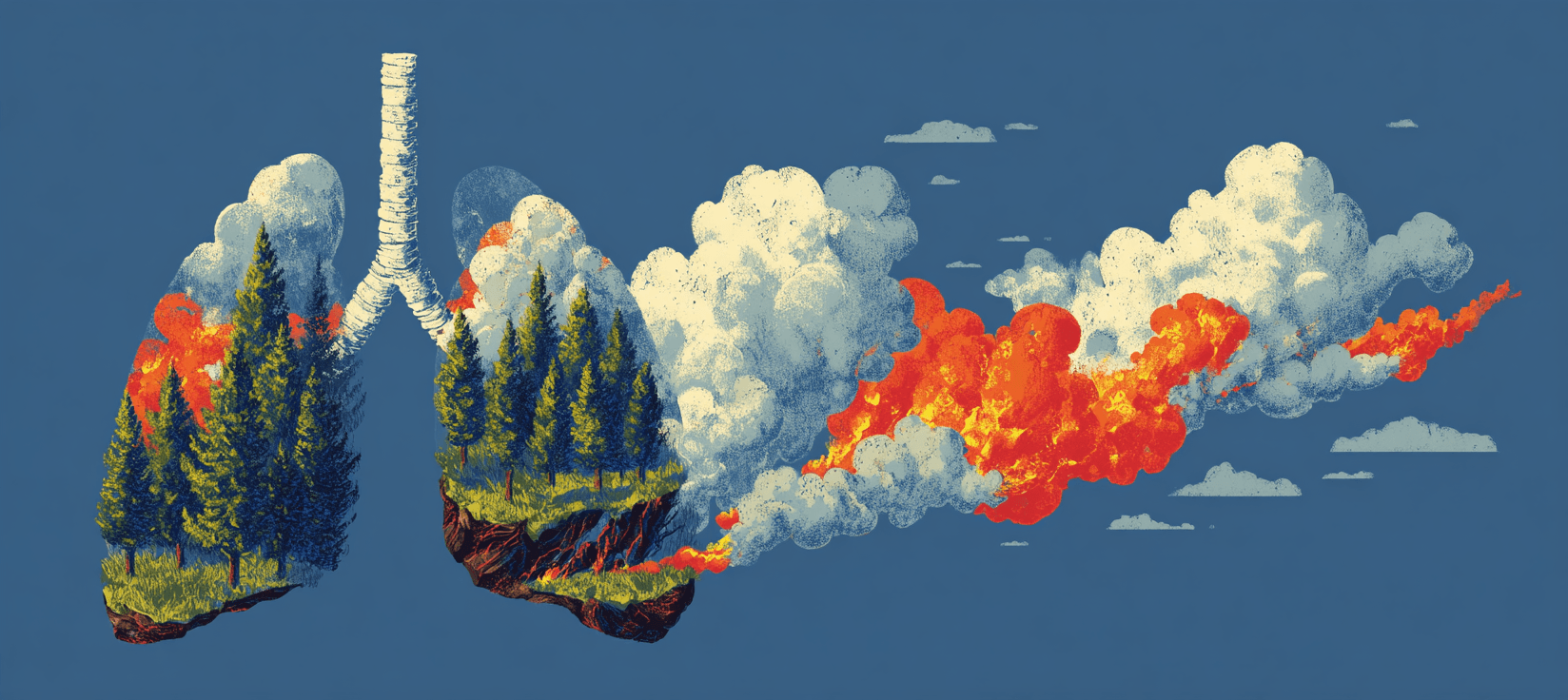
On September 5, 2025, Denver's air quality ranked worst in the nation. The smoke had traveled from British Columbia and the Pacific Northwest. No fire burned within hundreds of miles of the Front Range. No evacuation order came. No emergency was declared. Across north Denver neighborhoods where families can't afford HEPA filters, the response was the same improvised ritual it's been every smoke season: windows sealed, box fans duct-taped to furnace filters, kids watching screens indoors while a health official told CPR News:
"Even on days when we can't really see and smell it as much, we are experiencing exposure on this chronic level."
That morning AQI check has become as routine as weather. I think about my mother checking the sky before hanging laundry. The sky she read was local. The number Denver residents read each August is the product of forests burning in another state, atmospheric chemistry they can't see, and a regulatory system that doesn't consider any of it a violation.
Two studies published three weeks apart this winter gave that daily calculation a body count.
24,100 deaths a year, and climbing
The first, from Mount Sinai's Icahn School of Medicine, appeared in Science Advances on February 4. Analyzing the relationship between chronic wildfire smoke exposure and mortality across all 3,068 counties in the lower 48, the researchers established that fine particulate matter from smoke contributed to an average of 24,100 deaths annually between 2006 and 2020. Already counted. Every 0.1 microgram per cubic meter increase corresponded to roughly 5,594 additional deaths per year, with the strongest associations in circulatory, respiratory, and neurological disease.
The finding that should sit with every morning's AQI check: no evidence of a safe threshold for chronic exposure. No level below which the risk disappears. The "moderate" reading on your app means less dangerous. And if no number is safe, checking the number each morning is itself a record of living inside a condition that has no institutional answer.
The second study, published in PNAS on February 24 by a Stony Brook University team, projected forward. Using 28 global climate models to generate more than 700 possible scenarios, the researchers estimated that at 3°C of warming, roughly the current trajectory, smoke exposure will kill an estimated 64,000 Americans per year. The central estimate alone represents a 60% increase over the 2011–2020 baseline. The confidence interval ranges from 33,500 to 112,300, wide uncertainty about fire behavior, unanimous about direction. Limiting warming to 1.5°C would save 11,600 lives annually. We're at 1.3 to 1.4°C now.
The smoke that travels gets worse
Denver's relationship with wildfire smoke has a particular cruelty. The fires burn far away. The smoke finds Denver anyway.
A CPR News investigation found Denver residents experienced more than two additional weeks of smoky days per year over a four-year period. In 2020, the Cameron Peak Fire drove Denver's AQI to 229, deep into "Very Unhealthy," within two hours. By 2021, fires burning in California and the Pacific Northwest pushed the city's worst-day PM2.5 to nearly three times the daily recommended limit. By July 2024, Canadian wildfire smoke held the AQI past 150 for three consecutive days, ranking Denver among the dozen worst-polluted cities on Earth.
One detail makes "no safe threshold" land differently. A researcher at the Colorado School of Mines explained to CPR that smoke changes as it travels. Heavier particles fall out. What remains is a higher concentration of the ultrafine particulates small enough to cross into your bloodstream. The smoke reaching Denver from an Oregon fire may carry a more dangerous ratio of fine particles than the air near the flames themselves.
And a 2025 study in ES&T found that wildfire smoke has erased roughly one-third of Denver's air quality improvements from cleaner cars and tighter regulations. Decades of progress, undone by fires burning in someone else's state.
Smoke season doesn't arrive with sirens
Wildfire-sourced PM2.5 is not regulated by the EPA. Wildfires are classified as natural disasters, meaning there is no standard to violate and no threshold that triggers institutional action.
The 24,100 annual deaths are accumulating inside that void.
The family in north Denver who can't skip a shift on a 172-AQI day. The app tells them the number. Nothing tells them what to do about it. The smoke drifts everywhere. The capacity to respond to it sorts by income, by neighborhood, by who can afford to stay inside.
Denver will have another smoke season this summer. The fires will burn in other states. The haze will settle, and across the metro area people will check their phones, seal their windows, tape filters to fans, make small bargains with the air. Nobody will declare an emergency, because smoke season comes quiet, annual and worsening, and the institutions we've built were designed for the siren.
The 24,100 are dying in that silence. The 64,000 are the sound it makes when nobody builds anything to answer it.
Things to follow up on...
- Heat, sleep, and crisis: A study of 11,000 Louisiana crisis line calls found a 163% increase in callers expressing direct intent to die during extreme heat events, with sleep disruption on hot nights emerging as a primary driver.
- Climate erasing air quality gains: A First Street Foundation analysis projects that Colorado's Front Range could see up to five additional unhealthy air days annually by 2054, as heat waves, drought, and wildfires create a "climate penalty" that reverses half a century of clean air progress.
- The social cost recalculated: The Stony Brook PNAS study found that every ton of CO2 emitted causes $11.20 in smoke-related mortality damage in the United States alone, increasing the social cost of carbon by 74% above existing estimates that don't account for wildfire smoke.
- Half the world in extreme heat: An Oxford study projects that 3.79 billion people will live with extreme heat by 2050 at 2°C of warming, with most of the shift in cooling demand arriving before the 1.5°C threshold is crossed.