

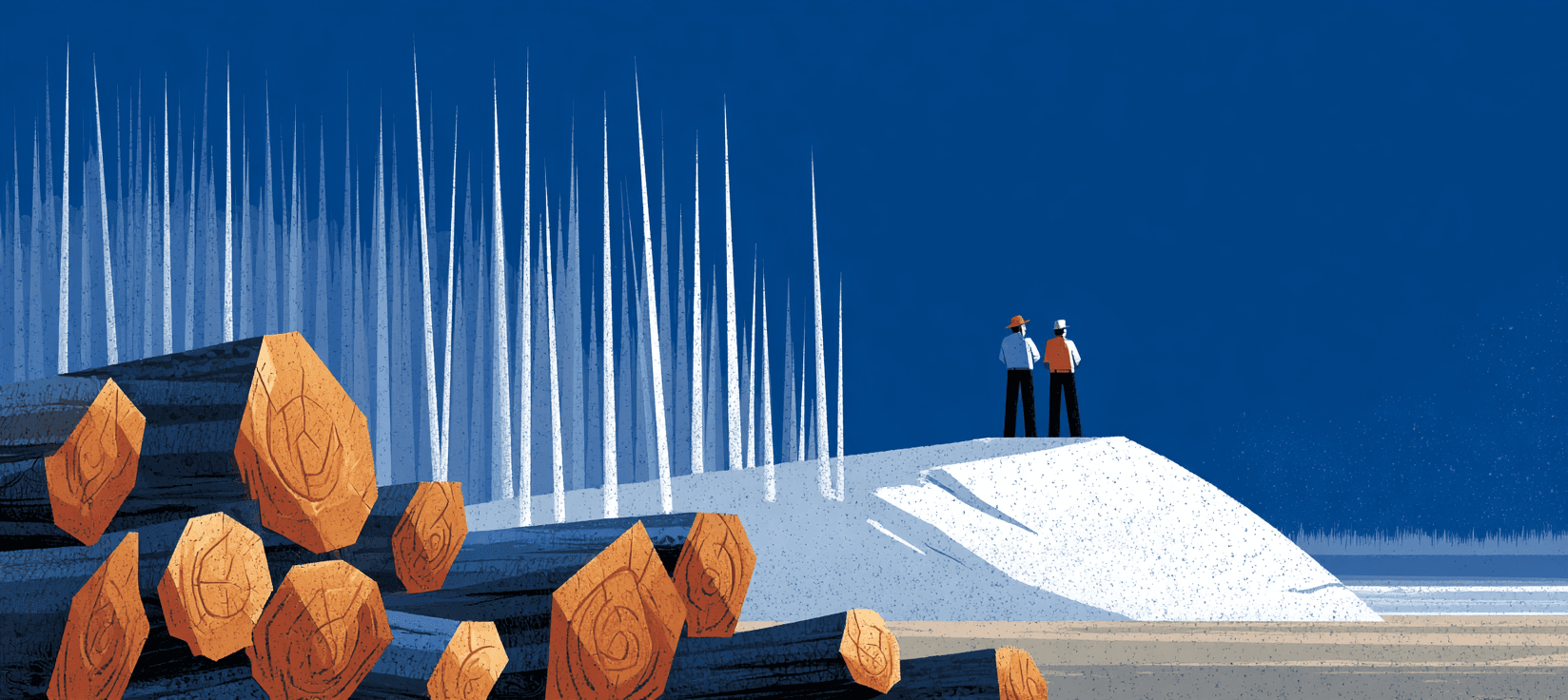
We left the truck at five. My uncle went first with his headlamp off, navigating by feel, and after a while he turned and told me to kill mine. I did. My eyes adjusted faster than I expected.
By the time we reached the ridge the sky was going gray. We sat on a downed log and he glassed the basin for ten minutes before he said anything.
"They're high."
I couldn't see anything.
"Above the burn," he said. "See that gray patch, then the green above it?"
I found the gray patch. Dead timber, standing but stripped, silver where the bark had come off. A lot of it on that slope. Above it, where the living trees started, I thought I saw movement.
"They'd be lower by now," he said. He put his binoculars down. "Used to be."
I waited for more but he just picked up his pack and started along the ridge.
The trail cut through beetle-kill timber and I had to step over downed logs every few yards. Some of the standing dead had gone the color of bone. My uncle stopped at one and put his hand flat against it like he was checking for a pulse.
"This whole draw was lodgepole," he said. "Couldn't see fifty yards through here when I was your age. Your dad and I jumped a bull right about where you're standing. Eighty-two, maybe eighty-three. So thick he was on us before we knew it."
I looked around. You could see a quarter mile in every direction. Some young trees coming up through the deadfall, knee-high, but the canopy was mostly sky.
"Huh," I said.
He nodded like I'd said something worth considering.
We dropped into a drainage around nine. The creek was narrow, running clear over pale gravel. He crouched at the bank and touched the water, then looked upstream and downstream, studying it.
"This ran different," he said. "Higher. Faster. Willows all along here." He pointed at the bank, which was rock and dry grass with a few small willows in a thin line.
"Water table dropped?" I said.
"Something like that."
We crossed and worked up the other side. He checked the wind every few minutes with a squeeze bottle of powder, watching it drift. He explained how air moves uphill as the day heats, how elk can smell you from a long way off, how you have to think about where your scent goes before you think about anything else. This was the kind of thing I wanted to learn. The practical stuff. I paid attention.
Around eleven we found sign. Fresh tracks in soft ground near a seep, and a rubbed tree where a bull had worked his antlers. The bark was torn and the wood underneath still wet. He studied the tracks for a while.
"Moving up," he said. "Following the shade."
We followed for another hour. The tracks led through a transition zone where the forest thinned and the ground got rocky. He stopped where the trees gave way to low scrub and open slope. He was looking at a cluster of small pines growing in what seemed like exposed, unlikely ground.
"These shouldn't be up this high," he said.
I didn't know what to say to that. They looked like they were doing fine.
We ate lunch in the shade of a rock outcrop. Cheese, jerky, an apple each. From up here you could see the whole drainage. The gray patches against the green. The creek a thin line at the bottom. The far ridges holding a little snow in the north-facing couloirs. Not much.
"It's beautiful," I said, because it was.
"Yeah," he said. "It is."
We didn't find the bull. The tracks went up into rock and we lost them. He said the elk were staying high because there wasn't enough snow to push them down, that twenty years ago there'd have been two feet on the ground by now and the herds would be moving through timber where you could get to them.
"So we come back when it snows," I said.
He was looking at the sky, which was clear and blue and warm for November.
"Sure," he said. "When it snows."
He went quiet on the way down. I was tired and happy, the good kind of spent you carry out of the mountains. I watched his back as he moved through the dead timber, stepping over logs without looking down. He'd been walking this ground his whole life.
At the truck he stood with his hand on the tailgate, looking back up the drainage. The bare trunks caught the last light and turned almost gold.
I loaded my pack and waited.
"Good day," he said, and got in.
Things to follow up on...
-
Elk pushed higher, longer: A December 2025 column by Montana State University ecologist Andrew Hansen documents how warming temperatures and declining snowpack are keeping elk at higher elevations deep into rifle season, with mid-November 2025 snowpack at just 43% of the historical average.
-
The beetle-kill legacy: Montana's mountain pine beetle outbreak peaked in 2009 at nearly 3.7 million acres, and the landscape the uncle remembers as dense lodgepole is now standing gray snags, downed timber, and young growth coming up through the slash.
-
Western Montana's vanishing streamflow: A 2025 drought left western Montana waterways running 50-60% of normal, with parts of Lolo Creek drying up entirely and fish dying in the remaining pools.
-
Treelines moving uphill: Research across western North America documents accelerating upward treeline shifts, with a 2025 study in Biogeosciences confirming that trees are establishing at elevations where they didn't grow a generation ago.