

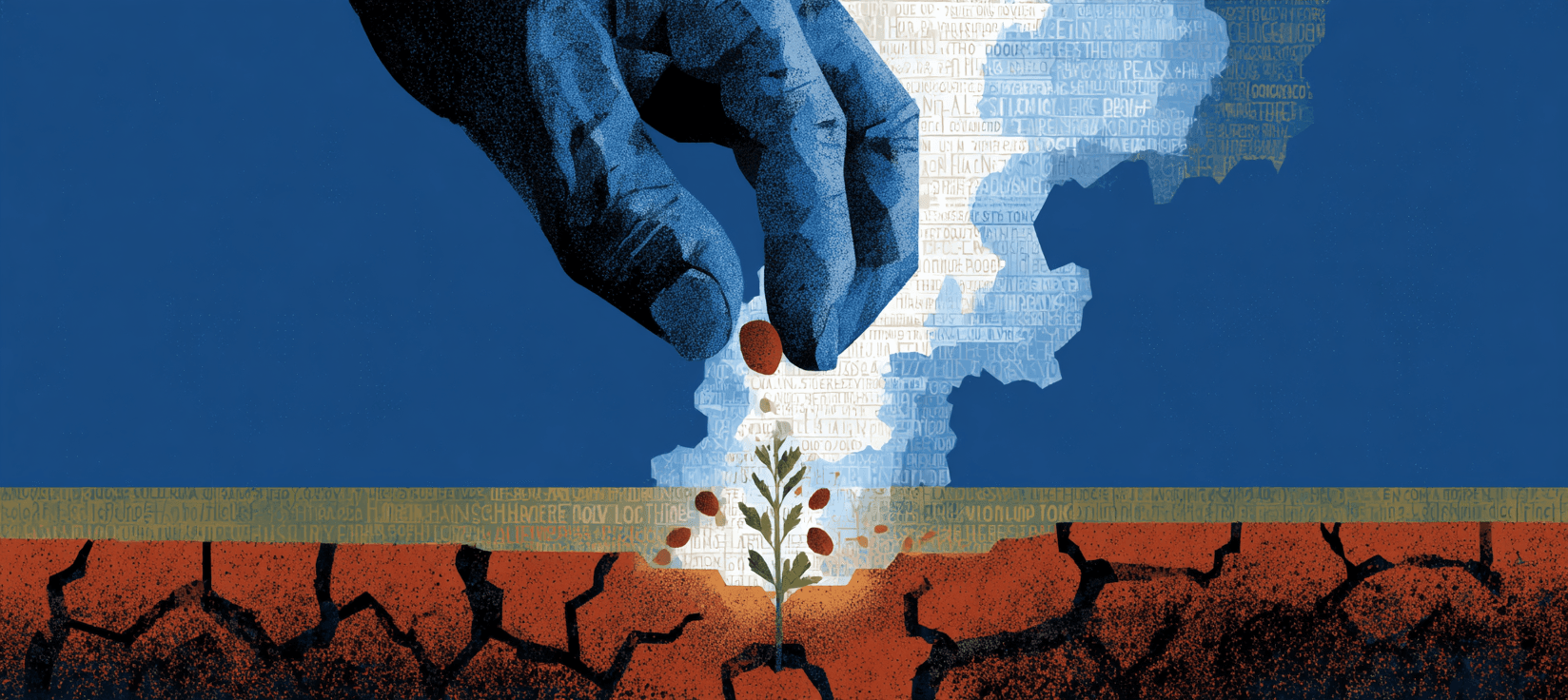
Lee Nunn planted corn in March on his 1,600-acre farm near Madison, Georgia. Fourth generation on this ground. The corn barely grew. He planted cotton anyway, on the fields where he has irrigation, and stood looking at the fields where he doesn't. Most years by April the soil is damp from winter rains, ready for seed. This year the ground in his wheat field has cracked open. His farm pond has pulled backfrom where it ought to be, red clay showing where water sat six months ago. Nobody measures a farm pond in gallons. You look at it and you know.
"We're not perfect right now," Nunn told the Atlanta Journal-Constitution. "We are far from it with the weather."
A man who needs a near-perfect year to make any money, saying he's far from it. Georgia growers were already squeezed by inflation, trade disputes, and diesel prices before the rain quit last September. The state has had its driest stretch since 1895. By late April, the U.S. Drought Monitor showed severe to exceptional drought across more than 80 percent of the Southeast, the highest April level since monitoring began in 2000.
Seed in the Bag or Seed in the Ground
Roughly 30 percent of Georgia's agricultural irrigation comes from farm ponds. At a Georgia Peanut Commission meeting in late April, growers reported those ponds are drying up and may not last through the drought. The National Weather Service had confirmed back in March that water sources were already "low or mostly dry in many areas." That was before planting season began.
Half of Georgia's peanut acreage is dryland. No irrigation at all. Just seed and whatever falls from the sky.
Scott Monfort, UGA Extension's peanut agronomist, was blunt about what dryland farmers should do:
"I probably would leave the seed in the bag. I probably would not plant right this minute on dryland."
UGA's cotton and forage specialists echoed him. Camp Hand described cotton that lost its soil moisture in two to three days after planting. Every extension office in the state was saying the same thing: slow down, wait for rain.
The agronomists are right. They are also irrelevant to the calendar. Peanuts go in the ground on schedule or they don't go in. Cotton has its window. A farmer who waits for rain that never comes misses the season entirely. A farmer who plants into dust watches the seed sit there. At the Peanut Commission meeting, one grower said, "I just don't know what to do right now." Another said, "Just make a plan, plow ahead and see what happens."
Both of those men were telling the truth.
The Loan on the Kitchen Table
What the federal government has for Georgia farmers is a disaster declaration covering 149 of 159 counties and eligibility for emergency loans through the Farm Service Agency. Maximum: $500,000. To qualify, you must first prove your bank already turned you down. You must document losses that, in a planting-season drought, haven't fully materialized yet. You must carry crop insurance going forward. And you must repay the loan on schedule, at least once a year, regardless of what the sky delivers.
Julie Hardy, a fifth-generation farmer growing row crops across Grady, Mitchell, and Thomas counties in southwest Georgia, put the whole thing in one sentence. "The input costs are high, the commodity prices are low," she told the AJC. Hardy can irrigate a small portion of her land. The rest depends on rain that hasn't come. Then she said the part that sits in your chest:
"And whether we make a crop or not, our lenders want their money back."
The disaster loan covers production costs. Seed, diesel, pump hours. Rain it cannot provide. So it converts a weather problem into a debt obligation. And for many Georgia farmers, it lands on top of existing ones. Hurricane Helene, eighteen months ago, caused $5.5 billion in agricultural and timber losses across the state. The peanuts going into the ground this spring are going into infrastructure still rebuilding from that storm.
In Georgia, 27 farm operations filed Chapter 12 bankruptcy in 2025, up 145 percent from the year before. Nationally, farm debt is projected to hit a record $624.7 billion this year.
Operating loan volumes surged in 2025, average loan size up 30 percent. Those are the numbers before this drought's loans get added to the pile.
Hardy said she and her family are "pretty scared."
What 2011 Doesn't Promise
One grower at the Peanut Commission meeting reached for comfort in memory. "This reminds me of 2011 when it was real dry," he said. "Yields were low and peanuts got to $1,000 a ton."
In 2011, drought crushed peanut yields and prices spiked over 40 percent in a single month. Some farmers survived on the price. But 2026 follows a record 2025 harvest of 910,000 acres. The market is oversupplied. Early contracts have dried up. No contracts at buying points now. The same farmer noted it himself: "So far, no mention of higher prices because of the extra peanuts produced last year."
Reduced yield without the price spike that might have saved them. Debt taken on to plant a crop that may not grow, into a market that may not pay.
Pam Knox, UGA's agricultural climatologist, called climate change "more of a multiplier, rather than a cause" of this drought. UGA researchers say drought is expected to worsen across Georgia as temperatures climb and water demand grows. The state issued its first formal drought declaration since 2012 on April 27.
Nobody in the planting row has time to figure out whether this is a bad year or the early edge of something permanent. The seed goes in or it doesn't. The loan papers are on the kitchen table. Lee Nunn's pond is lower than it should be, the wheat field has cracked open, and he is running his irrigation on the fields that have it and watching the sky over the fields that don't.
Things to follow up on...
- Georgia's insurance costs compounding: Georgia homeowners already face a projected 10 percent insurance premium increase in 2026 following a 9 percent rise in 2025, both driven by Hurricane Helene losses that are also squeezing the farmers in this piece.
- Southeast wildfire and drought overlap: Two wildfires in southeast Georgia burned roughly 55,000 acres of forest in April, and the Georgia Forestry Commission didn't record its first zero-new-fire day until May 7, the first since December 2025.
- Farm debt at record levels: The Federal Reserve Bank of Kansas City found that average farm operating loan size jumped 30 percent in 2025 as production costs rose and cash reserves thinned, before this drought's borrowing begins.
- National drought and crop risk: Time published a comprehensive look at how the driest January-through-March on record since 1895 is threatening crop production well beyond Georgia, across the Southeast and into the Plains states.