
The concentrator had been the sound of the house for three years. About as loud as someone talking in the next room, except nobody was talking. Just the machine pulling air through its filters, pushing it through twenty feet of clear tubing that ran from the living room down the hall to her grandfather's bedroom.
She checked the flow gauge on her way to the kitchen. Two liters per minute. Green light steady. Tubing along the baseboard, no kinks. She did this the way she checked the stove burners before bed. Routine, not worry.
Her father was at the kitchen table with his laptop open and a letter beside it. The letter had been on the counter for a week, maybe longer. She'd seen it but hadn't read it. Now he had it smoothed flat, one crease running through the middle where someone had folded it wrong, and he was on the phone.
"I understand that," he said. "I'm trying to upload it right now."
She opened the refrigerator. Leftover rice and some of the chicken her aunt had brought Sunday. She wasn't hungry but she should eat before the meet. She put rice in a bowl and didn't heat it.
"It says the file's too large," her father said. Not to her. His voice had the particular shape it got when he was being patient with someone who controlled something he needed.
She ate the rice cold, standing at the counter. The letter was close enough to read. She caught lender-placed and may cost significantly more and a date that had already passed. Below that, a URL and a loan number.
The outage notification was on the refrigerator, held by a magnet from a dentist's office they didn't go to anymore. SMUD. Planned maintenance. Tonight, 11 PM to 4 AM. Five hours. Her father had called the equipment company Tuesday about a portable tank and been told there was a deposit. He'd said he'd figure it out.
She rinsed her bowl and set it in the rack.
"Lina."
She turned. Her father had his hand over the phone.
"I need your phone for the code."
She knew what he meant. When they'd set up the mortgage portal two years ago, they'd used her number because his wasn't receiving texts reliably. They'd meant to change it. Changing it required a form and two business days.
"The meet's at five," she said.
"I know. I just need the code."
She pulled her phone from her back pocket. There was a text from Mateo and one from Priya saying she'd leave in forty minutes. She didn't answer either one. She set the phone on the table next to the letter.
Her father picked it up and turned back to the laptop.
She went down the hall. Her grandfather's door was open. The tubing ran from the hallway into the dark of his room, and she could hear him breathing over the concentrator's hum. The backup tank stood in the corner, half full, which would last about four hours at two liters per minute if the power went out and the concentrator shut down. She'd done that math once and kept it.
He was asleep. His hand was on his chest and the cannula was in place. She watched his breathing for a few seconds, counting without deciding to count.
Back in the kitchen, her father was typing. Her phone was on the table, screen up. A notification slid in but she couldn't read it from where she stood.
"Did it go through?"
"It's loading. The file might be too large again."
She should get her bag. She should change her shirt. Priya would be here in twenty-five minutes. The robot needed the new sensor mount checked before inspection, and if they didn't pass by six they couldn't compete in the first round.
"Dad. The outage starts at eleven. The tank's at maybe four hours."
"I'll set an alarm."
"The alarm on the machine is loud. If the power cuts it'll beep."
"I know."
"You have to switch him to the tank before the battery runs down. There's like ten minutes on the battery."
"Lina. I know."
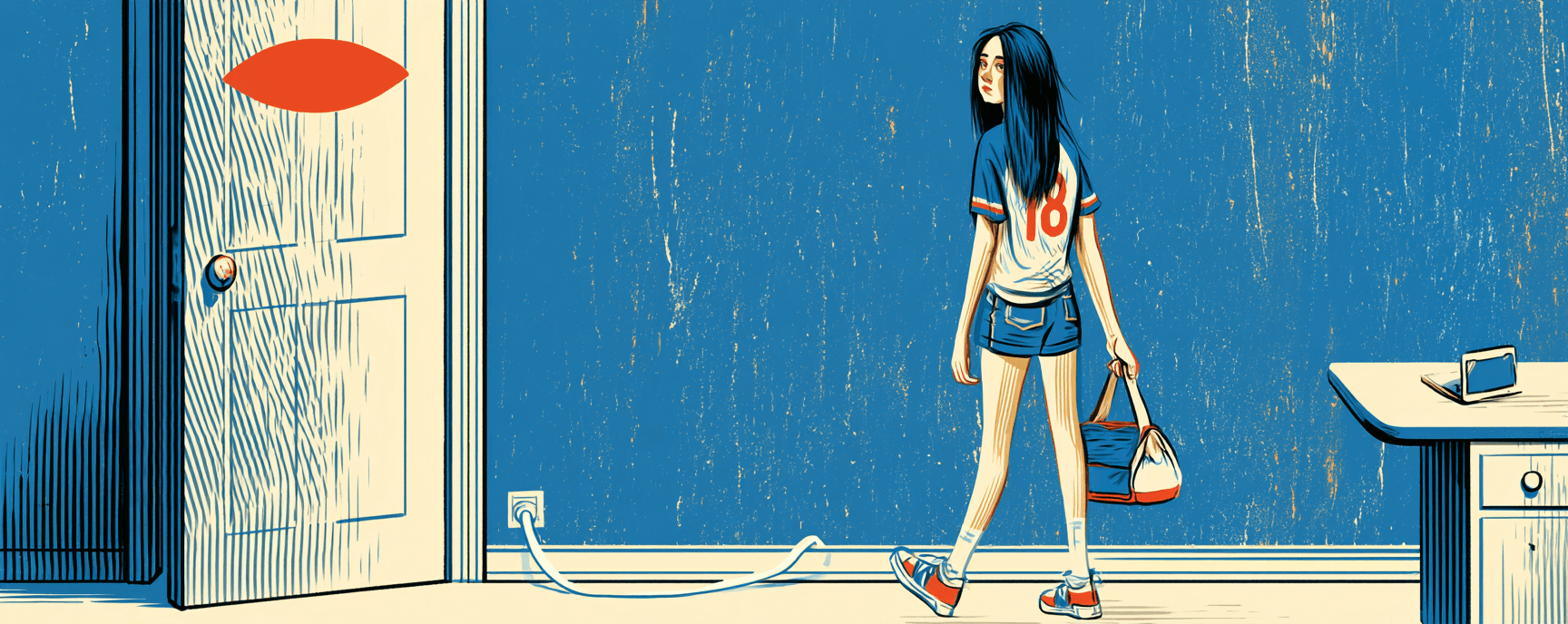
She went to her room and changed into the team shirt, the one with the gear-and-roadrunner logo that Mateo had designed. She put her wallet in her bag and her water bottle and the notebook with the sensor calibration values. She put in her charger out of habit, then took it out.
She came back to the kitchen. Her father was staring at the laptop.
"Did it upload?"
"It says processing."
"Can I take my phone?"
He looked at her. "If they send another code."
"You could use your phone."
"My number's not on the account."
She looked at the phone on the table. Priya would text when she was outside. She wouldn't get that text. She'd have to watch for headlights.
"Okay," she said.
"I'll try to have it done before you're back."
"The meet goes until nine."
He didn't say anything to that. She didn't say what she was thinking, which was that she wouldn't have a phone to tell him when she was coming back. She didn't say what if the upload fails and you need another code and I'm across town. She didn't say what if you fall asleep.
"The backup tank valve is the red one," she said. "Quarter turn."
"I remember."
She picked up her bag. The concentrator hummed from the living room. She could hear it from anywhere in the house, had heard it every night for three years. She'd stopped noticing it except when she listened for it, which was now, standing in the kitchen doorway with her bag over her shoulder.
She stood on the porch and watched the road. No headlights yet. The railing was warm under her hand. The team shirt was enough.
Priya's car smelled like vanilla and the dashboard clock said 4:22. Priya was talking about the sensor mount and whether the bracket would hold during the obstacle run. Lina kept her hands in her lap where her phone usually was and answered in the right places.
"Mateo asked if you were coming," Priya said.
"I'm coming."
"He asked twice."
"I'm here."
The school parking lot had a few cars already. The gym lights were on, visible through the high windows, and a couple of parents stood by the entrance with thermoses. Inside, the gym was set up the way it always was for meets: competition mats on one half, pit area on the other, folding tables for judges along the baseline. Behind the far bleachers she could see the stacked cots from when the gym ran as overflow. The charging cart was plugged in at the nurse's station, a power strip with eight cords, most of them taken.
She found their pit area. Mateo was already there, kneeling by the robot with a multimeter. He looked up when she walked over.
"Sensor's reading off," he said. "I think it's the mount angle."
"Let me see the values."
She knelt beside him and opened her notebook. The gym was cool, the air system running steady, and she could hear it the way she heard the concentrator at home. She worked on the mount for twenty minutes, checking calibration numbers against the notebook, adjusting, rechecking. Other teams filtered in. The gym filled with the noise of cordless drills and voices and someone's speaker playing something she didn't recognize.
Mateo was careful with his hands. Patient the way some people just are, moving at the speed the work needed. He held the bracket while she tightened the mount screws and neither of them said anything that wasn't about the robot.
A parent volunteer unlocked the vending area at five-thirty. She stood in front of the machine for a moment, looking at the rows. She picked the cold tea. The can dropped and she held it, the metal sweating against her palm, and she stood there a second longer than she needed to. Then she went back to the bleachers.
She sat and drank the tea and watched Mateo run a test cycle. She thought about her phone on the kitchen table. Whether the upload had gone through or whether her father was still looking at the word processing. Whether the outage had started. Whether her grandfather was breathing the way he'd been breathing when she checked, steady and even, the machine doing what it did.
The first pale light was coming through the high windows. She could feel the gym shifting around her, the light turning from electric to morning.
She didn't know if any of it had worked. She was here, in the gym, with the cold tea and the robot and the cots stacked behind the bleachers and the air system running.
She finished the tea slowly.
-
Force-placed insurance rules: CFPB Regulation X requires mortgage servicers to send written notice at least 45 days before charging borrowers for lender-placed coverage, including the warning that it "may cost significantly more" and "may not provide as much coverage."
-
Electricity-dependent medical equipment: HHS emPOWER tracks over 4.6 million Medicare beneficiaries who depend on electricity for durable medical equipment, home oxygen, dialysis, or hospice services, a population whose survival thresholds intersect directly with grid reliability and planned outages.
-
Schools as cooling infrastructure: A GAO report estimated that 41% of U.S. school districts needed HVAC updates in at least half their buildings, representing roughly 36,000 schools that already serve civic roles as voting places and emergency shelters.
-
Household energy insecurity now: EIA reported that 34 million U.S. households had difficulty paying energy bills or kept homes at unsafe temperatures in 2020, including 6 million households unable to use air conditioning because equipment was broken or unaffordable to run.