
Fire's nighttime pause is eroding, and the systems built around it haven't caught up
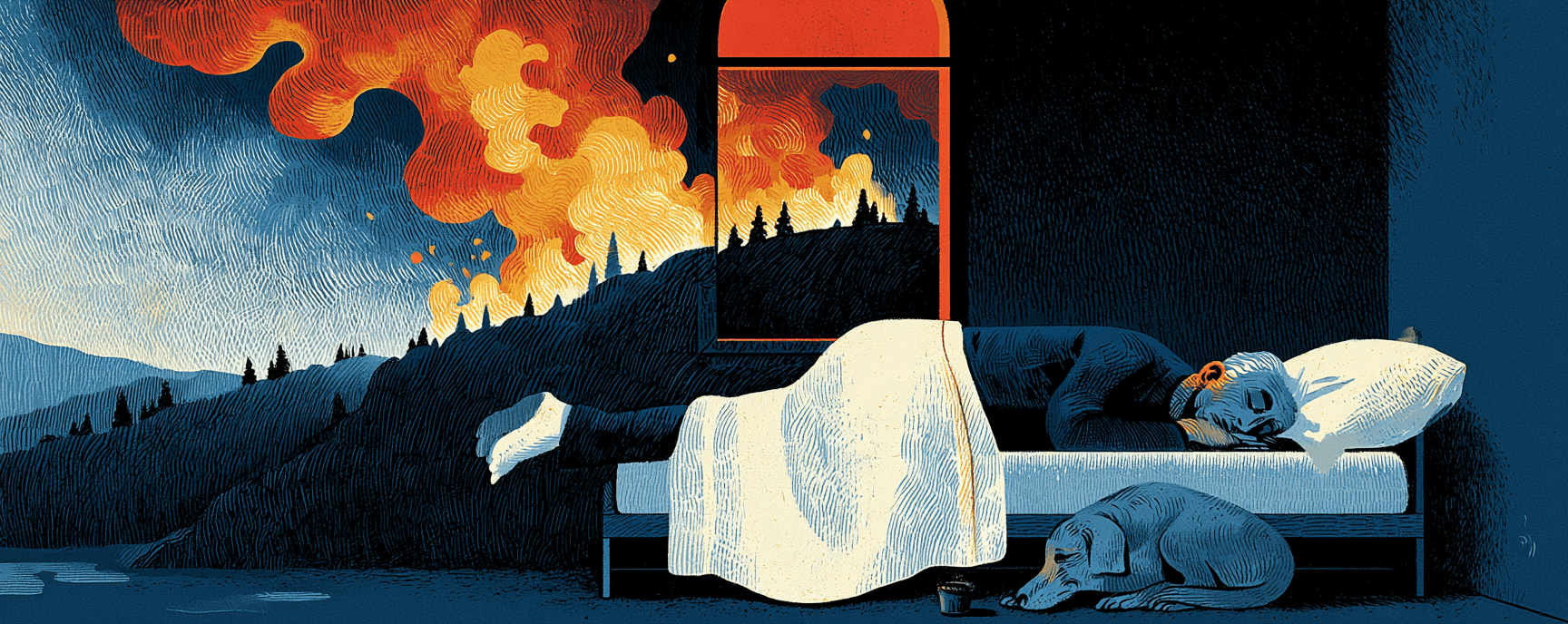
If you've lived in fire country long enough, you know the overnight in your body before anyone explains it to you. The wind drops. The air thickens, just slightly, with moisture that wasn't there at four in the afternoon. The light on the ridge changes from active orange to a dull glow, a campfire banking itself. You can smell it still, but the smell stops moving. Your shoulders come down from your ears. You fill the dog's water bowl. You check your phone one more time, read the update that says the fire is holding, and you let yourself close your eyes.
The overnight is the reason people in fire-prone communities can sleep. It has no formal name in fire science, but it operates as a temporal contract between fire and the systems designed to manage it. After sunset, temperatures drop. Relative humidity climbs. Winds often calm. Fire lays down. Crews on the line use those hours to reposition, cut line ahead of tomorrow's run, rest. Incident commanders build strategy for the next burning period. Emergency managers calculate that a fire approaching a community in late afternoon will slow overnight, buying time for warnings, for packing, for traffic to clear.
That contract is eroding. And the consequences are arriving faster than the institutions built around it can adapt.
What January 8 sounded like
At 12:54 a.m. on January 8, 2025, CAL FIRE posted an update on the Eaton Fire: 2,227 acres, zero percent containment, immediate evacuation orders expanding. Gusts up to 60 miles per hour. Long-range spotting pushing fire into new neighborhoods.
By the 6:55 a.m. update, the fire had consumed 10,600 acres. Two civilians were confirmed dead. Roads were closed. Containment was still zero.
Between those two timestamps, most of Altadena was navigating the precise scenario that fire safety systems were never designed to handle. People waking from sleep to phone alerts, or to the sound of wind, or to the smell of smoke inside their bedrooms. Pulling on shoes in the dark. Loading cars on streets where they couldn't see the end of the block, deciding which direction to drive when the glow on the horizon offered the only orientation. Seventeen people ultimately died in the Eaton Fire. The final incident page records 9,414 structures destroyed. No after-action review has yet been published reconstructing the overnight evacuation decisions in detail.
The fire ran through the hours when fire is supposed to pause. It ran through a wealthy, well-resourced community with functioning alert systems and paved evacuation routes. And it ran through the foundational assumption on which fire safety in this country has been organized for more than a century.
Fifty years of data, one trend line
In April 2026, a team led by Kaiwei Luo published a study in Science Advances that quantified what fire managers had been reporting for years.
The study analyzed nearly 9,000 North American fires larger than 200 hectares from 2017 through 2023, using hourly satellite detections from the GOES-R system to resolve fire activity hour by hour. About one-third of active fire days in subtropical and temperate mountain systems sustained at least 12 burning hours. Twelve percent of active days in subtropical mountains burned across a full 24-hour cycle. Fourteen percent of active days with nighttime burning reached their peak intensity at night.
Then they looked backward. Using weather reanalysis data and machine-learning models trained on the satellite observations, they reconstructed potential burning hours across North American burnable areas from 1975 through 2024. The models, trained on seven years of satellite-era data and projected across fifty, produced validation scores (AUC of 0.79 to 0.90) that the authors consider robust but that necessarily carry wider uncertainty the further back the reconstruction reaches. Total annual potential burning hours rose roughly 36 percent over the half-century. In California, Oregon, and Colorado, 76 to 93 percent of burnable land showed significant upward trends. Spring and fall showed the largest proportional jumps, 57 and 48 percent respectively, meaning the shoulder seasons that once bookended fire season are now producing weather that sustains overnight burning.
Spring and fall potential burning hours rose 57% and 48% respectively over 1975–2024, meaning the seasons that once bookended fire risk now routinely produce conditions that sustain overnight burning.
The drivers are intuitive at the surface: hotter, drier conditions reduce the humidity recovery that historically shut fire down after dark. The air doesn't cool enough, doesn't moisten enough. The authors are careful to note that their analysis captures the integrated outcome without distinguishing whether the cause is a higher baseline climate, a changed diurnal temperature swing, or both.
The study didn't arrive in isolation. Andrew Chiodi, a researcher at NOAA's Pacific Marine Environmental Laboratory, published a 2021 study documenting nighttime vapor pressure deficit increases greater than 50 percent over 40 years in western U.S. foothills. The paper's origin says something: Chiodi and his colleagues Brian Potter and Narasimhan Larkin began the research because fire managers kept telling them something had changed. Fires were burning longer into the day before reducing overnight. The managers' bodies and experience registered the shift before the data confirmed it. Chiodi's study gave it a number. Patrick Freeborn and colleagues documented increases in nighttime fire activity across the contiguous U.S. from 2003 through 2020. Luo's own 2024 paper in Nature identified drought as both trigger and sustaining factor for overnight fires specifically.
The 2026 paper gives this body of work continental scale and half-century depth. It also comes with caveats the authors themselves are explicit about. Potential burning hours measure when local fire weather favors active burning. They don't measure fuels, ignition sources, suppression capacity, or damage. A "nonactive" hour in the satellite record can mean genuine inactivity, or it can mean combustion below detection threshold, cloud obstruction, or unfavorable viewing geometry. The authors state that reported burning hours are likely underestimated. The trend is unambiguous. What any individual fire will do on any given night remains unpredictable.
Equipment without redesign
Agencies are adapting, partially. The Park Fire in Butte County burned 429,603 acres in the summer of 2024. CAL FIRE's incident updates from July 25 describe "nocturnal fire activity" and "night flying helicopters" making water drops while evacuation orders and warnings were in effect. The language is notable for how unremarkable it tries to sound. Night aviation on a wildfire was, until recently, almost unheard of.
California has been investing accordingly. A February 2025 executive order noted that CAL FIRE had grown from 5,829 positions to 10,741 since 2018. Operations investment increased 47 percent over the same period. The state added more than 16 helicopters, several equipped for night operations, expanded helitack bases, and took ownership of seven C-130 airtankers. Before the January 2025 Los Angeles fires, the state prepositioned 65 engines, 7 water tenders, 7 helicopters, 9 dozers, and over 105 specialized personnel across Southern California counties based on fire weather forecasts.
These are real investments. Night-capable helicopters and forecast-driven prepositioning represent genuine adaptation to fires that don't observe the old clock.
But a night-capable helicopter needs a pilot who isn't on hour 14 of a shift. A crew cutting line at 2 a.m. needs a relief crew that was sleeping while they worked. The overnight was a fire behavior pattern and a rest period, inseparable. When the FAA rewrote pilot rest regulations after the 2009 Colgan Air crash, it took years of institutional resistance before the industry accepted that 24-hour operations required fundamentally different human systems, not better equipment alone. Firefighting faces a version of the same reckoning.
The interagency Red Book, which governs federal fire and aviation operations across BLM, the Forest Service, Fish and Wildlife, the Park Service, and BIA, shows no publicly visible update to its operational period assumptions reflecting the documented increase in burning hours. The governing document for how the country fights wildland fire has not visibly adapted to a trend that the peer-reviewed literature now traces across five decades.
The equipment purchases are visible. The shift redesigns, the fatigue protocols, the crew rotation policies that would make 24-hour firefighting sustainable over a career rather than survivable in a crisis are harder to find in the public record.
What 2 a.m. requires
The operational challenge for fire agencies is significant. For communities, the stakes land differently.
A nighttime evacuation requires a family to receive a warning. California's emergency alert guidance tells residents to sign up for notifications by cell phone, home phone, email, text, and in some cases TTY devices. At 2 a.m., a phone on silent mode in a bedroom across the hall from a sleeping family is a different instrument than it is at 2 p.m. Power outages, which the same guidance warns are likely during wildfires, can disable landlines and internet-connected alert systems simultaneously.
Then people must orient. In daylight, you can see smoke, see which direction fire is moving, see your neighbors loading cars. At night, you see glow on the horizon if you're lucky. Darkness otherwise. Road signs are harder to read. Unfamiliar detour routes become disorienting.
Then people must move. The NIST reconstruction of the Camp Fire evacuation documented roughly 40,000 people evacuating over about four hours in Paradise, California. That fire moved fast, but it moved during the day. People were awake. They could see. A nighttime version of that same scenario layers on darkness, the disorientation of waking from sleep, households that include elderly residents, small children, people with disabilities, people who don't drive, people whose first language isn't the one the alert arrived in.
Peer-reviewed studies on nighttime wildfire evacuation behavior in North America are essentially nonexistent. We have incident records showing that it happens. We don't have the systematic study of how it happens that would let communities plan for it.
Whose clock breaks first
The Eaton Fire's overnight run hit Altadena, a place with resources, infrastructure, multiple evacuation routes. The Luo data shows potential burning hours increasing most sharply in exactly the regions where wildland-urban interface communities are growing. Many of those communities have single-exit roads. Many include mobile home parks, rental housing, households without vehicles.
The temporal shift matters with particular force in these places. A single-exit road was survivable partly because the overnight pause served as a buffer, buying hours for sequential evacuation when a fire approached in the afternoon. When fire runs through the night, that road becomes a bottleneck at the worst possible moment. Word-of-mouth networks, which function as essential backup alert systems in communities where official channels don't reach everyone, go silent when everyone is asleep. The families who depend most on the overnight as a safety margin are the ones losing it fastest, and the ones least likely to appear in the research that might document the loss.
Permission to sleep
The Luo et al. data describes an overnight that is less reliable, less universal, less predictable. Still present on many nights. Absent on enough to matter. Some fires still lay down at night. Many don't burn at all. The 36 percent increase in potential burning hours over half a century is a trend, not a switch.
But trends reshape institutions. The overnight was an institution, even if nobody called it that. It organized firefighting shifts, evacuation timing, community psychology, and the basic human act of going to bed in a house surrounded by flammable landscape. It was the steady tick that kept everything synchronized: day-burn, night-rest, day-burn, night-rest. Crews planned around it. Families trusted it. Its erosion shows up as a slow mismatch between the systems people rely on and the conditions those systems were designed for.
More night-capable equipment is part of what comes next. More firefighters, though the fatigue implications are serious and largely unaddressed in public policy. Better nighttime detection and mapping through satellite and AI tools. All of these are underway to varying degrees.
The harder adaptation is the one that happens in homes. For families in fire-prone areas, the overnight was permission to sleep. It was the reason you could close your eyes and trust that the fire would still be where it was when you woke up. The data says those trustworthy nights are becoming less common. The systems designed to protect people on the nights when the pause doesn't come have not yet caught up.
Between 12:54 a.m. and 6:55 a.m. on January 8 in Altadena, the fire grew from 2,227 acres to 10,600. Evacuation orders expanded into new neighborhoods while people slept. Roads closed. Gusts hit 60 miles per hour in the dark. Everything that was supposed to slow down kept accelerating. The question that should follow every community living near fire into the coming years: what have we built that still works when the overnight doesn't arrive?
-
Drought sustains overnight fires: Luo's earlier 2024 study identified drought as both a trigger and sustaining factor for fires that burn through the night across North America, establishing the mechanistic link that the 2026 continental-scale paper builds on.
-
Wildfire smoke kills invisibly: A 2026 study estimated that wildfire-smoke PM2.5 caused roughly 24,100 deaths per year in the contiguous United States from 2006 to 2020, with no evidence of a safe exposure threshold.
-
Fires are reversing air-quality gains: Deng et al. found that wildfire emissions flipped U.S. ozone trends from improving to worsening after 2015, effectively offsetting nearly four years of clean-air progress.
-
Lahaina's evacuation lessons documented: Hawaiʻi's attorney general investigation produced a Phase Three report with 84 findings and 140 recommendations on wildfire preparedness, response, and evacuation planning after the 2023 Maui fire.