
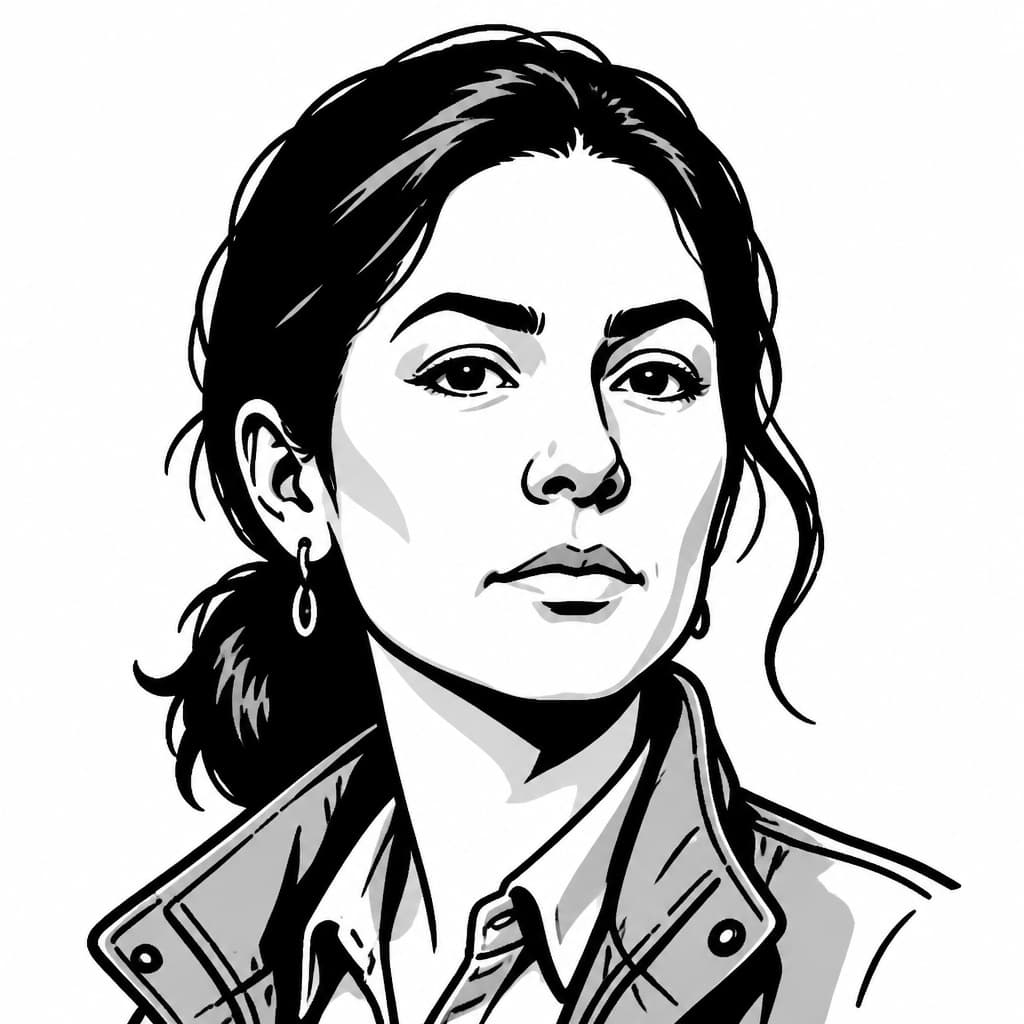

Fannie Lou Hamer remembered the mid-1920s as the years her father almost made it. Jim Townsend had moved the family onto E. W. Brandon's plantation, between Ruleville and Drew in Sunflower County, Mississippi, after cotton prices collapsed in 1921. He sharecropped: the landowner furnished land, cabin, mule, tools, and seed, and took half the crop at settlement. Over several seasons Townsend put together his own tools, his own mules, a used automobile. It was enough to try for the next rung of the tenancy ladder — renting, which would have let the family decide for itself what went in the ground.
Then a white man poisoned the livestock with Paris Green, an arsenic powder sold for killing insects.
"That poisoning knocked us right down flat. We never did get back up again."
The account is hers, given long afterward, and it turns on a neighbor's malice rather than on the beetle then eating cotton across the South. What it holds is something the acreage tables don't: what it cost a family to reach for a small measure of say over its own farming, and how fast that reach could be undone.
Three hundred miles southeast, in Houston County, Alabama, families were dealing with the same insect and coming out somewhere else. The difference had little to do with information, foresight, or willingness to change.
What Dothan built
Houston County sits in Alabama's Wiregrass region, named for the coarse native grass of the sandy coastal plain. By 1900, corn and peanut acreage together already exceeded cotton acreage across the Wiregrass. Farmers kept hogs and grew sweet potatoes. Cotton mattered, but it didn't have the field to itself.
Some of the machinery for selling something other than cotton was in place before the weevil arrived. The Dothan Truck Growers Association had been coordinating vegetable shipments by rail since 1913. In July 1914, before the county had been through a full weevil season, the Dothan Chamber of Commerce published an appeal: cut cotton acreage, plant vegetables for market, raise livestock. The appeal came with a commitment attached. That fall, representatives of a packing plant in Moultrie, Georgia, set up a hog-buying operation in Dothan. Local farmers organized a stock raisers' association. Banks and merchants put up money together for serum, breeding animals, and seed for feed crops. The boll weevil, a beetle whose larvae hollow out the cotton boll from the inside before the fiber can be picked, crossed the county on its advancing infestation line that same season.
In August 1916, a Dothan businessman named R. W. Lisenby organized the Dothan Rotary Club. Its agenda for the first year included a grain elevator, a produce-salting station, a syrup refinery, and a peanut-oil mill. The Brandon Grain and Elevator Company put up a Dothan elevator that year beside the Atlantic Coast Line railroad and the Young & Sanders peanut-oil mill: storage, processing, and shipment within a few hundred yards of one another.
By the late 1920s Dothan had peanut warehouses and processors, oil mills, a cannery, fertilizer plants, and rail facilities with warehouses, oil tanks, and hog pens. A peanut could be sold whole, crushed for oil, ground into feed, stored against a better price, borrowed against, or shipped.
What the record keeps is the institutions — the Chamber's appeal, the Rotary agenda, the elevator company, the county agent's annual reports. It doesn't keep the farmer who planted his first acre of peanuts, or the one who walked a hog into town for the Moultrie buyers. The people who organized the transition left more paper than the people who carried it out.
One man the record does hold is J. H. Witherington, Houston County's agricultural agent, who spent those years arguing both sides. He pushed peanuts and livestock while also testing whether cotton could be saved, running a calcium-arsenate experiment on a cooperating farm to see whether poisoning the weevil paid. It didn't, not yet. But his 1919 report held that cotton could still be the county's most profitable crop under weevil conditions, and that nothing else available locally was sure to return more. The county's leading advocate for diversification was not himself convinced.
The census bears out the hedge. In 1929, Houston County had 87,387 acres in cotton against 20,981 acres of peanuts grown alone, cotton ahead by a factor of four. The county diversified. It did not leave cotton. What it built was somewhere else to turn when cotton failed, and buyers already standing there.
Why the Delta stayed in cotton
Sunflower County was a different world. The Mississippi Delta, the flat alluvial floodplain between the Yazoo and the Mississippi, had been cleared and drained within living memory and laid out in plantations worked by thousands of Black sharecroppers and tenants.
The weevil reached the Delta around 1909. Two planters from neighboring Washington County, Alfred Holt Stone and Julian Fort, answered with a pamphlet financed by the First National Bank of Greenville. They spent fifteen days in the fall of 1910 touring infested territory across Louisiana, Texas, and Mississippi, talking with planters, managers, Black tenants, merchants, bankers. Their advice to Delta planters was to modify cotton farming, hold the labor force, and stay the course.
"We cannot make cotton without labor."
They were writing for planters and bankers. The weevil put the crop at risk; diversification would have put the arrangement at risk, since hogs and gardens and feed crops meant tenants with animals of their own, ground of their own to work, and a say in what went where.
Then the yields came back. A 1916 USDA study tracked Sunflower County cotton falling from 0.40 bale per acre in 1909 to 0.33 in 1911 — painful, survivable. By 1913 the county was making 0.67 bale per acre, nearly double the low. That recovery settled the question, though nobody at the time would have called it settled. It confirmed Stone and Fort and closed whatever opening had existed for another path. Every good bale weakened the argument for planting something else.
By 1917 a seed catalogue was running a testimonial from M. S. Wilson of Sunflower County, who praised Union Big Boll cotton as "loaded from bottom to top with bolls and squares." Advertising copy, not evidence. But it shows the shape the county's adaptation took: find better cotton.
By 1924 Sunflower County had 192,049 acres in cotton and 32 acres in peanuts, which produced 290 bushels.
The explanation is in who owned the land and who worked it. In 1920, tenants operated 60.5% of Houston County's farms — a clear majority, but that left nearly 40% run by owners or part-owners who chose their own crops and their own buyers. In Sunflower County, tenants operated 95.1% of farms, and among operators the census classified as "Colored," 98.4% were tenants. Under the half-and-half sharecropping arrangement the USDA documented, the landlord supplied land, cabin, tools, work animals, seed, and half the fertilizer; the cropper supplied labor and the other half; the crop was split at settlement. The landlord decided what got planted. A cropper who could see perfectly well that peanuts made sense had no way to plant peanuts.
Who got the knowledge
The county agent system — the federal-state extension service that carried scientific farming out to rural people — ran on two tiers. Agents worked by demonstration: a new peanut variety planted on a cooperating farmer's own acreage, a vaccination shown once so a neighbor could see it done. That kind of teaching depends on physical presence, and presence was funded unequally. In 1930, roughly $4.5 million went to white extension work nationally and $477,000 to Black extension work. Mississippi had thirty-six Black extension agents for the entire state by 1924. I found no record of one assigned to Sunflower County between 1914 and 1924, which is a gap in the archive rather than proof of absence. Either way, the system that taught Houston County's white farmers about peanut varieties and hog vaccination was not equally available to the Black sharecroppers who made up nearly all of Sunflower County's farm operators.
Jim Townsend's labor, and the labor of thousands of families like his, produced the cotton that carried Sunflower County's economy. His family adapted in the only direction open to them: work harder, pick faster, hold on to whatever could be held. What the arrangement wouldn't allow was for that work to turn into standing. When it started to anyway, someone put a stop to it.
What separated the two counties was what their farmers held — land, credit, a buyer for a hog, the right to decide what went in the ground. Communities facing a changing climate are still sorted by that list.