

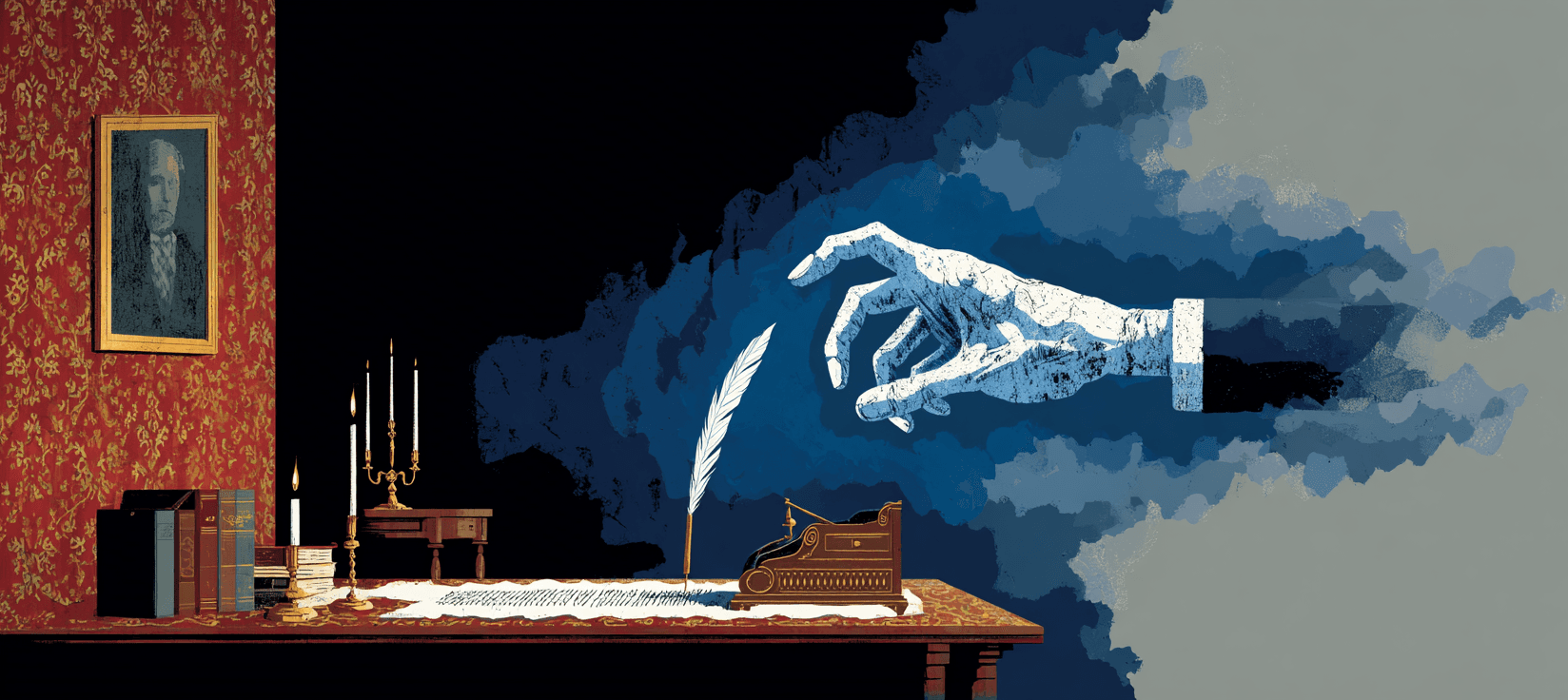
The rain would not stop. It had been falling since they arrived at the villa above Lake Geneva in June of 1816, cold rain in what should have been summer, and by the middle of the month the young English tourists had given up on the outdoors entirely. Lord Byron, twenty-eight, renting the Villa Diodati at considerable expense. Percy Bysshe Shelley, twenty-three, with his eighteen-year-old lover Mary Godwin in a smaller house below. Byron's physician Polidori, bored and quarrelsome. The lake was too rough for rowing. The mountain roads were impassable. So they read ghost stories by the fire, and Byron proposed a contest: each of them would write one.
Mary Godwin began Frankenstein. Polidori started what became The Vampyre. Two monsters conjured indoors while the rain hammered the windows. It is the most famous literary house party in the English language, and it has been told so many times that the weather itself has become a character in the story, a gothic prop, the atmospheric condition that produced genius.
The weather was also killing people. But that story doesn't get told at house parties.
Outside
The same 130 days of rain that kept Byron's circle indoors swelled Lake Geneva until it flooded the city. In the fields around the lake, crops rotted where they stood. The cause was Mount Tambora, which had erupted in Indonesia in April of 1815 and thrown enough sulfur into the stratosphere to dim the sun across the Northern Hemisphere. Nobody alive knew this. They only knew the harvests had failed and the snow would not melt.
Baroness Juliane von Krüdener knew. A Baltic German mystic turned humanitarian, she had been running a traveling soup kitchen through the Swiss cantons, drawing crowds of the desperate and the devout. In the canton of Saint Gall she came upon a column of four thousand refugees staggering across muddy fields, scrounging for roots, picking at the carcasses of animals already devoured. Dysentery thinned their ranks as they walked. When she reached Basel, the police surrounded her house, beat the refugees who had followed her with swords, and drove them into the forests. The authorities' fear was simple: if the beggars stayed, they would consume the city's remaining grain. In eastern Switzerland, single communities lost a ninth of their population. People made bread from straw and tree bark. In Swiss folklore, the title would be plain: l'année de la misère.
All of this, as the scholar Gillen D'Arcy Wood has documented, barely a hundred and fifty miles from the fireplace at the Villa Diodati.
The Remedy
On September 26, 1816, with Byron still in residence up the hill, the Geneva Grand Conseil met in extraordinary session. They voted a credit of 800,000 francs to secure grain for the canton, then doubled it. The neighboring canton of Vaud banned the export of grain, flour, bread, and potatoes, eliminated import duties, and dispatched buyers to the ports of Marseille, Genoa, and Livorno to intercept ships carrying wheat from Crimea.
A serious response, and every canton in Switzerland was making the same one.
Each canton, acting to protect its own people, banned exports across its borders. The logic was obvious and irresistible: keep available food where it is. But Switzerland's geography meant that remote mountain communities had always depended on grain from the lowlands. The cantonal export bans severed those supply lines. Highland villages, already the hardest hit by harvest failure, now had to find grain from farther away at far higher cost. The people with the least money faced the highest prices. The intervention fed the lowland towns and starved the mountains.
I spent enough years watching cargo move to know that the first thing a frightened government does is close the door. And the people standing on the wrong side of the door are always the ones who were already farthest from the warehouse.
Russian grain ships reached Geneva by November 20. Byron had left the villa on November 1. He never saw whether the money worked. Switzerland recorded more deaths than births in both 1817 and 1818. A contemporary Genevan administrator identified as the Hospitalier Dufour called 1816:
"Certainly one of the most miserable ever seen in the annals of mankind."
The Distance
Mary Shelley's surviving letters from that summer record the weather, the scenery, the literary conversations. She received correspondence about unemployment protests in England. She did not record the famine outside her window. Nobody would single her out for this. The misery of the Tambora period, as Wood has written, "was borne overwhelmingly by the poor, who left scant record of their sufferings," while the affluent left voluminous accounts of their lives. To read only their documentary record is to conclude that nothing exceptional happened.
The silence is structural. Built into which suffering gets recorded and which responses get designed. When climate disrupts food systems now, governments still reach for the same tool the Swiss cantons reached for in 1816. India banned rice exports in 2023. Russia banned wheat exports after its 2010 heat wave and again after invading Ukraine. The reflex is to hoard what you have. The consequence lands where it always lands: on the people farthest from the decision, highest up the mountain, with the least money and the fewest alternatives. They eat last.
We remember the villa. We teach the monsters that were written there. The people outside the windows, the ones who looked monstrous to the well-fed towns that turned them away, we have to keep discovering all over again.
Things to follow up on...
-
The climate refugee reading: Gillen D'Arcy Wood argues that Shelley's Creature, read against the 1816 famine, looks less like a symbol of technological overreach than a figure for the despised refugees crowding Switzerland's market towns that year.
-
Emergency relief as precedent: A 2002 Journal of Nutrition study found that the 1816–17 crisis forced European governments toward a then-radical acknowledgment that states bear responsibility for direct public intervention into failed food markets, a principle still contested two centuries later.
-
The glacier that didn't forget: The cold summers of 1816–17 created an ice dam below the Giétro Glacier in Switzerland's Val de Bagnes, and despite engineer Ignaz Venetz's efforts to drain the growing lake, the dam collapsed catastrophically in June 1818, killing forty people in a flood that arrived two years after the eruption's first effects.
-
Export bans in 2023: India's rice export ban, imposed during climate-driven crop anxiety, triggered the same cascading price effects on import-dependent nations that the Swiss cantonal bans inflicted on mountain communities, a pattern documented in ongoing research on how adaptation measures deepen inequity for the most vulnerable.