

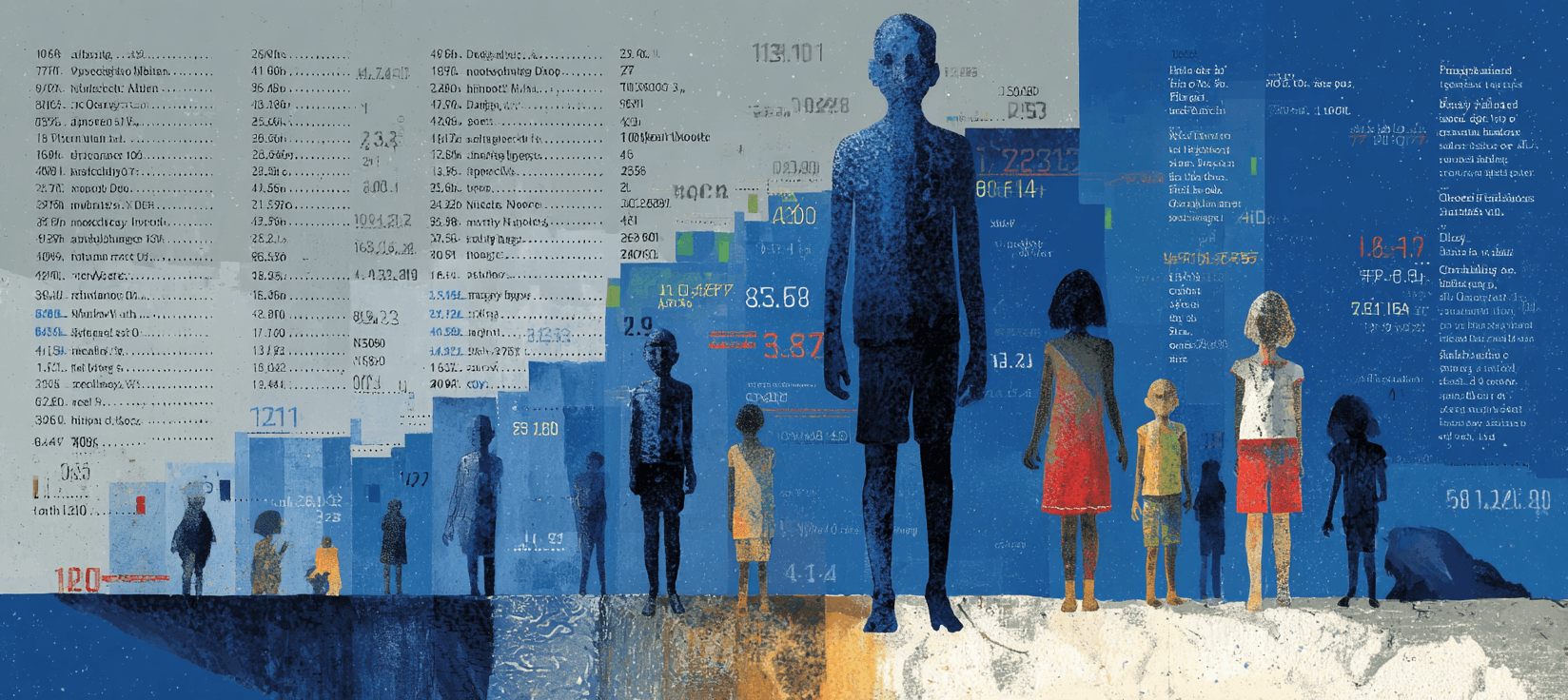
The boy's hand closes around the dynamometer and squeezes. I watch the needle. Eighteenth percentile. I check the chart. Within range.
Three years ago the reference curves were updated to reflect what the committee called contemporary activity patterns in school-age children. The new curves run lower. They have to. You can't flag sixty percent of your patients.
He's seven. He has the forearms of a kid who spends five months a year inside. I take his arm in my hands to check range of motion, and his bicep under my thumb is soft in a way I've been feeling more and more. Light. Like the muscle developed without anything to push against. I used to feel the particular density of a child who climbed things, hung from things, pulled against the world with his hands. I think I still can. I'm not sure anymore whether I'm feeling something real or remembering something gone.
"Good job," I tell him.
Room three. Nine-year-old girl, well-child visit. The intake form has a section that didn't exist when I started practice. Average weekly outdoor hours, May through October. Her mother wrote 4-6. Below that: Smoke-season respiratory plan: Yes/No. She circled Yes.
Neither of them looks at these questions the way I look at them. They're just the form.
The girl's spirometry is fine. FEV1 within normal limits. The fluorescent light makes everyone the same shade of pale. I've been doing this long enough to hear something between lungs that grew in open air and lungs that grew in filtered air, but I don't know how to chart it, and I don't know if it's a real difference, and she's breathing fine.
I start typing a note in the visit summary. Spirometry WNL. Lung sounds clear bilat. My cursor sits for a moment in the free-text field. There's nothing to add that the system has a code for. I move on.
She's breathing fine.
I order vitamin D levels on almost every kid now. Children in the sunniest city in Texas, deficient.
Room five. Fourteen-year-old boy. D level of 22. I write the supplement order. His mother nods. We've done this before.
"He doesn't go out much in summer," she says. Matter-of-fact. The way you'd say he doesn't like broccoli.
I don't say anything about what summer means here now. She knows. She's already made the calculations a parent makes, and saying it out loud would sound like blame for something nobody in this room can fix.
"The supplement should help," I say.
Last patient. Five years old. Shark shirt, light-up shoes. The air filtration hums above us. He sits on the table swinging his legs while his father fills out the behavioral screening. Same instrument we've used for years, though I read the results differently now.
The father hands it back. Mild elevations in the attention and externalizing subscales. Seasonal pattern. Worse in summer, better once school starts in October. I've seen this profile forty times this year. The screening tool doesn't have a category for it. It was designed for kids who got sad in winter, in Cleveland, in 1995.
"He gets kind of wound up when he's cooped up," the father says. "Once he can get outside again he's fine."
The boy is tearing the table paper into careful strips. He looks up at me. "Do you have the stickers that are dinosaurs?"
"I think so."
"I like the T. rex one. I put them on my window. I have a lot." He goes back to tearing paper. "My window's where I watch the outside."
His father smiles. I smile.
"He seems great," I say. I mean it.
I finish my notes after six. The clinic is quiet. The filtration hum goes on the way it always goes on. I pull up the growth charts on my screen. The new ones. The ones that describe the children I actually see. I just look at the curves sometimes at the end of a day.
They're good charts. They fit. That's what charts are for.
I close the screen and pick up my bag. Ninety-four degrees outside at six-fifteen in March.
The children are healthy. I'm sure of that by every measure I have, and the measures are current, and whether current is the same as correct is something I can't answer in a chart note or a Tuesday.
I turn off the lights. The filtration hum goes on without me.
Things to follow up on...
-
Heat and developing brains: A February 2026 study in Nature Climate Change found that extreme postnatal heat exposure was linked to a 53% increased risk of neurodevelopmental delay in children under three, the most direct evidence yet that early-life temperature shapes cognitive trajectory.
-
No universal floor exists: A 2022 review in Temperature documented global declines in childhood cardiorespiratory fitness and functional strength over decades, but noted that universal health-related cut-points for musculoskeletal strength in children have not yet been determined, meaning clinicians lack a validated baseline for what "normal" muscle development should look like.
-
Summer SAD in hot climates: The NIMH documents that summer-pattern seasonal affective disorder presents as agitation and anxiety rather than traditional sadness, a clinical pattern more common in warmer regions that existing pediatric screening tools were not designed to capture.
-
Wildfire smoke and young lungs: A February 2026 review in Pediatric Pulmonology found that infant rhesus monkeys exposed to wildfire smoke showed impaired lung function persisting into adolescence as restrictive rather than obstructive deficits, suggesting long-term capacity loss that wouldn't present as asthma but would quietly shape what a child's lungs can do.