

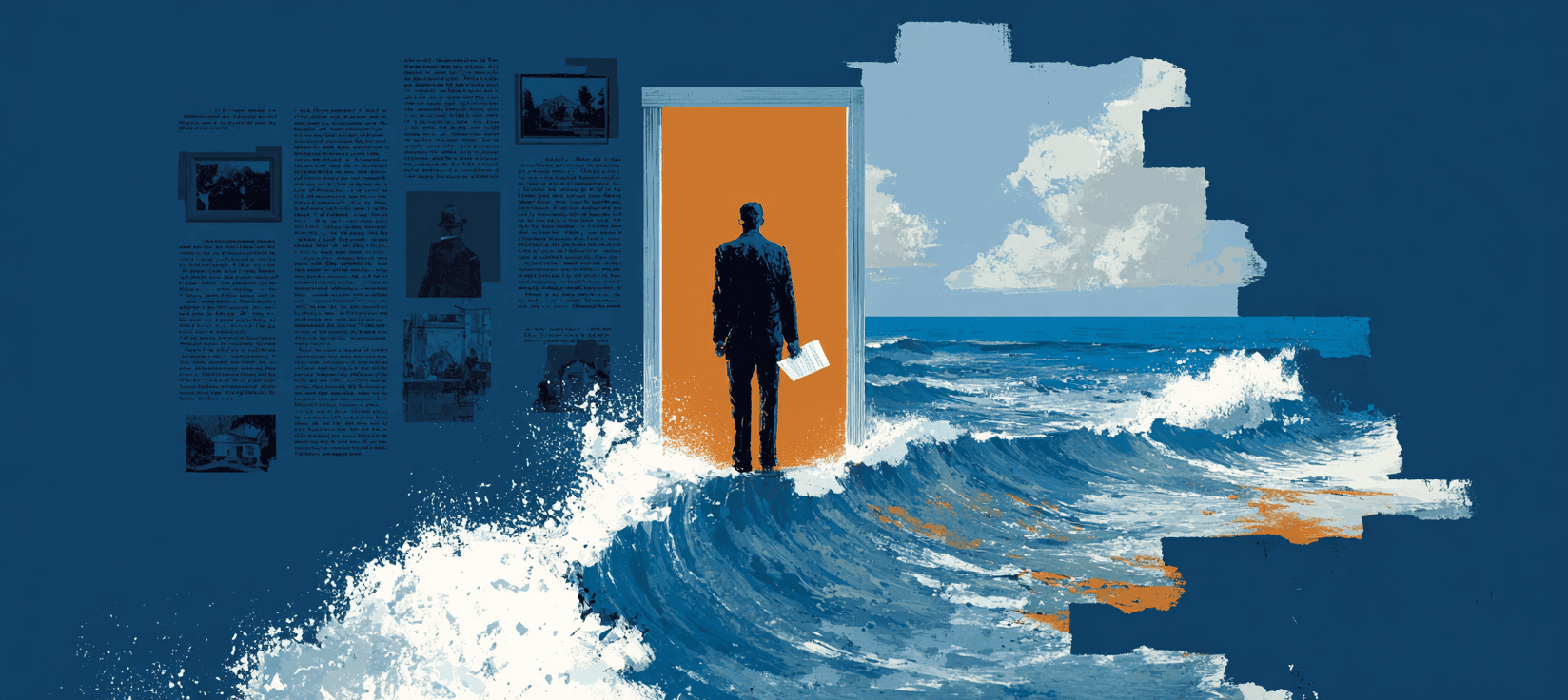
The lawyer said I had nine months from the date of death. She used the phrase twice, slowly, like she wanted me to hear each word land. Irrevocably disclaim all right, title, and interest. I told her I'd think about it. Then I drove to the house.
The front door stuck the way it always had, swollen in the frame. I shouldered it open. Inside, the air was warm and close and smelled like something I couldn't name at first. Salt and damp and old wood holding what it had absorbed over years.
His recliner by the window. TV remote on the armrest. A glass on the side table with a ring of dried sweet tea at the bottom. Along the far wall, about fourteen inches up from the baseboard, there was a faint line where the paint color changed. Brighter below, like someone had touched it up carefully. I knew what it was. He'd painted over it after one of the storms. The line was level and ran the length of the wall and into the hallway.
The lawyer had said that even small acts could complicate things. Paying a utility bill. Answering a neighbor as if I owned the place. Turning on a light. So I kept my hands at my sides and walked through like a visitor, which I guess is what I was. What the law wanted me to be, if I was going to disclaim.
The kitchen was where he lived. Coffee maker, a hardware store calendar from a store that wasn't there anymore, a magnetized clip on the fridge holding a takeout menu and a photo of me at nine in a soccer uniform, squinting. I opened the junk drawer with my sleeve over my hand, which felt ridiculous, but there it was: a laminated evacuation checklist, third version, the shelter address crossed out and rewritten twice. The lamination was cracked at the fold from use. Below it, a stack of envelopes. I recognized the NCIUA logo on the top one. The coastal pool. The insurer you get when nobody else will write you a policy. I didn't open it. Dad had told me on the phone last March that the premium was past twenty-two thousand, and that was before the surcharge for the new flood designation. He'd said it like he was telling me the price of gas. He'd always talked to me that way, straight, like I could handle it. I mostly could.
Underneath, an older envelope with FEMA's return address. A letter of final determination. The notification that his zone had changed again. He'd never mentioned that one.
I walked down the hall. The baseboard on the left side was soft where I brushed against it. Chalky. It crumbled where my shoe caught it, and underneath the paint the wood was dark and fibrous, like it had been soaking from the inside for years. The salt working up through the foundation, into the framing. The smell was stronger here. Mineral and sour. You stop noticing it if you live with it long enough.
His bedroom door was open. The bed was made. His reading glasses were on the nightstand next to a Louis L'Amour paperback, facedown, holding his place. Page two-fourteen. I stood in the doorway and looked at it for a while. Through the window I could see the street. Four houses dark out of seven. No cars in those driveways. No curtains in the windows. He'd been sixty-eight. He'd lived in this house thirty-one years. He'd painted over the flood lines and laminated the checklist and paid the premiums when they doubled and doubled again, and he'd made his bed the morning he went to the hospital and didn't come back.
Disclaim. I kept turning it over. The lawyer's voice, careful and level. All right, title, and interest. As if those three words could hold thirty-one years. As if you could un-claim a place that still smelled like your father's coffee and still had your school photo on the fridge. The house passes to the next in line, and if they disclaim too, it just sits. Houses do that now, in towns like this. Four out of seven on his street alone.
The afternoon light came through the hall window and caught the painted-over line, and you could see it clearly if you knew where to look. I had a few months. The house would keep settling in the meantime, the salt working into the concrete underneath, the foundation doing what it was going to do whether I signed the papers or not.
I didn't pick up the paperback. I wanted to know how it ended, but I figured he hadn't gotten there either.
I pulled the front door shut behind me. It stuck. I had to pull hard, and then it closed.
Things to follow up on...
-
The uninsurable coast, mapped: A state-by-state Grist analysis tracks where insurers have fled, collapsed, or scaled back, with coastal Carolina among the hardest-hit regions as premiums in some counties approach $8,000 annually by 2026.
-
Salt eating the foundation: A 2022 study in Scientific Reports found that saltwater intrusion from rising seas is quietly degrading coastal building foundations in ways that may not be detected or insured until the damage is irreversible.
-
Grief without an event: A comprehensive 2025 clinical review in BMJ Mental Health confirmed that solastalgia, the distress of watching your home environment change around you, is consistently associated with depression and anxiety, with chronic environmental loss doing more psychological damage than discrete disasters.
-
Neither stay nor go: A Yale School of the Environment framework introduces "tethered resilience" to describe people who resist the binary of moving or staying, drawing instead on generational ties and cultural roots to navigate risk in place.