

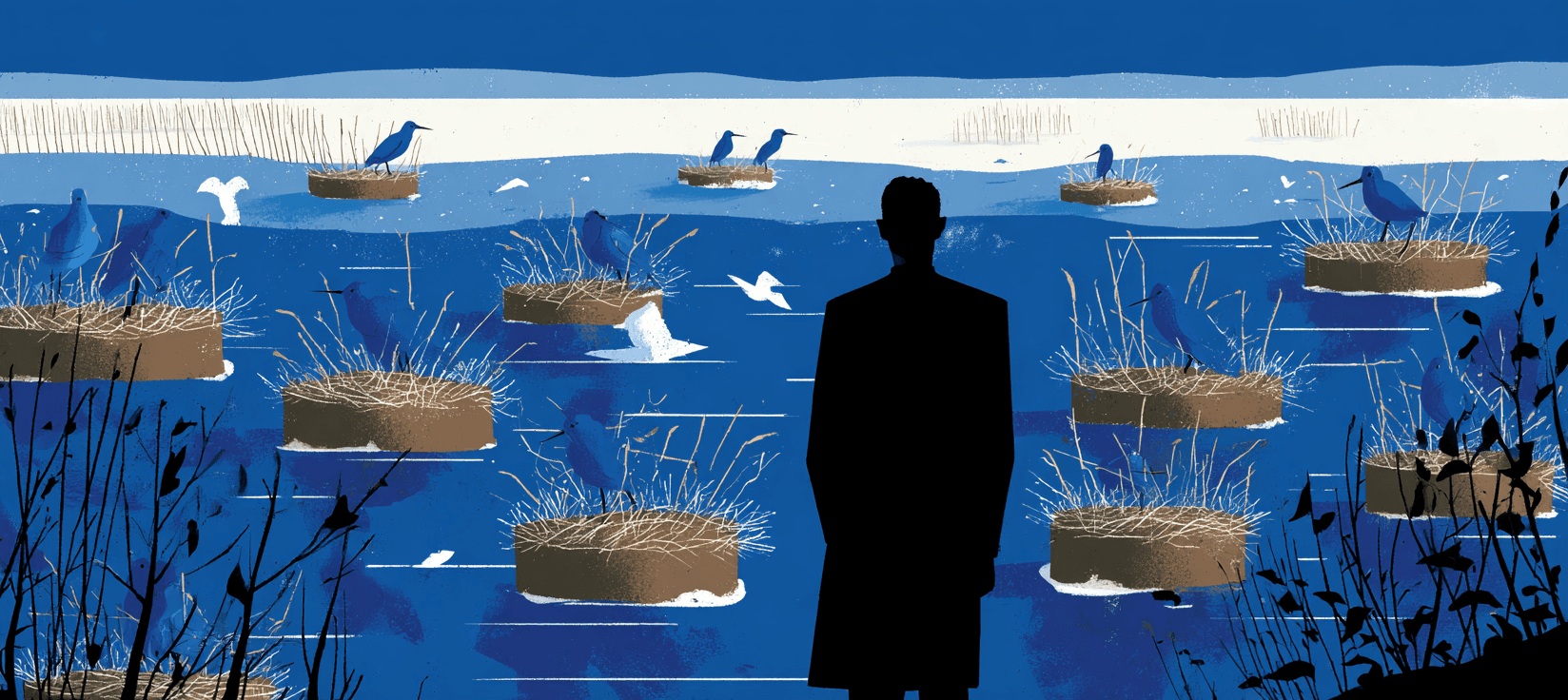
The birds showed up in April. I'd been sitting on the porch for three hours now, watching them work the cattails. Dark heads, white breasts, moving fast through the reeds. I didn't know what they were.
The back forty had been soybeans until two years ago when the water started pooling in the low spot. Last spring it stayed through June. This year it hadn't dried at all. Margaret died that winter. By the time the cattails came up thick in May, I was alone with it.
Coffee twice, both times cold before I finished.
The birds were building something. I couldn't see the nest itself, just the movement—one diving into the cattails, staying maybe thirty seconds, coming back out. Then the other one would go. They had a rhythm. I'd been watching long enough to see the pattern.
Margaret kept field guides on the mudroom shelf, notebooks going back forty years. I could look the birds up. I just hadn't.
The water was maybe a foot deep in the center, less at the edges. Still this morning, reflecting clouds. The cattails were head-high in places. One of the birds landed on a stalk and rode it down as it bent, then hopped to another. The stalk didn't break. When it got to wherever the nest was, it stayed inside longer than before. Maybe a minute. When it came back out, it had nothing in its beak.
I thought I'd want to know their names. Margaret would have known by now—cross-referenced the markings, written it in her notebook with the date. I hadn't looked them up. I kept watching.
The thing about living somewhere sixty years is you know what used to be there. The back forty was corn when we bought the place. Then soybeans. Then corn again. Margaret and I used to walk it evenings, checking the rows. Now it was water and cattails and birds I'd never seen before.
The water smelled different than I expected—not stagnant or swampy, but clean, almost sweet. And the cattails made a sound in the breeze I hadn't heard before, a kind of whisper that wasn't quite rustling. I'd stand at the edge sometimes just listening.
I watched one of them come out of the cattails with grass in its beak. It disappeared back in. The other one was singing somewhere—a quick, complicated song. The first one answered from inside the cattails. They were talking to each other while they worked.
My son stopped by last weekend. Walked the property, looking at the outbuildings, the fence line. Asked about my plans. I told him I was staying. He nodded, said okay, left it alone.
I hadn't mentioned the birds.
The coffee was cold again. I went inside and poured it out, made a fresh pot. Through the kitchen window I could see the back forty, the water catching morning light. The birds were still working.
Once I tried to describe it to my daughter on the phone. How the water held still in the mornings. How the cattails moved. How the birds had found it and were building something. The words came out wrong—made it sound like I was documenting loss. The birds knew what they were doing.
I took the fresh coffee back to the porch. The sun was higher now, warming the boards under my feet. Both birds were visible for a moment, working the same section of cattails from different angles. Building something that would hold.
Margaret would have wanted their names. She would have wanted the record complete. I had the porch, the coffee, the morning light. I kept watching.
The water was reflecting clouds. The birds kept working. One of them dove into the cattails and stayed longer this time. When it came back out, the other one went in immediately. They knew what they were doing.
I figured that was something.
Things to follow up on...
-
Birds nesting earlier: North American Tree Swallows are nesting up to 9 days earlier than 30 years ago, corresponding to increased spring temperatures.
-
Seasonal wetlands and wildlife: Wetlands that dry out periodically are important habitat for species that rely on areas where fish and other predators requiring permanent water cannot survive.
-
Why older adults stay: Nearly 90% of older adults want to remain in their homes as long as possible, with emotional attachment and financial security among the top reasons.
-
Range shifts in action: Since the 1960s, 61% of studied North American bird species have shifted their wintering grounds northward, with 48 species moving more than 200 miles.