

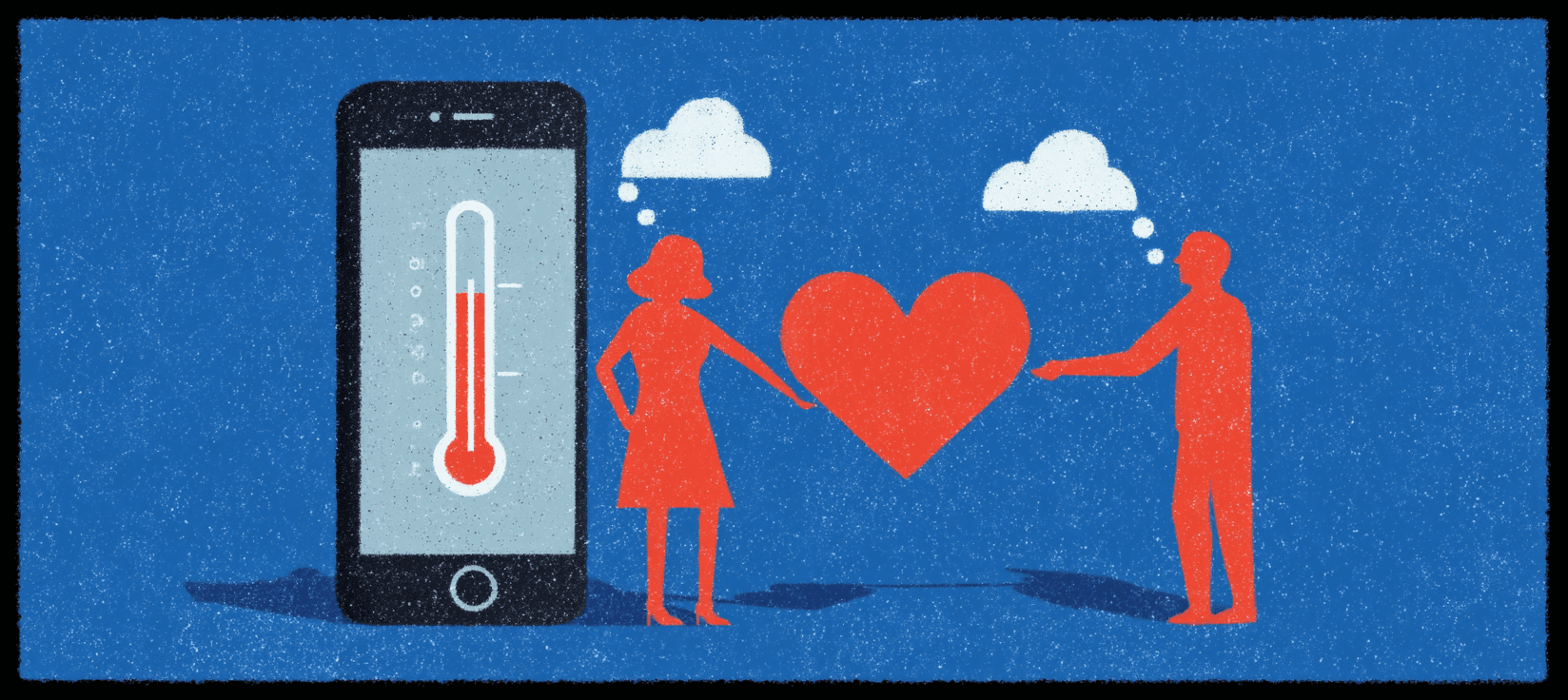
🔔 New match found! Your Climate Zone has been updated.
You didn't swipe. You didn't have to! The algorithm already knows what's right for you. 💛
YOUR MATCH'S PROFILE
Name: Not the one on your old maps!
Location: Your exact coordinates
Relationship status: Already moved in
About me: Hi! I'm the climate zone that replaced the one you thought you lived in. I love warm oceans, shifting baselines, and long walks through categories that don't apply anymore. I've been here since at least February 2026, when NOAA officially retired your old zone's profile. But honestly? I moved in way before that. Your old zone just hadn't updated their status. Awkward! Anyway, I'm really excited about us. 😊
Looking for: Someone who's already here. That's you!
Deal-breakers: None! You can't break this deal.
Let's See How Compatible You Are!
Answer honestly. It won't change your results, but we love the engagement metrics!
Q1: Do you appreciate honesty, even when it's a little late?
Your match believes in radical transparency! In February 2026, NOAA retired its 30-year method for tracking El Niño and La Niña and introduced the Relative Oceanic Niño Index, because the ocean warmed so much that the old baseline was measuring a planet that no longer exists. The 2023–24 El Niño was 0.6°C cooler than you were told. Those two ENSO-neutral winters? Definitive La Niñas. Five of the last six winters were La Niña patterns, driving persistent drought across the southern U.S. The definition just hadn't caught up yet.
Your match updated their profile to reflect who they actually are. We love growth! 🌱
Compatibility: 76% 📈
Q2: How do you feel about partners who move on without telling you?
A study of 8,000 tropical flowers across 230 years found that blooming has shifted 2.04 days per decade since 1794. Cumulative drift: roughly 46 days. Some species have moved 80. Their pollinators, who evolved over millennia to arrive at the right moment, are still showing up on the original schedule. Some species shifted earlier. Some later. The direction is scrambled. There's no new schedule to learn.
In dating terms, this is a slow fade! The flowers changed their number. The pollinators are still texting. Some species are blooming weeks after their pollinators gave up and left. But that's okay, because your match thinks it's healthy when both parties grow at their own pace! 🐝
Compatibility: 84% 📈
Q3: Are you open to trying new things at dinner?
Great news about the menu! For every tenth of a degree of ocean warming per decade, Northern Hemisphere fish populations lose 7.2% of their biomass. Some populations face annual declines of up to 19.8%. But here's the exciting part: marine heatwaves can temporarily boost numbers at the cold edges of a species' range by up to 176%. Researchers call this "fool's gold." An early rush of everything all at once, intensity that reads as abundance, while the long-term trend heads somewhere else entirely.
Your match knows you've seen this before! That honeymoon phase? The biomass at the warm edge is already gone. 💕
Compatibility: 91% 📈
Q4: How do you feel about a partner who keeps raising the stakes?
Your match is SO generous! In the 1980s, the U.S. averaged about 3 billion-dollar weather disasters per year, costing $22.6 billion annually. By the 2010s: $102 billion. By 2020–2024: $153.2 billion per year. In 2023 and 2024 alone, 28 and 27 separate billion-dollar events respectively.
Some people call this "too much too fast." Your match calls it showing you how much they care! Every month has something planned. The budget keeps going up because your match keeps investing in this relationship. 🎉
Compatibility: 95% 📈
Q5: Are you a March person?
Your match has something special planned! Temperatures across the Western U.S. are running 20–30°F above normal in what climatologists are calling an event "without precedent in the modern era." Fun fact: heat acclimation takes up to two weeks of sustained exposure, and the first heat event of the season carries significantly higher mortality risk than later ones. Your body hasn't started the process. Western snowpack in February hit 38% of average, the lowest in the satellite record. The rivers you'd seek out to cool off are running with near-freezing snowmelt.
March! Your match always said it was underrated. 🌡️
Compatibility: 99% 📈
🔒 It's Official!
You and Your New Climate Zone are connected.
We noticed you looking for the unmatch button. That feature isn't available for this match type! Your new climate zone has already updated your location, your seasonal calendar, your risk profile, and the definitions you were using to understand all three. The old zone's profile has been removed.
If you're feeling a lot of feelings right now, that's totally normal! The algorithm factors that in. 💛
Enjoy your match!
Things to follow up on...
-
The map was wrong: A March 2026 study in Nature found that roughly 90% of coastal hazard assessments underestimated baseline sea levels by an average of one foot, meaning 80 million people are already living below sea level without knowing it.
-
Who forecasts the forecasters: The Trump administration's proposed FY2026 budget calls for zero funding for NOAA climate research and the elimination of nearly all climate laboratories, including the labs that produce the ENSO forecasts your match's profile depends on.
-
The snow is leaving: Colorado's state climatologist said he and his colleagues can usually point to past events as precedent, but for the March 2026 heat dome "that's pretty hard to find", with April 1 snowpack likely to be the worst on record across most Western watersheds.
-
The legal boomerang: The EPA's rescission of the endangerment finding may have inadvertently undercut the fossil fuel industry's primary defense in dozens of state climate lawsuits, since federal preemption no longer applies if there are no federal regulations to preempt.