

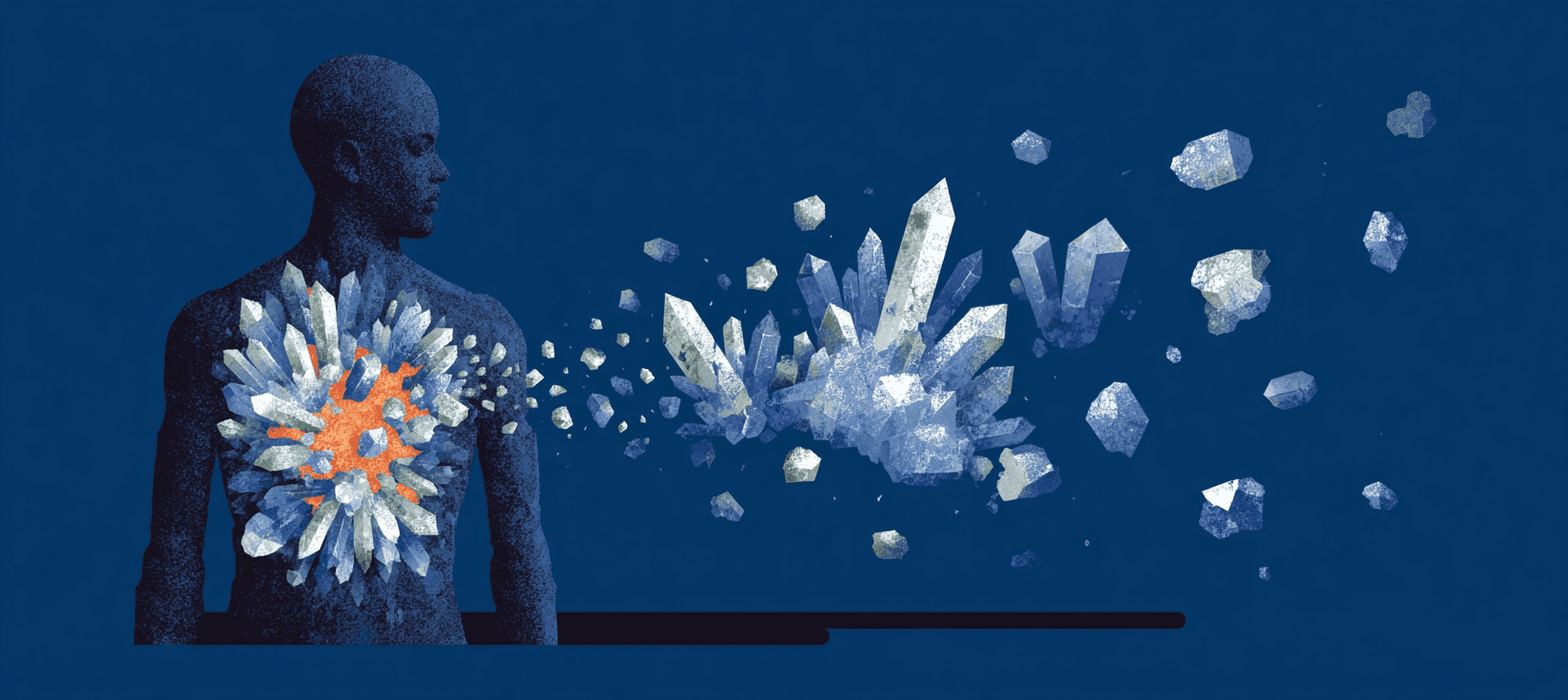
Your sweat crystallizes at 47 degrees Celsius. You learned this on a Tuesday in July, watching the salt formations bloom across your forearm like frost. Beautiful, actually. The modification conserving water, cooling efficiently, leaving mineral deposits that flake away when you brush them off.
You don't remember what it felt like before. When sweat was just wet.
The intake form asked: Do you consent to permanent physiological modification?
The clinic smelled like antiseptic and formaldehyde—that specific sweetness of preserved tissue. The technician explained about the thermogenic bacteria, the modified sweat glands, the enhanced capillary networks. You signed. Everyone was signing. The waiting list was eight months long.
Your body temperature runs constant now, a fever that never breaks. The parking lot asphalt feels neutral against your palms. Comfortable, even.
You meet someone at the grocery store—one of the unmodified.
They're moving through the produce section like they're underwater, each gesture deliberate and slow. Skin flushed, damp at the temples. They reach for a bag of apples and their hand trembles slightly, the fine motor control degraded by heat. Shopping at 5 AM when it's coolest. When their body can still function.
You're here at noon because it doesn't matter anymore.
Reaching past them for lettuce, your arm brushes theirs—your skin dry and neutral, theirs slick with moisture. They flinch. Not from contact but from the difference. The faint geometric patterns where your capillaries have reorganized themselves show through translucent skin. The crystalline residue along your hairline catches the fluorescent light.
They pull their cart away. Not quickly. Their body can't move quickly anymore. But deliberately. Putting distance between their flesh and yours.
They shuffle toward the freezer section, seeking the cold air that pours from the open cases. Stand there longer than necessary, letting it wash over them. Their shoulders drop. Their breathing slows. For a moment their body remembers what relief feels like.
You haven't stood in front of a freezer in eight months. Your body doesn't seek cold anymore. Doesn't need it.
Your niece visits in the evening. She's seven. She touches your arm tentatively, then pulls back.
"You're hot," she says. A radiator. A sun-warmed stone.
She asks why your eyes are like that. In the mirror: the tapetum lucidum the modification added, reflecting light back through your retinas. Your eyes shine in the dark now. Gold-green, like a cat's.
She reaches up to touch your face. Her small palm against your cheek. Processing the temperature, the texture. Her hand stays there for three seconds. Four. Then she pulls away and wipes her palm on her shorts, a reflexive gesture she doesn't seem conscious of.
"Does it hurt?" she asks.
You tell her no. You don't tell her that hurt isn't the right word for what happened.
The modification works through horizontal gene transfer. Bacterial DNA integrating with human cells, rewriting your thermal regulation from the inside out. The consent form said "minimal risk of rejection."
Your fingernails grow faster now. Thicker. The keratin composition changed to handle higher temperatures. You file them down every three days. They grow back harder each time. Last week you broke a nail file. The metal kind.
There's probably a point where you'll need different tools. Where "fingernail" won't be the right word anymore.
The unmodified are dying—steadily, summer by summer, as the wet-bulb temperature exceeds what human bodies were designed to survive.
The modification program expands. Voluntary becomes encouraged becomes mandatory for anyone who wants to work outdoors, attend school, qualify for housing.
You got in early. Before the side effects were fully documented. Before they understood that the bacteria don't stop modifying you just because the initial adaptation is complete.
They keep optimizing.
At night, you don't sleep the same way. Circadian rhythm shifted—less sleep needed, different hours. You're awake from midnight to four AM, your most alert period.
This wasn't a choice your body consulted you about.
You lie in bed during the old sleeping hours, feeling your heart beat slow and efficient. Lungs processing air with modified alveoli that extract oxygen at higher temperatures. Sweat glands producing their crystalline formations. Capillaries reorganizing themselves in patterns you can see when you hold your arm up to the light.
The bacteria keep improving you, keep pushing your baseline higher, keep making you more suited for heat that hasn't arrived yet.
Your niece asks if you're still you.
You tell her yes. But you're not sure anymore. Sweat crystallizes. Eyes shine. Temperature rises. Decisions made by processes you don't consciously control.
You are adapting, successfully, into something that survives.
Soon your sweat will crystallize at forty-eight degrees. Then forty-nine. Learning to be something else while you're still inside it, enthusiastically becoming what you can't yet recognize.
Standing in heat that kills the unmodified and feeling comfortable. Working through the hottest part of the day. Optimized for the world that's coming.
Your niece's hand on your cheek. Her palm pulling away. The person in the grocery store putting distance between their flesh and yours.
The modification working. Making you more suited for a future that's still getting hotter.
Things to follow up on...
-
Wearable biosensors today: Current wearable biosensors can continuously monitor physiological markers through sweat, saliva, and tears, providing real-time health data through flexible designs that adapt to skin movement.
-
Lagos faces extreme flooding: With sea levels rising 3.7 mm annually and the city sinking at up to 87 mm per year, Lagos experiences flooding that affects approximately 90,000 residents annually, making adaptation infrastructure critical.
-
Wet-bulb temperature limits survival: When humidity combines with extreme heat, wet-bulb temperatures can exceed what unmodified human bodies can survive, making physiological adaptation increasingly necessary.
-
Horizontal gene transfer in bacteria: The mechanism enabling rapid adaptation, horizontal gene transfer allows bacterial DNA to integrate across species, potentially rewriting human thermal regulation systems.