The Flashlight in the Flood
On the night of September 10, 1965, the President of the United States held a flashlight to his own face in a flooded shelter and told people he was there to help. Within seven weeks Congress authorized a wall around New Orleans. The wall was never finished to spec, and still it told a quarter million people it was safe to build in a swamp. What followed took sixty-one years to unfold, involves a river denied permission to do its job, and an ancient beach ridge waiting patiently underground.
The Flashlight in the Flood
On the night of September 10, 1965, the President of the United States held a flashlight to his own face in a flooded shelter and told people he was there to help. Within seven weeks Congress authorized a wall around New Orleans. The wall was never finished to spec, and still it told a quarter million people it was safe to build in a swamp. What followed took sixty-one years to unfold, involves a river denied permission to do its job, and an ancient beach ridge waiting patiently underground.
The 2073 Horizon

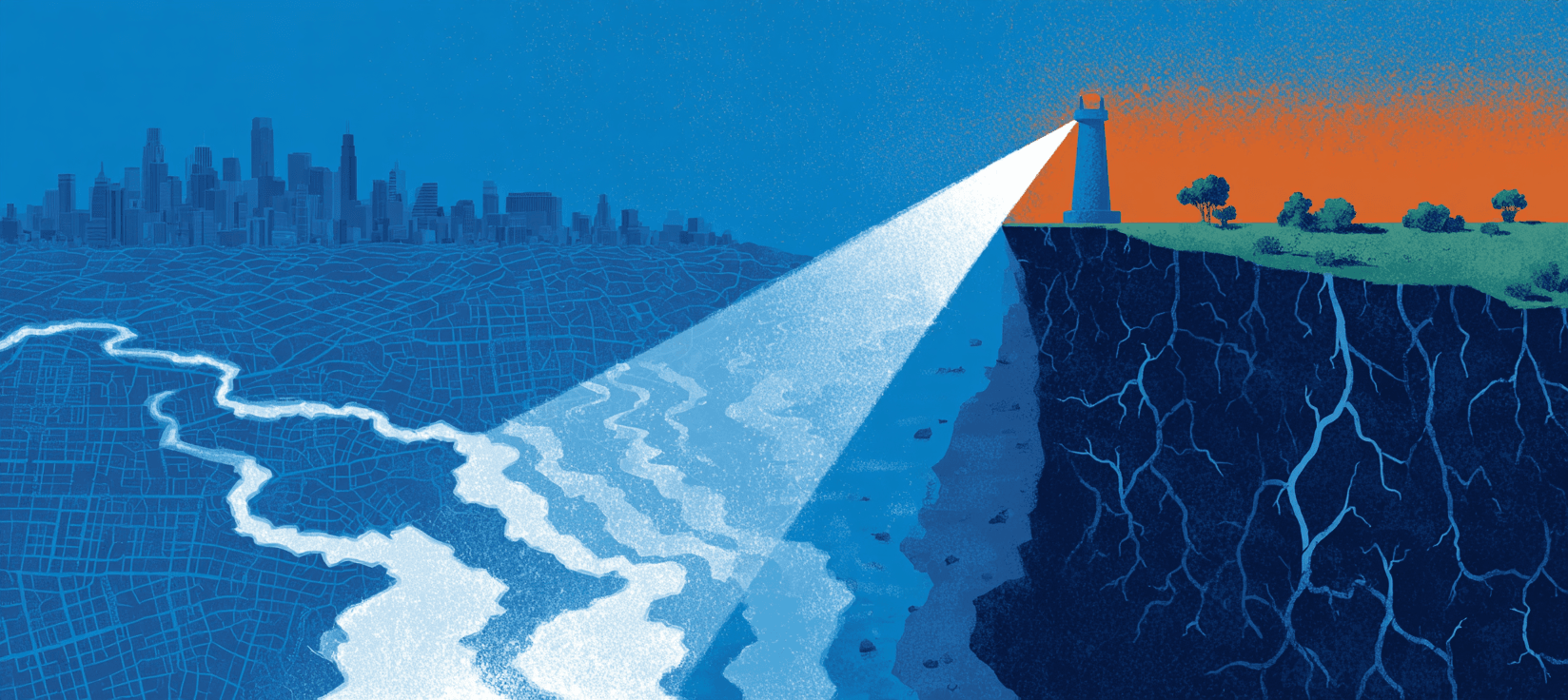
In engineering, "design life" is the period over which a system's built-in assumptions about the world are expected to hold. The Army Corps completed the Hurricane and Storm Damage Risk Reduction System in 2018 with a 50-year design life, meaning its 350 miles of levees and floodwalls were sized against projected subsidence rates, sea level rise, storm intensity, and coastal wetland extent through roughly 2073.
Those projections assumed a cushion of up to three feet of freeboard. By 2019, the Corps acknowledged that cushion was shrinking fast enough to threaten the system's 100-year protection standard "as early as 2023" without periodic levee lifts. The agency budgets $3.5 to $4.2 billion for those lifts through 2073. Beyond that year, no engineering plan exists. The Corps says "additional evaluations will be needed."
So 2073 is not when the levees fail. It is the last year anyone has committed to doing the math. The distinction is real, and less reassuring than it sounds.

What Grew, What Moved

What the Swamp Became
East of New Orleans' Industrial Canal, Black families shut out of homeownership everywhere else in the city built 22,000 homes on drained cypress swamp. Federal levees made the promise; developers and lenders read it as permission. By 2005, 95,000 people had staked their lives on that ground. Both communities in this pair trusted an engineered answer to flooding. Neither could plan for what came after.

The City That Jacked Itself Into the Sky
After the 1900 hurricane killed thousands, Galveston jacked 2,000 buildings into the sky and pumped sixteen million cubic yards of sand beneath them, raising the entire city above storm surge. Congregations worshipped in churches suspended on seven hundred screws. The engineering worked. Both communities in this pair trusted an engineered answer to flooding. Neither could plan for what came after.
The Week's Context