

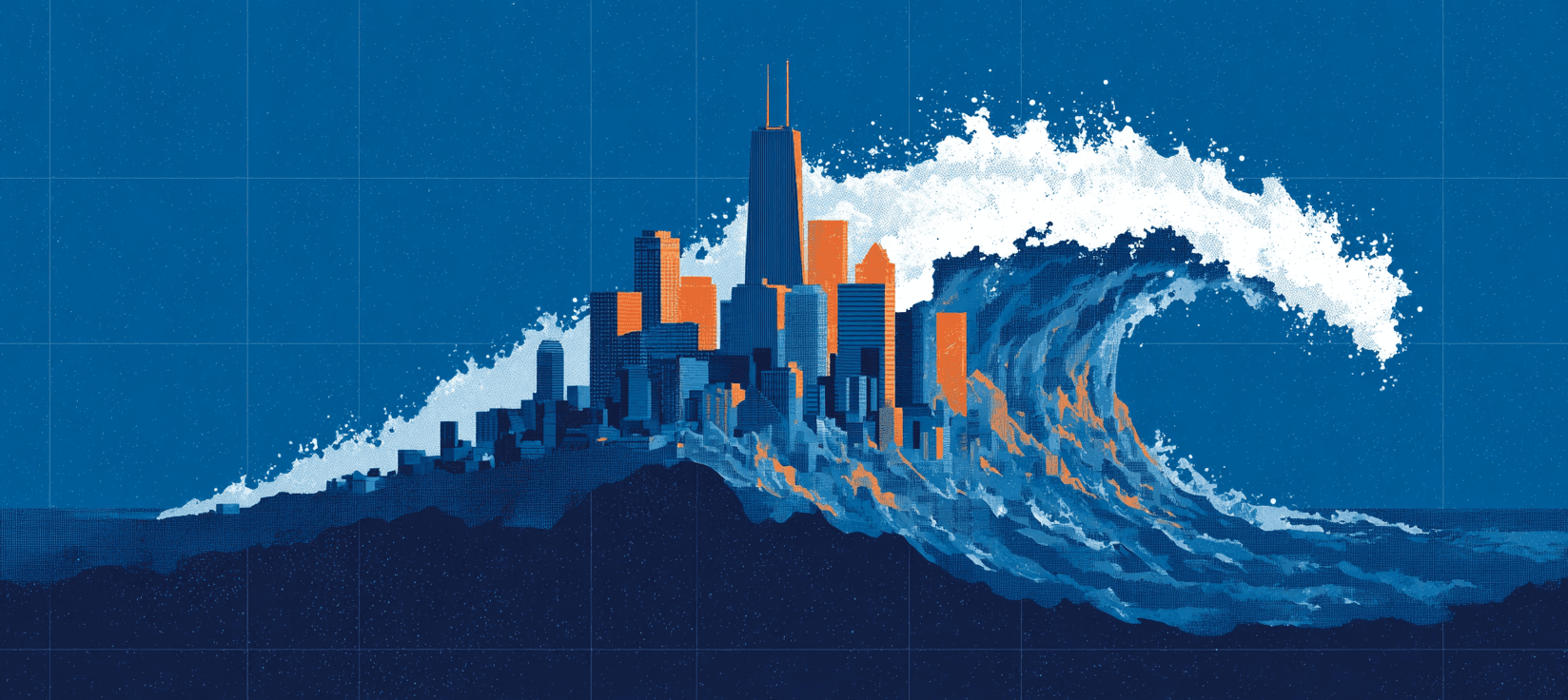
Every ship I ever worked had a rated service life. The hull, the engines, the navigation gear, all of it designed to operate within a specified envelope of conditions for a specified number of years. You could maintain it, patch it, extend it some. But the assumptions baked into the steel at the shipyard didn't change just because the ocean did.
In March 2026, Grant Foster and Stefan Rahmstorf published a finding in Geophysical Research Letters that ought to keep certain people up at night. After stripping out the estimated noise of El Niño cycles, volcanic eruptions, and solar variation, they found that global warming has accelerated since roughly 2015. The adjusted rate: approximately 0.35°C per decade, with over 98% confidence. The rate embedded in most current U.S. adaptation planning, derived from the 1970-to-2015 trend: just under 0.2°C per decade.
The observed warming rate is now nearly double the rate embedded in U.S. adaptation infrastructure. The systems are already under construction.
Near-double. And the concrete is already setting.
What's locked in
Take the Coastal Texas Project, the Ike Dike. Thirty-four billion dollars authorized, the largest coastal infrastructure project the Army Corps has ever attempted. Fifty-year design life. Its feasibility study, completed in 2021, used the "Intermediate" sea level rise scenario from NOAA's 2017 framework: 0.5 meters of global rise by 2100. Then in 2022, NOAA updated its projections. The new Intermediate: 1.0 meter. What had been called "Intermediate" got reclassified as "Intermediate Low." The reference scenario for a $34 billion project was demoted before design work actually began in late 2025.
Now Foster and Rahmstorf suggest the warming rate feeding those sea level projections has itself nearly doubled. Since NOAA scenarios track IPCC warming trajectories, a sustained 0.35°C rate pushes toward the higher scenarios: 1.5 to 2.0 meters by century's end. Along the Gulf Coast, where land subsidence adds 5 millimeters or more per year on top of ocean rise, the design margin shrinks from both directions at once. The Corps does evaluate multiple scenarios and explicitly acknowledges residual risk. But the benefit-cost ratio justifying $34 billion in public money rests on the Intermediate. And the Intermediate just moved.
Phoenix's 2025 Heat Response Plan is a different kind of design life. The plan itself refreshes annually: cooling centers, outreach triggers, tiered response protocols. But the infrastructure beneath the plan does not. Roads, power grid, water system, cooling centers have service lives measured in decades, built to temperature assumptions that predate the acceleration. Days above 110°F are projected to double by 2060 under the old rate. Under the new one, that threshold arrives sooner, and the infrastructure absorbs the difference.
Insurance has the shortest design life of all: annual renewal. And it looks backward. Catastrophe models, the pricing engines behind every coastal property policy, estimate future risk from historical losses. Vendors now offer forward-looking models where users can select a warming scenario, but the selection is a business decision, and the default remains the historical catalog. A rate shift doesn't enter the model until it shows up as a claim. Florida's Citizens Property Insurance Corporation charges rates more than 40% below private insurers for comparable risk. The warming rate embedded in those prices is whatever happened last.
The honest uncertainty
Here I have to be honest about what we don't know, because what we don't know matters as much as what we do.
In October 2024, Céline Beaulieu and colleagues published a study using changepoint models to test for acceleration. They found a clear trend break around 1970 but could not reliably detect anything more recent. Foster and Rahmstorf counter that Beaulieu's method is statistically underpowered for this purpose. Climate scientist Zeke Hausfather noted the method would need an 85% increase in the warming trend to register as detectable, far above the expected signal. But Hausfather also named the ghost: a "lingering spectre of the hiatus," the years when climate science arguably over-indexed on short-term variability to declare a slowdown between 1998 and 2012. The fear of making the same mistake in reverse is legitimate. What Hausfather finds more persuasive than the surface temperature record alone is that multiple independent lines of evidence, from ocean heat content to Earth's energy imbalance, also point toward acceleration.
Then there's the question Foster and Rahmstorf deliberately left unaddressed: why. The leading candidate is reduced aerosol masking. In 2020, shipping fuel regulations cut sulfur emissions by roughly 80%. Sulfur aerosols cool the climate by brightening clouds. Remove them and you remove a mask. Published estimates of the resulting radiative forcing range from 0.073 W/m² to 0.2 W/m², a spread that matters enormously. A temporary unmasking pulse would look different from a sustained shift. Broader declining aerosol cooling increased anthropogenic forcing by roughly 50% between 2000 and 2019.
All of which makes the planning problem worse. The chain from peer-reviewed paper to revised engineering specification runs through federal guidance updates, state adoption, local permitting revision, construction bidding. Each link takes years. The NOAA scenarios updated in 2022; three years later, the Ike Dike entered design referencing a feasibility study built on the prior framework. The Foster and Rahmstorf paper landed in March 2026. Insurance policies renew annually on last year's losses. At the current pace, the authors wrote, Earth will exceed 1.5°C of warming before 2030. The Ike Dike's fifty-year operational life extends to the 2070s.
"Ultimately depends on how rapidly we reduce global CO₂ emissions from fossil fuels to zero." — Stefan Rahmstorf, on whether the acceleration continues
That's the honest scientific answer. The honest planning answer is uglier: the systems Americans live inside were designed for a rate that may no longer exist. The argument about whether 0.35°C per decade will persist is real, and serious people are on both sides of it. The certainty that plans already locked in were built for 0.2 is absolute. The design life of those plans has already begun. The operating environment they assumed has not waited for the argument to settle.
Things to follow up on...
-
Sea levels higher than modeled: Two largely independent studies found that actual sea levels worldwide are 9.4 to 10.6 inches higher than predicted by geoid-based models, a discrepancy that exceeds total global sea level rise since 1900 and compounds the rate-shift problem for every coastal project already in design.
-
The land carbon sink weakened: A marked drop in the global land carbon sink in 2023, flagged in the 10 New Insights in Climate Science 2025/2026 report, raises the possibility that Northern Hemisphere ecosystems stressed by wildfire and permafrost thaw are absorbing less CO₂ than the models feeding adaptation plans assume.
-
Plants fix less nitrogen than assumed: A January 2026 PNAS study found that natural nitrogen fixation has been overestimated by roughly 50% in major climate models, reducing the projected CO₂ fertilization effect by about 11% and further narrowing the margin between emissions trajectories and the scenarios infrastructure was designed around.
-
Hazardous coastal sites at flood risk: A Nature Communications study identified 5,500 U.S. facilities handling hazardous substances at risk of a 1-in-100-year flood by 2100 under continued high emissions, with Louisiana, Florida, and Texas accounting for a disproportionate share of the exposure.