

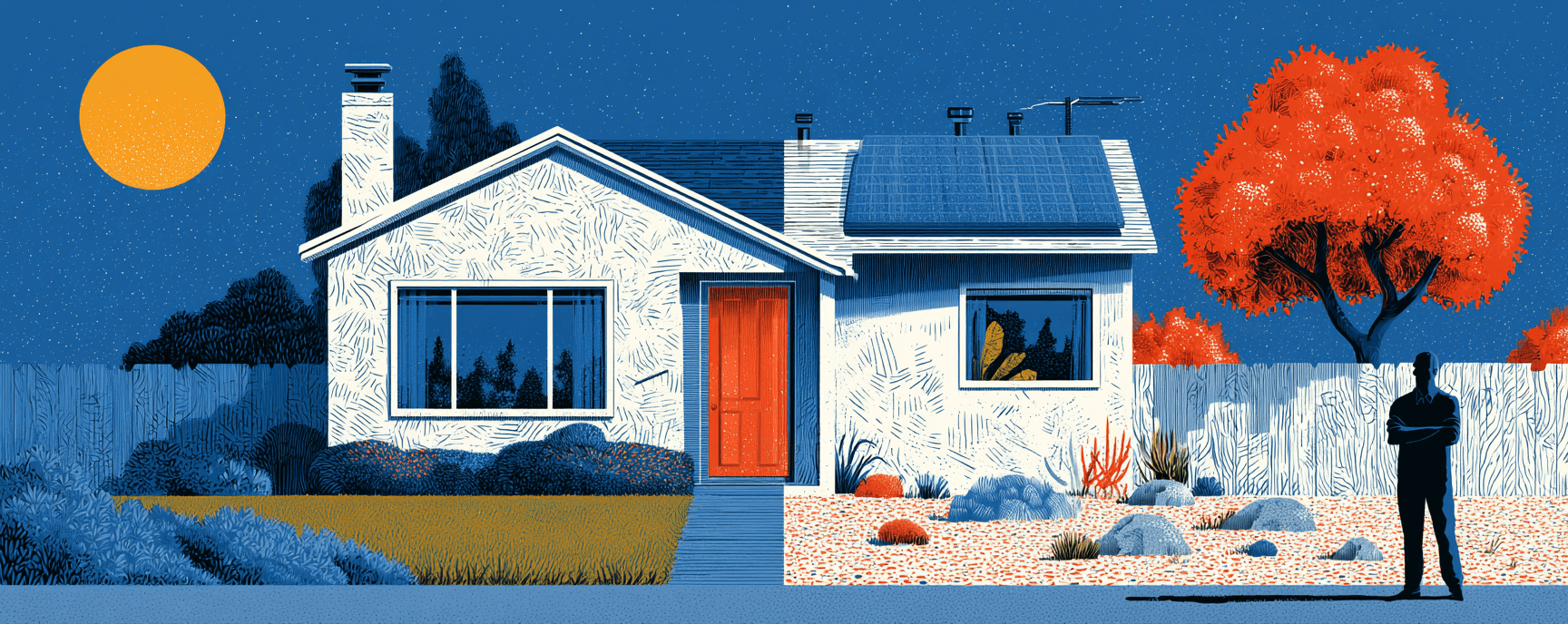
In 2021, a Broomfield, Colorado homeowner named Kelly Armstrong looked at her dying grass and did what her local water district had been encouraging residents to do: she stopped watering it. She replaced the lawn with artificial turf. Her HOA told her to remove it because the community's rules prohibited artificial turf, according to Denver7, which reported Armstrong's situation as part of the policy background for a state law signed two years later.
For those two years, Armstrong was in violation of rules the legislature would eventually override. She was a homeowner trying to cut her water bill in a state where public agencies were running rebate programs to get people to do exactly what her HOA was punishing her for.
That collision sits at the center of a legal and practical conflict spreading across the Sun Belt and beyond. At least six states have now passed laws limiting HOA authority over some category of climate-adaptive home modification. The protections are real. They are also uneven, varying by state, by modification type, and by how much room the statute leaves for an HOA to say yes in principle while making the approval process slow, costly, or conditional enough to function as a soft no.
For a homeowner trying to figure out what they can actually do to their own property, the answer turns on what that law says about one word: reasonable.
What the statutes protect, modification by modification
The broadest protections cluster around solar panels and drought-tolerant landscaping. Rainwater collection and energy-efficient roofing have thinner coverage. Cool or reflective roofing has almost none.
Solar panels. Florida, California, Texas, Arizona, and Colorado all bar HOAs from outright prohibiting solar-energy devices. Every one of these statutes also allows what the legislatures call reasonable restrictions on placement, appearance, or approval process. Florida lets an HOA determine roof placement as long as the panels face roughly south and the restriction doesn't impair effective operation. California allows reasonable restrictions that don't increase system cost by more than $1,000 or decrease efficiency by more than 10 percent, and requires written approval or denial within 45 days. Texas permits limits on color, location, and prior approval. Arizona allows placement rules that don't prevent installation or impair function. In 2025, Texas expanded its definition to include solar roof tiles, catching up to technology that had moved past the bulky panel designs older statutes imagined.
Drought-tolerant landscaping. This is where the most legislative activity has happened recently, and where the contradiction between public water policy and private covenants is sharpest. California voids HOA rules that prohibit low-water plants or artificial turf, and bars fines for reduced watering during declared drought emergencies. Florida bars HOA documents from prohibiting "Florida-friendly landscaping", a defined term covering drought tolerance, efficient watering, and stormwater reduction. Texas bars HOAs from prohibiting drought-resistant landscaping or water-conserving natural turf, and in 2025 added protection for homeowners whose lawns go brown during mandated watering restrictions, extending the shield for 60 days after the restriction lifts. Colorado's SB23-178, the law Armstrong's situation helped produce, requires HOAs in single-family communities to allow water-wise designs and to offer at least three preapproved garden templates. Arizona bars associations from banning artificial turf where natural grass is allowed, while preserving reasonable rules on appearance, quality, and maintenance. Maryland, less discussed in this space, protects "low-impact landscaping" including rain gardens, pollinator gardens, and xeriscaping, so long as design and aesthetic guidelines remain reasonable.
The word keeps showing up across these statutes. Reasonable restrictions. Reasonable design guidelines. Not unreasonably withheld. The legislatures have drawn a line against outright prohibition, but the territory between prohibition and approval is governed by a standard that only gets defined after someone fights about it.
Rainwater collection. Texas and Colorado both protect rain barrels by statute, but Texas still allows HOAs to regulate their color, size, materials, and certain locations. Colorado's broader renewable-energy and xeriscape protections encompass rain barrels without creating a standalone right. Maryland's low-impact landscaping statute covers rain gardens. Beyond these states, rainwater collection sits in a gap. No named HOA enforcement case involving a rain barrel turned up in verified public records for this piece, which may say less about the absence of conflict than about the absence of litigation.
Cool and reflective roofing. This is the thinnest category. Texas protects energy-efficient roofing shingles if they resemble approved subdivision shingles and match surrounding aesthetics. Colorado's renewable-energy and energy-efficiency protections are broad enough to potentially cover some roofing choices, but the statute doesn't create a simple cool-roof right. No other state reviewed here has a comparable provision, and no named cool-roof HOA dispute turned up in verified records.
Cool roofing reduces indoor temperatures, cuts cooling costs, and lowers peak energy demand. But unlike solar panels or xeriscaping, it hasn't generated the same political momentum. Part of the reason may be visibility: a reflective roof doesn't look like a statement. It doesn't trigger the same neighbor complaints as panels on a slope or gravel where grass used to be. And the consumer market for cool roofing hasn't produced the same organized advocacy that solar installers and water districts have built around their respective modifications. So the modification most likely to pass an architectural review without a fight is also the one least likely to have statutory protection if it doesn't.
State-by-state summary
| State | Solar | Drought-Tolerant Landscaping | Rainwater | Cool Roofing |
|---|---|---|---|---|
| Florida | Protected; placement rules allowed | Protected ("Florida-friendly" defined term) | No specific statute | No specific statute |
| California | Protected; 45-day approval window, cost/efficiency caps | Protected; no fines during drought emergencies | No specific statute | No specific statute |
| Texas | Protected; expanded 2025 to solar tiles | Protected; 60-day brown-lawn shield after watering restrictions | Protected with HOA conditions on color, size, location | Partial: must resemble approved shingles |
| Arizona | Protected; placement rules can't impair function | Artificial turf protected where grass is allowed | No specific statute | No specific statute |
| Colorado | Protected | Protected; preapproved garden templates required | Covered under broader statutes | Potentially covered |
| Maryland | No specific statute | Protected ("low-impact landscaping") | Covered (rain gardens) | No specific statute |
How "reasonable" gets defined in court
The statutes override outright prohibition. They leave enormous room for HOAs to shape, delay, or condition approval. Two court cases show how differently that room gets used.
In Garden Lakes v. Madigan, an Avondale, Arizona HOA sued homeowners who installed rooftop solar pool-heating equipment without architectural approval. The HOA sought removal, penalties, and attorney fees. It had waived roughly $100,000 in estimated fines before trial. The Arizona Court of Appeals sided with the homeowners, finding that the HOA's guidelines and conduct "effectively prohibited" solar devices even though no single rule said "no solar." The court rejected the HOA's argument that "effectively prohibit" should mean only "inevitably preclude." Cost, efficiency loss, feasible alternatives, property characteristics, and the HOA's own behavior all mattered.
In Tesoro del Valle v. Griffin, a California HOA sued homeowners who installed solar panels on a slope outside their perimeter wall after the HOA denied that portion of their application. The jury found the HOA did not violate California's solar statute, and the appeals court affirmed. Solar was allowed. The dispute centered on where, how, and through what process. Drainage, slope maintenance, neighbor complaints, and the HOA's architectural review all factored in. Twenty-two panels came down.
Both cases involved solar installations and protective state statutes. The outcomes went in opposite directions. In Avondale, the court looked at the cumulative effect of the HOA's restrictions and saw a de facto ban. In Tesoro del Valle, the court looked at the specifics of siting and process and saw a legitimate exercise of community governance. The outcomes turned on what each HOA actually did with the discretion the law gave it.
What the property-value evidence actually shows
HOA boards raise property values first, and the evidence is more complicated than either side usually acknowledges.
For solar, the data is relatively strong. A 2015 Berkeley Lab study analyzing nearly 23,000 home sales across eight states found that buyers consistently paid premiums for homes with photovoltaic systems, averaging about $4 per watt, or roughly $15,000 for a typical residential installation.
Fannie Mae's lending guidance says leased solar panels or power-purchase-agreement systems cannot be included in appraised property value. Leases and PPAs are how many homeowners without upfront capital get solar installed, meaning the strongest property-value case for solar applies primarily to owned systems.
That distinction matters for the HOA property-value argument in both directions: the board that blocks solar to protect values may be wrong about owned systems, and the homeowner who argues solar adds value may be wrong about leased ones.
For xeriscaping, the evidence is thinner and more local. A 2004 UNLV study of Las Vegas-area homes found a "potentially positive impact" on sale price from xeriscape conversions, but that's a single local study, not a national dataset. A professionally designed drought-tolerant landscape in Tucson and a gravel-and-cactus conversion in a Dallas suburb are different things, and the property-value literature doesn't yet distinguish between them with any rigor.
For rainwater systems and cool roofing, there is essentially no published residential valuation research specific to HOA contexts.
The property-value argument is strongest for the modification type that already has the most legal protection, and weakest for the categories where homeowners have the least statutory cover.
The other side of the covenant
The statutes and court cases above might suggest that HOAs are simply obstacles to climate adaptation. But 75 million Americans live in covenant-governed communities, and most of them chose that arrangement for reasons that don't disappear because the climate is shifting.
The Foundation for Community Association Research's 2026 survey of 3,000 association residents, conducted by Zogby Analytics, found that 65 percent said community rules protect and enhance property values, and 63 percent preferred no change or less government control within their association. Six percent listed landscaping restrictions among the worst aspects of association living. The survey was commissioned by an industry-affiliated organization, and those numbers should be read with that in mind. But they reflect something about the people who chose to buy into these communities: most of them wanted the structure they got.
The Tesoro case illustrates the operational concern on the HOA's side. Before the HOA sued the Griffins, multiple neighbors had complained about the slope-mounted panels, submitted a petition, and raised visual and siting objections through management channels. The HOA's CC&Rs stated their purpose as "enhancing and protecting the value, desirability, and attractiveness" of the community. That language is boilerplate, but it represents a promise made to every buyer in the development. The neighbor who went through the architectural review process for their own renovation, who accepted conditions on their own choices, has a reasonable expectation that the same process applies to everyone else.
The industry perspective, as described by CAI's Colorado Legislative Action Committee during the SB23-178 process, is that state preemption of private covenants sets a precedent that erodes community self-governance. When the legislature tells an HOA it must allow water-wise landscaping and must provide preapproved garden designs, it is substituting its judgment for the community's.
Colorado's approach is actually worth examining for what it tries to do with that tension. By requiring HOAs to provide preapproved water-wise garden templates, SB23-178 overrides the covenant while building the approval pathway into the requirement. A homeowner who picks one of the three preapproved designs has already satisfied the architectural standard. The board doesn't have to say yes or no; the legislature has structured the process so the answer is built in. Whether that model scales to solar siting or rainwater systems, where the variables are more property-specific, is an open question. But it represents an attempt to make the process work rather than simply overriding it.
Where the fight actually lives
In 2018, the Dallas Morning News reported that a Texas homeowner named Ellen Taft had pushed her Dallas HOA to rewrite its policies after discovering that state law had protected composting, rainwater collection, efficient irrigation, and drought-resistant landscaping since 2013. The law had been on the books for five years. Neither the homeowner nor the board had known about it.
That pattern repeats. Texas's 2025 protections for brown lawns during watering restrictions and for solar roof tiles are already in effect. Colorado's preapproved garden design requirement is in effect. California's ban on fines during drought emergencies has been in effect since 2015. In every case, the protection is only as useful as the homeowner's awareness of it and willingness to invoke it against a board that controls the approval process, the violation letters, and the lien authority.
The law says your HOA can't stop you from putting solar on your roof. It also says your HOA can tell you where on the roof, what color the hardware should be, and how long it gets to decide. The law says your HOA can't ban drought-tolerant landscaping. It also says your HOA can require a design plan, aesthetic compatibility, and prior approval that may not be "unreasonably" withheld. A homeowner with time, documentation, and knowledge of their state statute can navigate this. A homeowner who doesn't know the statute exists, or who can't afford to fight a lien, or who doesn't have the hours to attend architectural review meetings, faces a different calculation entirely.
But there's a parallel calculation happening on the other side of the same covenant. The neighbor who bought into a community with certain aesthetic expectations, who accepted restrictions on their own property as part of a collective agreement, is also watching the landscape change. When the yard next door converts from grass to gravel, or panels appear on a slope, or a rain barrel shows up in a front setback, that neighbor is experiencing a modification they didn't choose to a shared environment they invested in. The statutes protect the modifier. They don't address the neighbor's loss of the community they were promised. The HOA board sitting between them is trying to apply the word "reasonable" to a situation where two legitimate claims compete and the climate is making one of them harder to sustain.
Kelly Armstrong spent two years in violation before the law caught up to what the climate had already made obvious. Somewhere in her neighborhood, another homeowner was looking at the artificial turf and seeing a covenant broken. Both of them were right about something. The statutes have started sorting out who gets legal protection. The harder question, how communities adapt together when the conditions that shaped their original agreements no longer hold, sits beyond what any statute can sort out.
-
Insurance and property financing: U.S. Treasury reported that homeowners in the highest climate-risk ZIP Codes paid premiums 82 percent higher than those in the lowest-risk areas, a cost pressure that may reshape which home modifications HOA boards and lenders treat as value-protecting rather than value-threatening.
-
Rising cooling costs at home: EIA reported that 34 million U.S. households had difficulty paying energy bills or kept homes at unsafe temperatures, a figure that puts the cool-roofing gap in HOA statutes in sharper relief for homeowners whose adaptation options are already constrained by cost.
-
School buildings as adaptation precedent: GAO found that 41 percent of U.S. school districts needed HVAC updates in at least half their schools, raising a parallel question about who controls climate-adaptive building decisions when the people inside the building have no seat at the approval table.
-
Adaptation funding bottlenecks: After a federal judge ordered FEMA to reopen its BRIC mitigation grant program, the restored rules dropped funding for hazard-mitigation planning and direct technical assistance, narrowing the pipeline for the kind of community-level planning that could help HOAs and local governments align on climate-adaptive standards.