

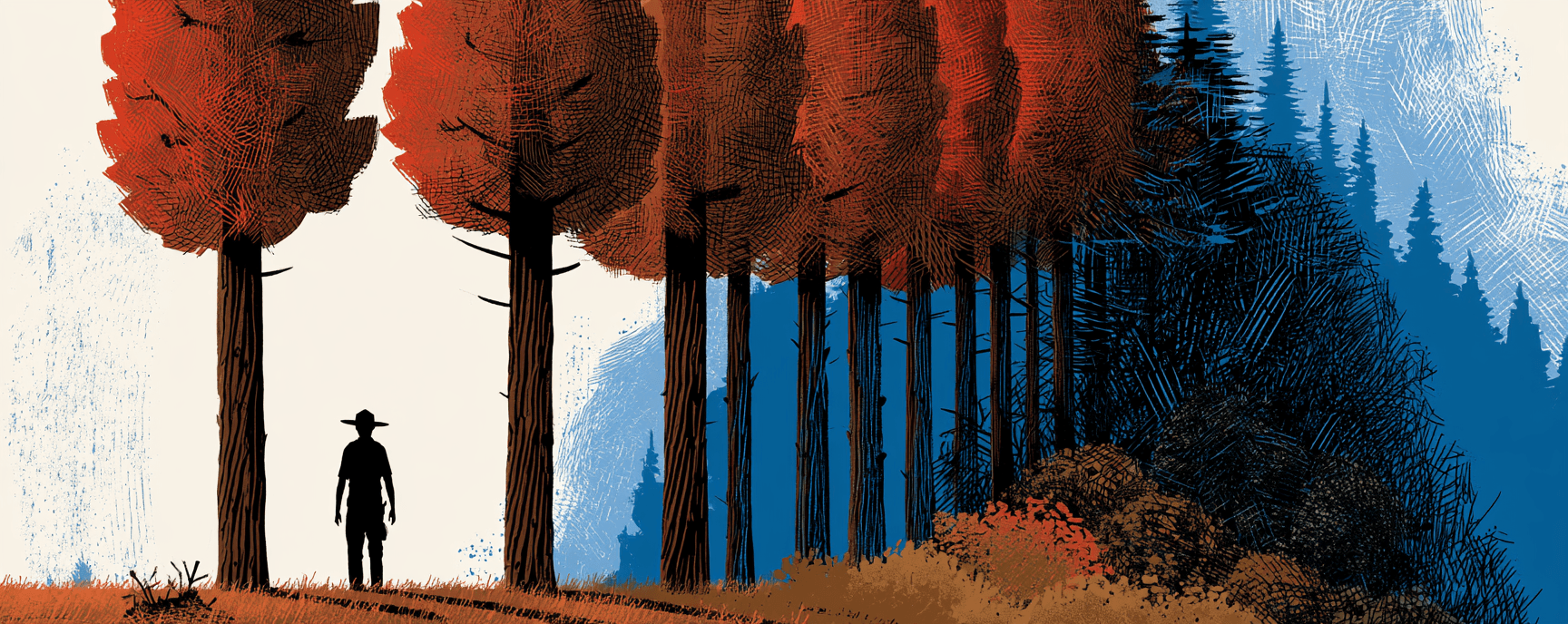
Ed Pulaski knew the country above Wallace, Idaho, the way people know a place they've worked for years on foot. On August 20, 1910, that knowledge was the only thing between forty-five men and the fire consuming the Coeur d'Alene Mountains.
The smoke had thickened past visibility. The fires across northern Idaho were no longer behaving like fires. Wind had joined them, and the ridgelines above Placer Creek were producing conditions that would later be described as a firestorm but in the moment were simply unsurvivable. Pulaski, a forest ranger, had collected his crew, most of them temporary laborers with little firefighting experience, and told them to grab blankets. His own account, published in American Forestry in 1923, is plain about what he was thinking: his "one hope" was an old mine tunnel he knew of along the creek.
A falling tree killed one man on the trail before they reached it.
Inside the tunnel, Pulaski ordered the men face down. He soaked blankets and hung them across the opening. He carried water in his hat. The mine timbers caught fire. Men cried and prayed. When at least one tried to rush outside, Pulaski drew his revolver. "The first man who tries to leave this tunnel I will shoot."
Then he lost consciousness.
He came to around five in the morning, fresh air circulating again. Someone had said the boss was dead. Pulaski's reported reply: "Like hell he is." Five men had died in the tunnel. The rest crawled and staggered over burning logs toward Wallace. Pulaski was blind, burned on both hands, and would spend nearly two months hospitalized.
These details come from Pulaski's published narrative. Later reconstructions have added specifics he didn't provide: the tunnel identified as the Nicholson prospect, its dimensions estimated at roughly six feet high, five feet wide, 250 feet deep. The National Register nomination formalized the site in 1984. But Pulaski's account names no one in the tunnel, doesn't identify the man killed by the tree, and gives no precise route beyond the creek and the mine. The scene has acquired a polish over the decades that the primary record doesn't fully support. What the record does support is enough: a man who knew the land made a decision under impossible conditions and brought most of his crew out alive.
And Pulaski's tunnel was one small piece of a catastrophe so large it would reshape American land management for a century. The people who shaped that response were not the ones who had been in the tunnel.
An Agency Under Siege
The United States Forest Service was barely five years old in the summer of 1910 and already fighting for its institutional life. Created in 1905 under Gifford Pinchot's aggressive conservation vision, the agency had spent its short existence battling western congressional members and timber and mining interests who resented federal control of forestland.
The previous year had been consumed by the Ballinger-Pinchot controversy, and by January 1910 the rupture was complete. Pinchot had sent an open letter to Senator Jonathan Dolliver accusing the Taft administration of favoring private development interests in its handling of Interior Secretary Richard Ballinger's public-land decisions. Taft fired him. The dismissal fractured the Republican Party along its conservation fault line, alienated Roosevelt-aligned progressives, and left the Forest Service in the hands of Henry S. Graves, Pinchot's replacement as Chief Forester, who inherited the agency's mission without the political base that had protected it.
Graves took office knowing the arithmetic. The Forest Fire Emergency Fund Act of 1908 had allowed the agency to spend beyond its appropriation on fire emergencies, and by the end of the 1910 season the Forest Service would accumulate more than a million dollars in emergency deficit. For an agency whose opponents in Congress and the timber industry were already arguing that federal forest management was an overreach, that deficit was the kind of number that could end the argument permanently. Secondary accounts describe the agency as "on the verge of cancellation," though this research pass did not locate a specific congressional motion proposing abolition. What is clear is that the political environment gave Graves almost no room to maneuver. Any position on fire that could be characterized as passive, tolerant, or accepting of loss would have been handed directly to the people who wanted the agency dissolved and the land opened.
Who Did the Dying
The men in Pulaski's tunnel were not foresters. They were the kind of men who show up when an agency needs bodies and has wages to offer.
By August 1910, the Forest Service had been recruiting emergency firefighters for weeks across the Northern Rockies. They came from the silver and lead operations of the Coeur d'Alene mining district. They came from Spokane, transient laborers who needed the work. When the situation became desperate, President Taft authorized military deployment. About four thousand troops were sent to the region, including seven companies from the U.S. Army's 25th Infantry Regiment, a Black regiment whose soldiers were known as Buffalo Soldiers. By August 20, roughly ten thousand people were fighting fires across northern Idaho and western Montana.
The pay records and recruitment conditions for this emergency workforce have not been fully retrieved from Forest Service archives. What is documented is the cost they bore. Of the approximately eighty-five dead (sources vary between eighty-five and eighty-seven, depending on how civilian deaths and later injuries are counted), the overwhelming majority were firefighters. One crew, sometimes called the Lost Crew, was killed near Setzer Creek, though the location name and count vary across sources between twenty-eight and twenty-nine. These were men with no institutional stake in the Forest Service, killed in a fire whose institutional consequences would be shaped by people in Washington who never held a shovel.
Wallace in the Canyon
The town Pulaski's survivors staggered toward was itself on fire. Wallace, Idaho, sat in a narrow canyon along the South Fork of the Coeur d'Alene River, a mining town of several thousand people that also served as the administrative center for the surrounding national forest. On August 20, the fires that had been burning across the region converged on it.
Passenger trains evacuated thousands of residents to Spokane and Missoula. Backfires set by defenders helped save portions of the town. But the eastern section burned. Accounts describe roughly one-third of Wallace destroyed, with damage estimated at about one million dollars in 1910 currency. The Spokane Daily Chronicle ran headlines on August 22:
"More than seventy die in forest fires."
Pulaski's own account notes one detail that tends to disappear in the institutional narrative. After his injuries were dressed, he insisted on going to his home. He wanted to confirm that his wife and daughter were safe.
The institutional story moves past this moment quickly, because the institutional story was already being written by other people, in other rooms, toward other ends.
The Hinge
The fires of August 20–21, 1910, burned approximately three million acres across northern Idaho and western Montana, with extensions into eastern Washington and southeastern British Columbia. Three million acres in roughly two days.
The fires could have ended the Forest Service. Instead, the disaster became proof of the need for more resources to fight wildfire. Secondary accounts consistently report that Congress substantially increased the agency's budget in the aftermath, with several sources describing it as a doubling. The specific pre-fire and post-fire appropriation figures were not retrieved in this research pass, and the exact fiscal-year comparison remains an archival gap. But the direction of the response is not in dispute. The agency that had nearly been destroyed by fire was rescued by it, and the cost of that rescue was a commitment: this would never happen again.
Graves pressed for aggressive fire prevention and used the post-fire political opening to build federal-state-private cooperation in fire protection, a framework that would find legislative expression in the Weeks Act. The institutional logic was straightforward. The agency existed to manage forests. Forests burned. Therefore the agency's job was to stop forests from burning. In the political climate of 1910 and 1911, with Pinchot's firing still raw and timber interests still pressing for the transfer of federal forestland, any other position would have been institutional suicide. Arguing for a more nuanced relationship with fire would have required the kind of political capital the agency simply did not have.
William B. Greeley, who had been the Region 1 forester responsible for forty-one million acres across Montana, much of Idaho, and parts of Washington during the 1910 fires, would carry the institutional lesson further than anyone. Greeley became Chief of the Forest Service in 1920. In his 1951 book Forests and Men, he wrote that the 1910 fire had "burned into" him the conviction that fire prevention was the "No. 1 job" of American foresters. The quotation is retrospective, written four decades after the event, and should be read with that distance in mind. But the policy trajectory it describes was real. Greeley had watched men die in fires he was administratively responsible for preventing. The political and personal pressures pointed in the same direction: total suppression.
The formal expression of total suppression required that every fire on Forest Service land be controlled by ten o'clock on the morning following its discovery. All fire was the enemy, and the only acceptable response was total, immediate elimination.
The policy came in the mid-1930s, most commonly dated to 1935 under Chief Ferdinand Silcox, though at least one fire-history source places the operational version in 1934. The original directive language has not been retrieved from Forest Service administrative records.
Dissent existed almost from the beginning. Aldo Leopold argued as early as 1924 that wildfires could benefit ecosystems. Harold Biswell advocated prescribed fire in subsequent decades. Leopold made the argument more than a decade before the 10 a.m. policy was formalized. The policy would not be abandoned until 1978, more than half a century of institutional resistance to what the agency's own ecologists were saying. The Forest Service did not formally shift from fire control to fire management until 1974.
By then, the forests had been transformed by the policy's success.
What the Forests Became
The ecological consequences of suppression in the Northern Rockies run deeper than the generic "fuel buildup" that appears in nearly every popular account. The change was structural. It altered what these forests were.
The dry ponderosa pine forests of northern Idaho and western Montana, the forests of the Coeur d'Alene and Bitterroot ranges where the 1910 fires burned, had historically experienced low-severity surface fires at mean return intervals of roughly fifteen to twenty-three years. These were maintenance fires. They burned along the ground, cleared understory, killed saplings of shade-tolerant species like Douglas-fir and grand fir, and maintained open, park-like stands dominated by thick-barked ponderosa pine and western larch. Trees that could survive surface flame. A forest shaped by fire into something fire could move through without destroying.
Remove that fire for decades and the arithmetic changes. Douglas-fir saplings that would have been killed at knee height survive to form a dense mid-story. Grand fir fills in beneath. Stand density increases. The open structure closes. Ladder fuels connect the forest floor to the canopy in continuous vertical pathways that never existed under the historical fire regime. A surface fire, the kind these forests had lived with for millennia, now has a staircase to the crown.
The ecological literature is careful to note that suppression did not act alone. Logging removed large, fire-resistant trees. Grazing reduced the fine fuels that had carried low-severity surface fires. Insects and disease found denser stands more hospitable. Climate variability shaped all of it. But suppression was the keystone removal. Without frequent fire, the forests that had coevolved with it became something else: denser, more shade-tolerant, more susceptible to the kind of high-severity crown fire that the suppression policy was designed to prevent.
Where historical surface fires left large trees standing and stimulated regeneration, fires in the altered forests can kill entire stands, consume the organic layer of the forest floor, and create conditions that resist recovery for decades. The scale of area burned may match historical fires. The severity exceeds anything the pre-suppression landscape produced.
What Success Cost
Greeley wrote that the 1910 fire had "burned into" him his conviction about suppression. The metaphor carried more weight than he probably intended.
The people who made the suppression decision were operating under real constraints, and those constraints deserve to be understood before they are judged from a distance. Graves faced a Congress that would have dismantled his agency if he had argued for letting forests burn. Greeley had watched men die in fires he was administratively responsible for preventing. The 10 a.m. policy was an institutional survival strategy, and it worked exactly as intended for the institution. It secured funding. It gave the agency a clear mission. It built the Forest Service into one of the most powerful land-management agencies in the world.
The land absorbed the cost. Quietly, structurally, in ways that became visible only when the fires kept coming.
Pulaski, for his part, went back to work. He spent the rest of his career in the Coeur d'Alene forests. He invented the combination axe-and-mattock tool that still bears his name, the one firefighters carry today. He never became an administrator or shaped doctrine. He stayed in the country he knew, doing the work that was in front of him.
The tunnel above Wallace is on the National Register now. The forests around it are not what they were. They are what a century of decisions, made under genuine pressure by people who believed they were protecting the land, turned them into.
-
Suppression's perverse policy legacy: Elizabeth Kolbert's 2024 New Yorker piece traces how the 10 a.m. policy and its successors created the fuel conditions that now drive catastrophic fire seasons across the West.
-
When protection outlives memory: The Guardian reported in July 2025 that the Miami Conservancy District's century-old flood-control system, built after a three-day disaster in 1913, now faces aging infrastructure, changed rainfall, and an estimated $140 million repair need as the generation that remembers the flood recedes.
-
Building codes after catastrophe: The Wall Street Journal examined how Florida's post-Hurricane Andrew code reforms, widely considered a model, coexist with continued high-risk development in flood zones where insurance pressure and contested FEMA maps complicate the legacy of stronger standards.
-
Counting the invisible disaster: Chicago's 1995 heat-wave playbook, built after the Cook County Medical Examiner certified 465 heat-related deaths, was being tested during a late-June 2026 heat stretch with heat indices forecast to reach 105°F, raising questions about whether recognition systems built for one era hold in another.