
The tomatoes were coming in. Not all of them. The Early Girls had started to turn, and the Romas were sizing up, and near the back fence there was a volunteer I hadn't planted and couldn't identify. It had come up on its own in May, in the spot where Carol used to dump the compost bucket. I'd let it go because I wanted to see what it would do.
I watered in the morning before the heat set in. This was July, Northern Virginia, and by ten the air had weight to it. I'd get up at five-thirty, make coffee, take it out to the garden, stand there while the sky went from gray to white. The snap beans from the spring planting were mostly done, but I'd put in a second sowing in mid-June the way Carol always did, and those were just starting to climb the strings. The hum from the substation two streets over was easier to hear at that hour. Not loud. Just there, the way a refrigerator is there in a room you've stopped noticing, except this one was outside and it didn't cycle off.
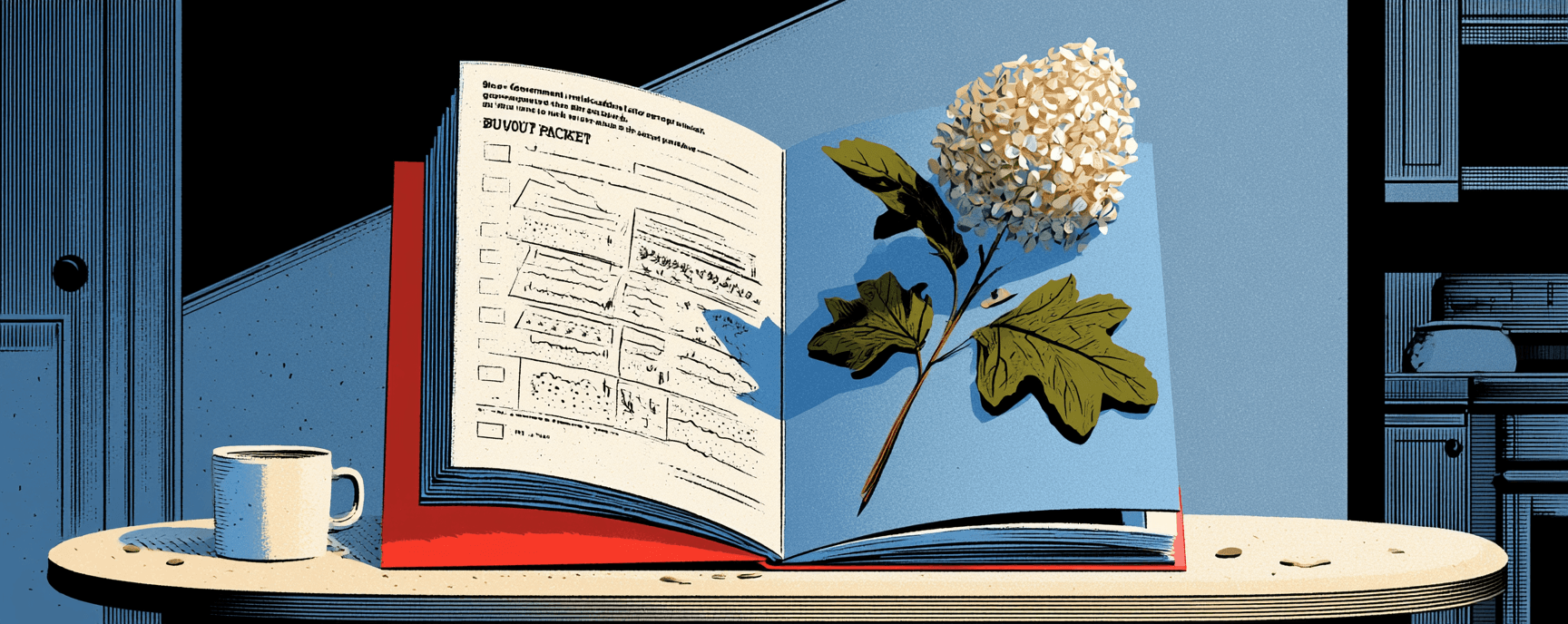
The packet was on the kitchen table where I'd left it three weeks ago.
Offer letter, appraisal, title report, relocation assistance form, proposed deed. The cover sheet said "Fair Market Value" and "Just Compensation" and, on the relocation pages, "Comparable Replacement Dwelling." The number was $487,000. We'd paid $310,000 in 2009.
The form had fields for square footage, lot size, number of bedrooms, distance to schools and services. No field for the oakleaf hydrangea Carol planted the spring we moved in, which was now taller than I am and just starting to fade from white to pink along the panicles. Nothing about row spacing in the vegetable beds, which was wider than most guides recommend because Carol liked to kneel between the rows without crushing anything.
Three neighbors signed in the spring. The last one told me the number was good, better than good, and that his wife had already found a place in Warrenton with more land and no hum. He said "hum" like it was a joke, but it wasn't entirely a joke.
The substation went in four years ago, on the lot where the old Caldwell place used to be. The data centers had been out here for years by then, gray buildings behind berms and fences along the Greenway corridor, but the grid work was newer. Transmission lines came through on easements along the power-line cut. Then the substation. Then the security lighting that turned the sky a flat cool white at night, visible above the roofline from my back porch.
The neighborhood changed the way neighborhoods change when infrastructure arrives. Not all at once. Truck traffic first, then fencing, then the hum, then meetings at the middle school where people asked questions and got answers that were technically correct.
I didn't go to the meetings. Carol would have gone. She was the one who went to things.
My daughter called on a Tuesday. She lives in Charlottesville. She teaches fourth grade and her husband does something with databases that I've had explained to me twice.
"Have you signed it yet?"
"Not yet."
"Dad."
"I know."
She asked if I wanted her to come up for the weekend and help me look at places. I said maybe. She said she loved me and I said I loved her too and we hung up and I went out to check the garden.
The peppers were loaded. Small green bells and a few starting to blush red at the shoulders. Carol grew cayennes too, in a separate row along the south fence where they got full afternoon sun. I'd kept the cayennes going. I didn't eat cayennes. I gave them to the woman at church who made hot sauce for the fall bazaar. But I grew them because Carol grew them, and the row was there, and the soil was amended the way she'd amended it. Carol used cotton twine on the stakes instead of the nylon stuff because she said it was easier on the stems. I still bought cotton twine. I still cut it to the same length she cut it, which was longer than it needed to be because she liked to tie a bow at the top instead of a knot.
The okra was waist-high and still putting out those yellow flowers. Carol loved okra flowers. She said they looked like they belonged somewhere more tropical than Loudoun County, which was true. The pods came fast once they started, and if you didn't pick them every day or two they got woody. I picked them every day. I had more okra than I could eat. I gave bags of it to the neighbors who were left.
The acquisition agent's name was Travers. He'd been out twice, both times professional, both times patient. He wore a polo shirt with the utility logo on it and drove a white SUV and carried a leather portfolio with copies of everything. He was maybe forty. He had a way of sitting at the kitchen table with his hands folded that suggested he'd done this many times and understood that people needed time.
The first visit he walked me through the packet. The appraisal, the basis for the offer, the relocation assistance, the timeline. He said the word "comparable" the way you'd say "Tuesday." Just a word in a sequence of words that described a process.
The second visit he asked if I had questions. I said I didn't. He said there was no hard deadline but that the project timeline had the corridor work starting in the fall, and that the sooner I could let them know, the more flexibility there'd be on closing and moving logistics.
I walked him out through the front door instead of the back. The back door goes through the garden. That would've required something I wasn't ready to say or hear, and Travers was the kind of person who would've said something about it, something decent and careful, and I didn't want that either.
Carol died in October of 2033. Pancreatic. Fast, the way they tell you it goes, though it didn't feel fast from inside it. Diagnosed in July, gone by October.
The third-floor parking garage at the hospital, the same spot near the elevator every time because she said she didn't want me circling. The way she organized her medications on the nightstand in a way that made sense only to her. The morning she asked me to take a picture of the garden from the bedroom window because she couldn't get down the stairs and she wanted to see how the black-eyed Susans were doing.
They were doing fine. They're still doing fine. They come back every August along the fence line, two and a half feet of yellow-orange around a dark center. Carol planted them because they tolerate clay and drought and neglect, which she said described her ideal plant and also her ideal husband. She was funnier than I am. Most people are.
The hydrangea was her real project. She'd read about oakleaf hydrangeas in a magazine and ordered one from a nursery in North Carolina and planted it the first spring, in the corner by the shed where it got morning sun and afternoon shade. It was a stick when she put it in. Now it's taller than I am, with leaves the size of dinner plates and those long white flower clusters that go pink and then tan as the summer wears on. In the fall the leaves turn red.
You can't move an oakleaf hydrangea that size. I looked into it. The root system is extensive and the transplant shock is significant and the success rate is not what you'd want it to be. The nursery websites say "not recommended for mature specimens." I read that and closed the laptop and went outside and stood next to it for a while.
The light from the substation was visible from the bedroom window. Not the substation itself, just the glow above the trees, a pale wash that didn't flicker or change. It was there when I went to bed and there when I woke up. On clear nights it competed with the moon. There used to be a line of tulip poplars along the Caldwell property that blocked everything to the east. Now you could see the steel framework above the fencing if you looked, and at night the security lights turned that whole quarter of the sky the same flat white.
That was the window Carol asked me to take the picture from. The garden was still there below it. The view past it wasn't.
I'd gotten used to it. You get used to things. The hum, the light, the truck traffic, the new fencing where the old place used to be. The neighborhood was becoming something else, and the people who lived here were either leaving or adjusting, and both of those were reasonable.
On a Thursday morning in late July I went out at five-thirty with my coffee and found the volunteer tomato had set fruit. Small green globes, maybe a dozen of them, tight against the stem. I crouched down and looked at the leaf shape and the fruit shape and I thought it was probably a cherry tomato, maybe a Sun Gold, which Carol used to grow in the bed along the back fence before she switched to paste tomatoes.
A seed from years ago, still viable in the compost.
I touched one of the fruits. It was hard and warm even at that hour.
The black-eyed Susans weren't blooming yet but the buds were forming, tight green fists along the stems. Another week, maybe two. The hydrangea was in full display, the panicles starting their turn from white to pink at the edges. The okra was putting out a flower a day. The cayennes were ripening.
Everything was doing what it was supposed to do. The garden was on Carol's time, the schedule she'd set up years ago with her row spacing and her cotton twine and her compost and her amended clay, and it would keep running on that schedule until someone stopped it or until the corridor came through.
I went inside and refilled my coffee and sat down at the table across from the packet. I'd read every page twice. The number was fair. The process was correct. Travers had been decent about all of it. My daughter was right that it was a good offer.
The form said "Comparable Replacement Dwelling" and it meant a place that was decent, safe, sanitary, adequate in size, functionally equivalent. A place with the same number of bedrooms and a similar lot and access to services. A place where I could live, which was true. People do.
I sat there for a while. The coffee got cold. The hum from the substation was there underneath everything, steady and low. Outside, the garden was doing its work in the heat, the okra flowers opening, the tomatoes sizing up, the hydrangea holding its slow turn.
I hadn't signed. I probably would.
The volunteer tomato had set fruit. I wanted to see what it would do.
-
Virginia's data-center footprint: A 2024 JLARC report found that Northern Virginia constitutes 13% of all reported operational data-center capacity globally, with residential electricity costs projected to rise $14–$37 per month by 2040 from grid investment driven largely by that growth.
-
Buyouts that stall midprocess: The Washington Post reported that hundreds of western North Carolina residents applied for FEMA buyouts after Hurricane Helene while carrying mortgages on homes they couldn't inhabit, illustrating how delay changes the thing being decided about.
-
When "available" isn't usable: A 2026 Vox investigation examined how American heat-wave response depends almost entirely on functioning AC, exposing the gap between cooling infrastructure that exists on paper and cooling that works under stress.
-
The low-frequency hum next door: JLARC found that one-third of Virginia data centers sit near residential areas and that constant low-frequency noise can affect nearby residents even when it rarely violates conventional noise ordinances, a detail that registers less as complaint than as ambient fact of life.