

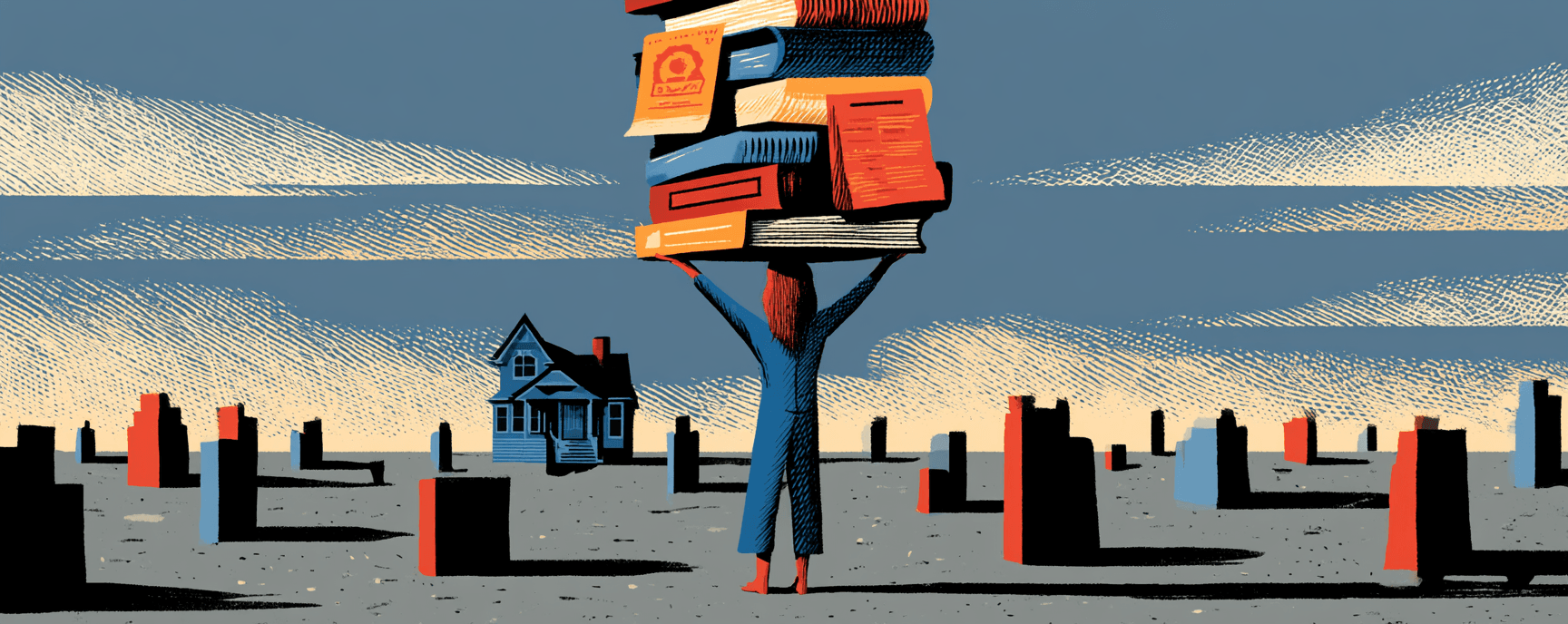
Altadena was Craftsman bungalows and Spanish Colonial revivals tucked into the foothills above Pasadena. Old trees. The kind of neighborhood where the houses had been there long enough to look like they belonged to the land rather than sitting on top of it. In January 2025, the Eaton Fire burned through and took most of it.
Missi and Frank Figueroa are both nurses. In June 2026, sixteen months after the fire took their house, they moved back in. Their street was mostly empty lots. About 65 homes had been completed in Altadena by then, out of roughly 6,000 properties the fire damaged or destroyed. And "completed" is an inspection category, a stamp on a form. A stamp that says the building passed code. Whether the family sleeping inside had to borrow money from their cousins to get there, that's somebody else's ledger.
The Figueroas did.
What follows is an inventory of what one household assembled to come home. At each step, the question is the same: who actually controlled whether the next thing could happen?
Whose Money
Their insurer paid $1.7 million. Structure, contents, additional living expenses. That sounds like security. It is a ledger entry.
Roughly half of it flowed through the mortgage company, which released it in construction draws. The way this works: you show the servicer that construction has progressed, and the servicer releases a portion of the insurance settlement. You need the money to make progress. You need progress to get the money. The insurance payment, the moment it hits a mortgaged property, stops belonging to the homeowner in any practical sense. It becomes the lender's money, disbursed on the lender's timetable, verified by the lender's inspector, protecting the lender's collateral. The family is the collateral's tenant.
So the Figueroas had $1.7 million on paper and something considerably less in hand at any given moment. They borrowed from relatives. They took out an additional bank loan. Friends and neighbors set up a GoFundMe that raised more than $25,000. A household with a seven-figure insurance settlement that still needed a GoFundMe.
The settlement is a number on a screen. The draw schedule is a faucet controlled by an institution whose interest is the mortgage, not the family.
Across Thousands of Claims
The Figueroas were not unusual in finding insurance difficult. A survey of 2,443 households by the Department of Angels, a community recovery organization, found nearly eight in ten policyholders reported serious challenges with insurance payments. Half cited demands for detailed inventory. More than a third said their adjuster kept changing. Only 26 percent of claims were fully settled at the time of the survey. (The Department of Angels has a stated recovery mission and should be read as an advocacy-adjacent source, though the sample is substantial and the findings track with independent press reporting.)
State Farm said it had paid more than $5 billion on more than 13,500 claims from the Eaton and Palisades fires. LA County launched an investigation into whether State Farm wrongfully denied or delayed claims. California insurance regulators found claims-handling violations in a sample review tied to the fires. Whether the Figueroas experienced these specific patterns, the public record doesn't say. What it says is that the mechanism everyone points to as the first line of recovery funding was functioning as a bottleneck across thousands of households simultaneously.
The Blank PDF
Before you can build, you need plans. The Figueroas first looked at modular construction. About $700 per square foot. Traditional came in around $500. They went traditional, which meant an architect, plans, a permit, and a builder, each one a gate that had to open before the next one could.
The Altadena Collective, a community organization formed after the fire, offered pre-designed plans in styles that matched what had burned: Craftsman, Spanish Colonial, California Bungalow. Flat fee of $55,000 for architect plans rather than a percentage of construction cost. The Collective was co-founded by an architect who lost his own home in the fire and was working with about two dozen clients at reduced cost by April 2025. (The Collective is a service-providing and advocacy-adjacent organization; its role here was architectural pathway support, not direct cash aid.)
The Figueroas chose a Collective plan. They signed with a builder in September 2025. Then the permit stalled for approximately three months because, according to the WSJ's account, a blank PDF had been submitted to a third-party plan reviewer.
A blank PDF. An empty document submitted into a system processing thousands of applications, and nobody caught it until the family on the other end started asking why nothing was happening. Three months of displacement. Three months of rent on temporary housing. Three months of carrying a mortgage on a lot full of ash. The county intervened, the permit moved. Nobody was corrupt. Nobody was malicious. The system simply had no mechanism to notice that a file contained nothing, because the system processes files. The family is always the error-correction mechanism.
I spent five years on cargo ships watching containers get routed to the wrong port because a bill of lading had a transposed digit. Nobody's fault. Nobody's problem, either, except the person waiting for the cargo on the other end. The family has to notice the error, identify the right office, make the right call, and push until something moves. Recovery. The word suggests something that arrives, something done to you, a process that carries you forward. For the Figueroas it was a second full-time job, and they already had jobs. They were working hospital shifts, caring for other people's emergencies, while managing their own reconstruction by phone and email and sheer persistence from someone else's spare room.
The Gates Before the Gates
Before any construction sequence could begin, the lot had to be cleared. The U.S. Army Corps of Engineers completed Phase 2 debris removal in September 2025, eight months after the fire. Ash, structural remains, vehicles, foundations, contaminated trees, soil. The public record doesn't show exactly when the Figueroa lot received final sign-off. But the sequence is clear enough: if your lot wasn't cleared until late in the program, and your architect plans weren't ready until the Collective delivered them, and your plan reviewer received a blank PDF, and your mortgage company released funds in draws, each gate opened only after the previous one closed. The family waited through every interval.
The state's mortgage relief program, CalAssist, had provided $6.5 million to about 800 households by February 2026. Caps assistance at $20,000 or one year of payments, whichever is less. Twenty thousand dollars against a sixteen-month rebuild.
The Families Who Couldn't
While the Figueroas were navigating their sequence, the Guardian reported in February 2026 on the families who couldn't return.
Esmeralda and Hector, an Altadena couple renting when the fire destroyed their home. Because they didn't own the property, the rebuilding decision didn't sit with them. They were in a temporary apartment, watching rental assistance run out. The lever they needed belonged to a landlord who might or might not rebuild, on a timeline the tenants couldn't influence.
Claire and Tim, homeowners who described rebuilding costs, insurance uncertainty, and temporary housing expenses as barriers they couldn't see past. John Kim's family, in temporary arrangements, facing the same cost and complexity. Cherie Marquez, who described the burned lot as no longer feeling like home, tying nonreturn to trauma, contamination fears, and uncertainty about whether the neighborhood would come back at all.
Every one of them had determination. For each of them, one or more of the levers the Figueroas managed to reach was simply out of range. Renter status. Insufficient coverage. The weight of returning to a place that smells like loss. Each barrier individually might be survivable. The combination produces nonreturn.
Two Arguments, One Family
Above the Figueroas' heads, a political argument was playing out. LA County Supervisor Kathryn Barger said funding was the biggest barrier to rebuilding, not permits. The Trump administration was pushing a plan to let homeowners with federal disaster loans self-certify code compliance if local approval wasn't granted within 60 days.
The Figueroas experienced both problems. Their permit stalled three months over a blank file. Their financing required insurance draws controlled by a servicer, supplemented by family loans, a bank loan, a GoFundMe, and their own labor sourcing bathroom tile on Facebook Marketplace and hunting down appliances and fixtures themselves. The family's timeline sits outside the political argument. The household is the only mechanism synchronizing all the clocks. Insurer, servicer, debris clearance, architect, permit office, plan reviewer, contractor, inspector. Each institution runs on its own schedule. The family absorbs every gap between them.
What Sixty-Five Means
By June 2026, 1,665 residential units were under construction across the broader Eaton Fire area, including Pasadena and unincorporated LA County. Under construction. That's a milestone word. Permits filed, work started, inspections in progress. Nobody's sleeping there yet.
The Eaton and Palisades fires together destroyed approximately 16,255 structures. By June 2026, about 65 homes had been completed in Altadena. A year earlier, fewer than a dozen had been rebuilt across all LA fire burn areas.
The county maintains a rebuilding dashboard that tracks permit activity and debris-removal progress. "Construction Completed" means the project passed all inspections and is ready for legal occupancy. Ready for legal occupancy. Another milestone phrase. The inspector signed off. The form says nothing about whether the family can afford to furnish the place, whether the kids' school is operating, whether the neighbors came back, whether the pharmacy reopened, whether the street has working utilities or just a house standing alone on a block of empty lots.
The Inventory
The Figueroas assembled the following to come home: a $1.7 million insurance settlement they couldn't fully access. A mortgage servicer's permission to spend portions of their own money. An architectural nonprofit that didn't exist before the fire. A permit system that lost three months to a blank file. A GoFundMe. Family loans. A bank loan. Their own labor sourcing materials. The physical and emotional endurance of two working nurses managing a rebuild from displacement while paying a mortgage on a pile of ash. Sixteen months.
Look at that list and ask which of those items a system could have provided. The insurance settlement, yes, if the draw process didn't trap the money behind the lender's schedule. The permit, yes, if the review process had a mechanism to catch its own errors. Debris clearance, yes, and the Army Corps did that. Mortgage relief, partially, though CalAssist's scale doesn't match the problem's scale. The Altadena Collective is an attempt to systematize one piece, the architectural pathway, and it worked for the families who found it.
The family loans, the GoFundMe, the Facebook Marketplace tile, the relatives' spare room, the sixteen months of holding every thread together while working full-time nursing shifts? That was the household absorbing the cost of every gap between systems. And it worked for 65 families in Altadena. Thousands of others are still out there, in temporary apartments, in relatives' spare rooms, in the slow process of deciding whether to try or to leave. One lever was out of reach, or two, or three. The blank PDF wasn't caught. The draw schedule didn't align with the contractor's invoice. The landlord didn't rebuild. The insurance wasn't enough. The program was capped at a number that assumed a problem one-tenth the actual size.
The Figueroas came home to a house on a street of empty lots. That's what coming home looks like when the household has to carry every system that was supposed to carry it.
-
California's insurer of last resort: The California FAIR Plan now carries 684,388 policies and $750 billion in total exposure as of March 2026, a 242% exposure increase since September 2022, raising questions about what happens to the next Altadena's insurance landscape before the fire starts.
-
The self-certification fight: The Trump administration's proposal to let homeowners with federal disaster loans self-certify code compliance after 60 days without local approval remains unresolved, and whether it accelerates rebuilding or undermines fire-resilient construction standards will shape the next wave of returns.
-
CalAssist's reach against the problem: By February 2026, CalAssist had disbursed $6.5 million to roughly 800 wildfire-affected households, but the program does not publish Eaton-specific application, denial, or pending counts, making it difficult to measure how much mortgage distress the program is actually absorbing.
-
LA County's rebuilding dashboard: The county's recovery data tools define "Construction Completed" as ready for legal occupancy, but the dashboard does not track whether completed homes are actually occupied, leaving a gap between the county's recovery metric and the condition it's meant to represent.