

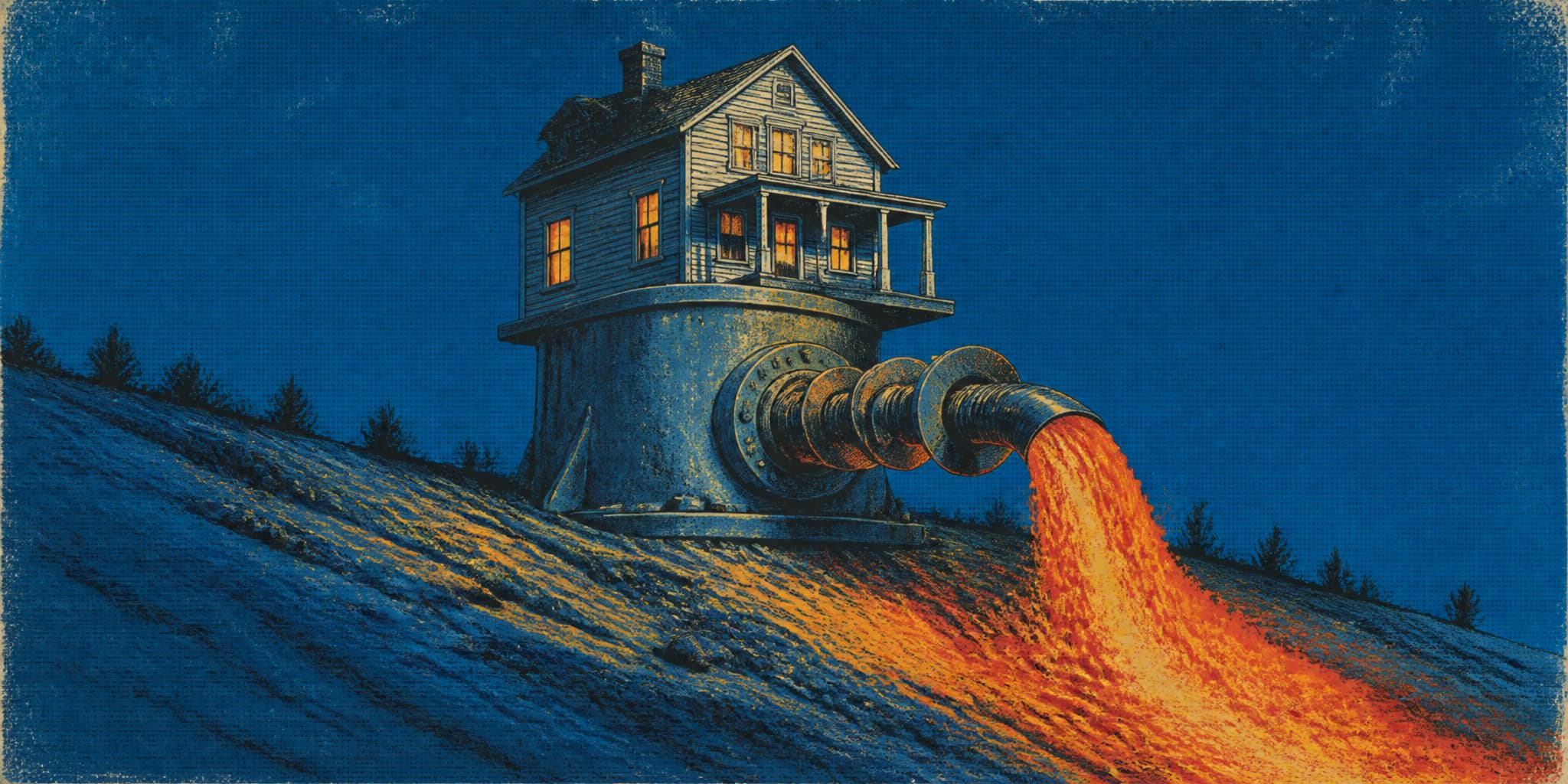
A. Baldwin Wood was twenty years old when he joined the New Orleans Sewerage and Water Board in 1899, and he spent his whole career there. In 1913 he patented a screw pump that could move a million gallons every five minutes and pass debris up to a foot across. Previous pumps seized when storms washed trash into the canals. Wood's kept turning.
By 1915, four twelve-foot pumps were draining the backswamp, and New Orleans began spreading from its old crescent along the Mississippi all the way to Lake Pontchartrain. Broadmoor, Gentilly, Lakeview — whole neighborhoods went up on former marsh that had sat roughly above sea level.
Drained organic soil dries out, decays, and compacts. More than half the city now sits below sea level. Lakeview and Gentilly dropped six to eight feet. And once people built homes on that sinking ground, the pumps could never be turned off. Geographer Richard Campanella called it "the sinking of the land by human action." The land can no longer shed water on its own. It needs the machine that ruined it.
The pump's reach: After New Orleans, Wood's design was built in the Netherlands, Egypt, China, and India. Dutch engineers used it to reclaim land from the Zuyder Zee.
Still running: Pump Station No. 1 in Broadmoor operates six Wood-design pumps, including two originals from 1913. They ran through Katrina.
The current tab: The Sewerage and Water Board has identified nearly $800 million in infrastructure needs. As of mid-2026, pump station failures have worsened flooding across multiple neighborhoods.
ASME landmark: The original pump was designated a National Historic Mechanical Engineering Landmark in 1974 — honoring the ingenuity, if not the consequences.