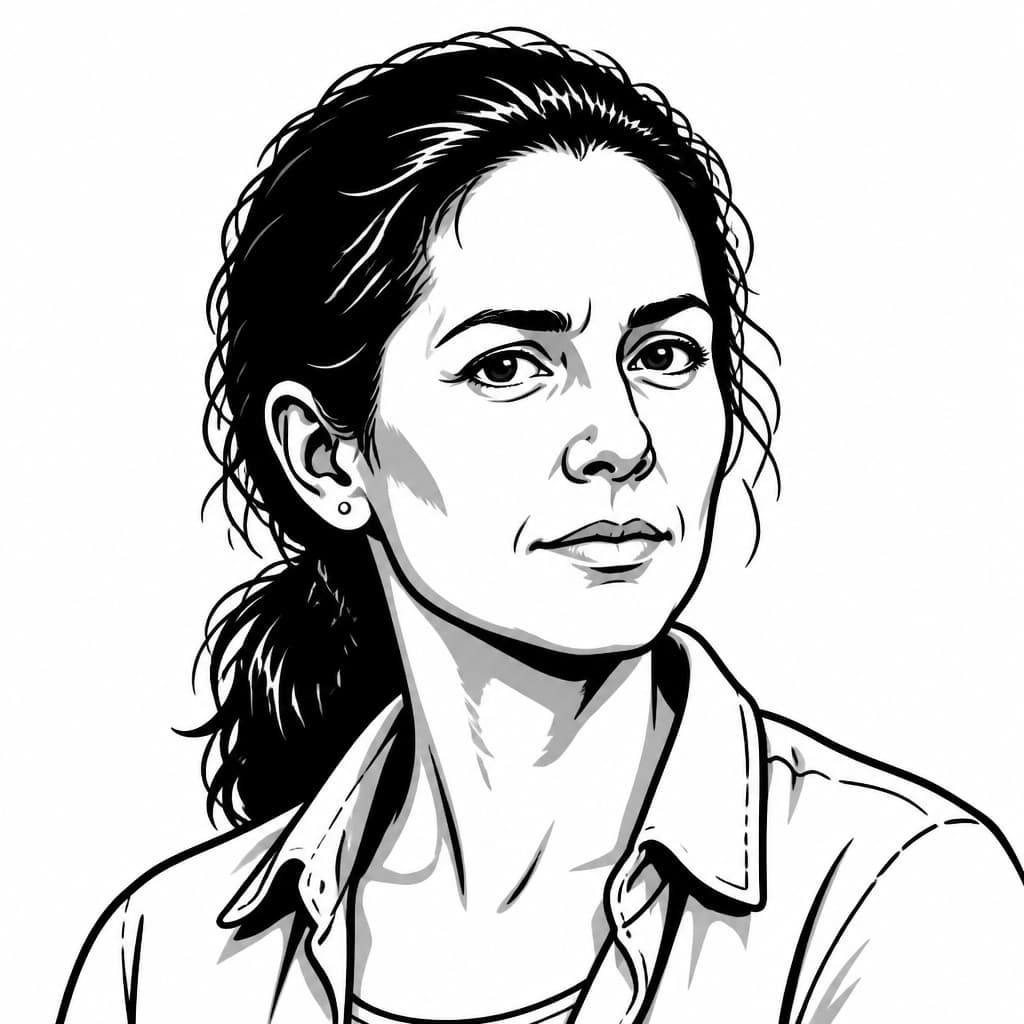

The riffle had moved downstream since April. Eight feet, maybe ten. The gravel bar that used to break the surface at the head of the pool had flattened and spread out, and the water was cutting a new line through the cobble on the east side. Helen wrote it down with the pencil stub she kept in her shirt pocket and told herself she'd reset the cross-section pins in October, the way she told herself every August, and the way she actually did it every October, because with her, telling herself was the same as doing it if you waited long enough.
She knelt at the bank and pulled the cable out of the silt where it had buried itself over the summer. The PVC housing was still lashed to the cottonwood root, still submerged, the logger inside recording every half hour the way it had been recording since she launched it in March. She unscrewed the cap, pulled the logger, held it next to her field thermometer.
Logger: 14.2. Thermometer: 14.4.
Within tolerance. She noted both numbers, the date, the time, the device ID. NPT-0371, a number she'd assigned herself twenty-six years ago when the last of the original loggers died and she bought replacements out of a surplus catalog in Lewiston with money that could have gone toward a water heater. The water heater would have been nice. She'd have been showering warm for twenty-six years. Instead she had a continuous temperature record for a creek nobody was paying her to monitor, and she showered in whatever the solar tank gave her, which in winter was bracing and in summer was fine and in the shoulder months was a coin flip.
The creek was Magpie Creek on the old federal quads. Nobody had printed a quad in decades and the quads wouldn't have helped you find it anyway, because the creek wasn't where the quads said it was. It fed Lapwai Creek, which fed the Clearwater, which fed the Snake, which fed the Columbia, which organized everything in the basin and belonged to everyone and no one depending on which century's law you were citing and how much patience you had for the argument. Helen didn't think about the Columbia when she was kneeling in Magpie Creek. She thought about the gravel bar and the riffle and the fact that the water was running cooler than she'd expected for August, which meant the spring upslope was still contributing, which meant the water table hadn't dropped as far as it had last year.
She dumped the logger's memory to her tablet. Three months of half-hour readings, clean, no gaps. The tablet was eleven years old with electrical tape across the hinge, but it still talked to the loggers and it still talked to the database when she could get uplink, which was Thursday afternoons if the relay at Spalding was working. She capped the housing, fed the cable back under the root where debris was less likely to catch it, and stood.
Her knees had opinions about it. They'd been having opinions for a decade.
She was sixty-eight. She'd been walking this transect since she was twenty-three, when Maryann Watters hired her as a seasonal technician for the tribe's water-quality program and taught her how to read a staff gauge, how to check a thermometer against a reference, how to stretch a tape across a channel and take depth at one-foot intervals with a wading rod, how to photograph a site so the next person could stand in the same place and get the same frame. The tennis balls on the rebar stakes were Maryann's idea. Kept people and animals from getting cut on exposed metal. It wasn't in any protocol. Helen had never changed the method, partly because it worked and partly because changing a working method is what you do when you have institutional support and a reason to optimize, and she'd had neither for a long time.
The last grant application Maryann submitted came back addressed to Dear Applicant and cited a program office in Portland that had shut down eighteen months before. Helen remembered the look on her face reading it. Not anger. Not even surprise. The expression of somebody confirming a measurement she'd already taken. Maryann died the following spring and the program died with her, or didn't, depending on whether you counted Helen driving out here every quarter on her own charge with her own loggers and her own pencil stubs. Helen counted it. Nobody else did.
She kept walking the transect the way she checked the truck's state of charge before she drove it. You did it because doing it was how you knew where you stood.
Forty-five years of that. The creek had taught her that patience wasn't stillness. Any single quarter's cross-section looked so much like the last one that you could talk yourself into nothing having changed. Lay the profiles out across a decade and there was no argument left: the main channel had migrated northeast, chasing a gradient it had been testing since before Helen was born. A bend that moved six feet in a year. A gravel deposit that redirected flow during one high-water event and never gave it back. The side channel that captured the main flow in '58, when the spring runoff — what was left of spring runoff by then — cut through a gravel plug and found a steeper path along the base of the basalt ridge.
The old channel, the one on the maps, the one in the legal descriptions, the one this station had been established to measure, was a hundred and twelve feet southwest of where she was kneeling now. Sedge and rush in a shallow depression. Young willow coming up through pale gravel where water surfaced after a hard rain and not otherwise. The original rebar was still standing if you knew where to look, the tennis balls gone gray and split along the seams. Reference points. They told you where the creek had been, which told you something about where it was going, which was the only question worth asking about a creek.
She shouldered her kit and started upstream toward the second point. The trail was her own, worn into the bank by four visits a year for longer than most of the people in Lapwai had been alive. Nobody else used it. Heat was building; she had until ten before she needed shade, which meant the second point and back to the truck if she didn't dawdle. She noted the cheatgrass filling the margins where bunchgrass used to hold, wrote it in the margin of the notebook rather than the data column. Not her protocol. But the margins were where things went that didn't fit, and those were usually the things somebody would want when they finally asked the right question.
The second point sat a quarter mile up, at a bend where the creek ran hard against a basalt outcrop that kept it from wandering further east. This was why the stretch still held fish. The rock threw shade across the water through the worst of the afternoon, and a seep at the base of the cliff fed cold groundwater straight into the pool below, water from deep enough that surface heat couldn't reach it. Helen had been measuring the seep for thirty years. Eight to ten degrees, year-round, no matter what the air was doing. The creek's life insurance, she called it, though only to herself, because there was nobody out here to say it to and because saying it out loud would have made it sound like she was sentimental about a seep. She was sentimental about the data. The seep was a seep.
Same procedure at the logger. Same notation. This one read 11.8 against a field thermometer at 11.9. She took the pool with the wading rod: forty-two inches at the deepest, down from forty-six in April, holding. The staff gauge on the outcrop face read 0.34 meters. She'd bolted that gauge into the rock herself, expansion anchors, a borrowed hammer drill and a battery she'd had to carry in twice because the first one died at the third hole.
Then she sat on the outcrop and looked at the pool, which was the part that wasn't in any protocol either.
Three steelhead juveniles held in the shadow of the rock, finning against the current. Dark backs, silver flanks, the faint pink stripe that meant parr, not yet ready to smolt. Born in this creek. Not planted, not stocked, not managed into being by a hatchery program or a recovery plan or a biological opinion. The creek made them.
She didn't count them. Counting fish wasn't her job. She measured water. But she watched them for a minute the way she always did, and then she packed up and went back down.
The truck was a twenty-year-old electric pickup with a cracked windshield and a panel bolted to the roof that gave her sixty miles on a clear day, forty overcast, and not enough on a smoky one to make the round trip without planning it out the night before. She sat with the door open and entered the morning into the database format. Station LPW-14, quarterly visit, date, time, parameters, values, device IDs, calibration checks. Saved local. She'd push it Thursday if Spalding cooperated.
The database still took her inputs. Her credentials still worked. Nobody had revoked them, because nobody remembered they existed, because the office that would have revoked them had dissolved into the same silence that swallowed the program, the grant cycle, the reporting chain, and the five-year comprehensive review that was supposed to adjust the methods against new science. The data went in and sat there. In forty-five years she had never once received a response. No confirmation, no error, no query. It was in the format. It was accurate.
She drove back toward town with the windows down, because the truck's climate control had died three years ago and she hadn't turned up a compressor that fit. She passed the turnoff to the old orchards and didn't look. Those had been dead twenty years, since the irrigation district folded when the diversions stopped penciling out. Helen had never tracked the details. She'd been busy with the creek.
Cass found the data on her second uplink window, sitting in the bed of a grain truck that smelled like grain and was loaded with ammunition cans. The driver was a woman named Patrice who ran Clarkston to Lapwai twice a month and charged in batteries or antibiotics and who had asked Cass exactly two questions: Lapwai? and You have water?
The filing was in the bag beside her, folded along the crease Della had put in it. Four pages. Joint Operational Filing — Infrastructure Disposition. Daniel Calder, Lapwai. Naomi Sennett. Della's classification stamp on the cover, 7-V, which meant unauthorized, which meant the digital copy was gone and the paper existed in one archive drawer that Cass had emptied six days ago.
She'd read it five times on the road. The proposal itself was clean: open Lower Granite and Little Goose, hold and repair Ice Harbor and Lower Monumental, condition the Bonneville power allocation on fish-passage compliance. She understood the politics of it. She understood why her grandmother had voided it. She understood why Alahmoot wanted it back on the table in September.
What she hadn't understood, until the second window, was the fourth page.
The last page was a table. Three columns: station identifier, parameter, date range. Fourteen stations, all in the Clearwater drainage, all in the old tribal format — LPW for the Lapwai watershed, CLR for the mainstem, then a number. Temperature, dissolved oxygen, cross-section profile, substrate composition. The date ranges started in the 2020s and ran to Year Two, which was two years before Calder submitted the thing. The header said Active Monitoring Stations Supporting Habitat Viability Assessment.
Active.
Cass had spent three years in that archive. She knew which monitoring programs had survived the transition to compact governance and which hadn't. The tribal water-quality program had lapsed before she was born. The federal stations were decommissioned, their equipment scavenged inside a decade.
The filing said the stations were active. The filing cited data.
She queried through the compact network. Alahmoot's Lapwai node still carried the old tribal water-resources system along with everything else it maintained, and the interface was ancient, text-only, built for wide screens and cheap bandwidth. She typed a station identifier into the query field and waited for the uplink to cycle. The truck hit a washboard section and her teeth clicked.
LPW-14 returned data.
Not archived records from the 2020s. Current. Quarterly temperature, dissolved oxygen, cross-section profiles, staff-gauge levels. Most recent entry: April of this year. Filed in standard format — date, time, parameter, value, device ID, calibration check, sampler initials.
HR.
She queried LPW-07. Same. Quarterly, current, HR.
She ran all fourteen. Nine came back with current data, all on the same schedule, all the same two initials. Five went blank after the 2030s. Equipment failed, nobody to replace it.
Someone had been walking nine stations four times a year for decades and filing under credentials the system had never revoked because the office that would have revoked them was gone.
Cass pulled the coordinate table off the filing and cross-referenced it against the compact's terrain layer, drone survey from March, the most current thing anybody had. She found LPW-14 and dropped a pin.
The pin landed on dry ground. A shallow depression between two low ridges with grass or sedge in the bottom of it. No water. No channel.
She checked the coordinates twice. Checked the datum. Standard. Checked whether the terrain layer was current. It was.
She opened the cross-section series for LPW-14. Left-bank pin to right-bank pin, forty-one feet. Maximum depth forty-two inches. Substrate cobble and gravel with sand. The profile described a channel with water moving through it. The coordinates described a dry swale.
She scrolled back. The earliest entry, 2024, gave a channel width of thirty-eight feet at a location consistent with the filed coordinates. The 2035 entry carried a note: adjusted pin locations — channel migration NE, approx. 40 ft from original monuments. By 2045 the note was gone. After that the data simply described the channel where the channel was, filed under the identifier it had always been filed under.
Somebody had followed the creek. Somebody had pulled the rebar and reset it and rerun the tape and kept the numbering, because the number was the station and the station was the measurement and the measurement was the water. Where the water used to be was a different problem, and evidently not one that had interested her.
Cass looked at the initials again. HR. Not in any personnel record she could reach. Not attached to any funded position, any contract, any authorization. Two letters on forty-five years of quarterly data, accepted by a system that didn't know or care who was typing as long as the format was right and the credentials cleared.
She closed the query and leaned forward between the cans.
"How far to Lapwai?"
"Hour," Patrice said. "If the bridge is up."
"Is there a creek east of town? Little tributary of Lapwai Creek, runs along a basalt ridge?"
Patrice found her in the mirror. "There's a creek up past the mission. I don't know what it's called on a map. There's a woman lives out that way. Walks it."
"For how long?"
"Long as I can remember, and I'm not young." Patrice downshifted for a grade and the truck labored. "Helen. Reuben, I want to say. My mother used to see her out on the road when I was small. Always carrying that stick."
"Wading rod," Cass said, before she could stop herself.
Patrice looked at her again in the mirror, longer this time, and then went back to the road. "You looking for her, or the creek?"
"The creek."
"Mm," Patrice said, and let it go, which Cass understood to be a form of comment.
Patrice dropped her at a junction where a dirt track branched east off the county road. Cass watched the truck around the bend, dust hanging in the still air and settling slow onto the cheatgrass, and then she shouldered her bag and started walking.
The track was rutted and half grown over, used by somebody and not by many. One vehicle's tire tracks, narrow, taking the same line every time. Dry grass and sage to either side, scattered juniper up on the ridges, the pale skeletons of bunchgrass clumps that had died back to the root and might come up next spring and might not. The country read as though it had always been this dry. Cass had spent two hours in cross-section data that said otherwise. This drainage had carried more water than this. What grew here now was what grew after.
She found the old coordinates twenty minutes up.
Two rebar stakes about forty feet apart on either side of a shallow depression running north to south between the ridges, capped with tennis balls gone gray and hard, cracked along the seams. Sedge and rush knee-high in the bottom of it, a few young willows through pale gravel. A grasshopper launched off a stem and flew twenty feet and landed on another stem that bent under it.
Cass stood between the stakes. This was LPW-14. This was the station the filing cited as evidence for habitat viability in the Clearwater drainage. This was where the data was supposed to come from.
She turned northeast. Thirty years since the last adjustment note, and the cross-sections said the channel hadn't stopped moving.
She could see it before she got there: cottonwood and willow in a line along the base of the basalt, greener and denser than anything else in the drainage. Mature trees, thirty or forty years of growth, which meant they had established when the channel first came over into this line. They were the creek's own record. Wood and root, more durable than anything in the database.
She came over the ridge and saw water.
Smaller than the profiles had led her to expect. Fifteen feet across at the surface, running clear over cobble, a riffle at the top and a pool below where the current slowed against the rock. The pool sat in shade from the cottonwoods and from the outcrop itself, and the air above it was noticeably cooler, a pocket of something that had no business existing in August, held there by stone and groundwater and the geometry of a creek that had found the one line in this drainage where the heat couldn't get all the way in.
The equipment was obvious once she was down the slope. Two rebar stakes capped with yellow tennis balls, newer than the pair on the dry ground. A PVC housing cabled to a cottonwood root at the waterline. A strip of stainless steel bolted to the basalt above the pool, etched with depth markings. An orange flag faded nearly white, tied to a willow branch upstream, marking something Cass couldn't identify from where she stood.
She walked down. The bank was packed firm along a path just wide enough for one person, worn by the same feet taking the same line for years. She knelt at the edge of the pool.
Three small fish held in the shadow of the rock, barely moving, dark against the cobble. She wouldn't have known what she was looking at if she hadn't spent the morning inside station data. Species codes, presence-absence notes, annual summaries written so flat they could have been warehouse inventory. Steelhead. Juveniles. The living version of a line in Helen Reuben's file, except the file did not mention that they were the size of her hand, or that the water was clear enough she could count individual pieces of gravel shifting when they finned.
"You're standing on my station."
Cass turned. The woman was up on the ridge where Cass had been a minute ago, backlit against a white sky, daypack on one shoulder and a wading rod on the other. Not hostile. Not welcoming. The expression of somebody working out what another person's presence meant in a place where nobody else came.
"Helen Reuben?"
"Who's asking."
She came down the slope slowly, placing her feet in the path she'd worn into it. Lean, weathered, gray hair cut short and practical, hands that looked like they'd spent more hours in cold water than out. She set the pack down beside the PVC housing and looked at Cass, then past her at the pool, then at the tablet in Cass's hand.
"You found the database," Helen said.
"I found the data. Forty-five years of it, filed under station identifiers that point at coordinates a hundred feet from here."
"Hundred and twelve." Helen crouched at the housing and started unscrewing the cap, the same motion she'd made a few thousand times. "The creek moved. I moved with it."
"The coordinates didn't move."
"No, they didn't." She pulled the logger, held it against her field thermometer, wrote both numbers down. "The coordinates are where the station got established. I file under the identifier because the identifier is the station. The station is the measurement, and the measurement's got to be where the water is or it isn't a measurement."
Cass watched her work. It was automatic, unhurried, exact. Helen wasn't performing any of it. She was doing what she did every quarterly visit, and having someone watching didn't change the procedure by a single step.
"Who asked you to keep doing this?"
Helen looked up. Brown eyes, steady. "Nobody asked me."
"The program ended. The funding, the reporting chain, the review cycle. All of it."
"The creek didn't end." She seated the logger, screwed the cap, fed the cable back under the root, and stood up with her hand on her knee for the last part of it. "You came a long way to ask a woman why she measures a creek."
"I came because Daniel Calder cited your data in a filing to the compact. Session Eleven, Year Three. Fourteen stations. Nine still active. All nine filed by somebody with the initials HR."
Something moved in Helen's face. Not surprise. The look of a thing you'd known was possible for a long time finally showing up at the door.
"Danny," she said. "He came out here two or three times. Years back. He wanted to know if the creek still had fish in it." She looked at the pool. "I showed him the temperature series. I showed him the seep. I showed him the parr."
"Did you know he was writing it into a filing?"
"He said he was writing something up. I didn't ask him what." Helen picked up the pack and put it back on her shoulder. "I didn't know he was going to put station numbers on it. I didn't know he was going to hand it to anybody who could run the numbers back to me."
"The filing was voided. My grandmother classified it 7-V. The digital copy was pulled. The paper went to the archive."
"I heard something about that." She said it the way she'd read out a gauge. "That's what Della does with things she doesn't want standing in the record."
"Alahmoot wants to reintroduce it. September session. He asked me to bring the original."
Helen's hands stopped. She'd been working a twisted strap on the pack, and she left it twisted. She looked at the bag on Cass's hip, where the corner of the filing was showing, four pages folded on an old crease.
"If he puts it back in," Helen said, "he cites the data."
"Yes."
"And the data says this creek is viable. Holds fish. Habitat's functional without one dollar from any program that was supposed to make it functional."
"Yes."
"And then everybody wants to know where it is."
Neither of them said anything for a moment. The steelhead hadn't moved. They held in the shade of the rock, finning in water four degrees colder than the same creek a quarter mile down, because the channel had run itself into a seep nobody planned, nobody managed, and nobody knew about except a woman who came out here four times a year and wrote down what the thermometer said.
"You want to know something that isn't in the file," Helen said. "The old channel ran warm. South-facing, no shade to speak of, no groundwater input worth writing down. When the gravel shifted and the water cut through to this side of the ridge, it picked up the seep. Temperature dropped four, five degrees inside two seasons. Fish came to the temperature." She jerked her chin at the pool. "The numbers show that happened. They don't show that nobody helped it happen."
"The numbers show enough."
"Enough for what?"
Cass had been turning that over since the truck and she still didn't have a clean version of it. "Enough for both of them. Alahmoot's argument is that the tributaries are viable, so the fish are here, so the monitoring proves it, and what the monitoring needs is power — generation, off the two dams he wants to keep and repair. He'll say the system works if you keep the machines running. Della's argument is that this creek came back on its own. No dams, no programs, no recovery plan. Which makes it proof the river doesn't need the infrastructure at all." She stopped. "They can both read the same page and both be right about the part they're looking at."
"And neither one of them is asking the creek."
"Neither one of them knows the creek exists."
"They know now." Helen shifted the wading rod to her other shoulder. "You know. Which means the seat at Toppenish is about eight days from knowing, and Lapwai already has the relay traffic if anybody bothers to look at it."
"That's what I'm trying to work out."
"No, you're not." Helen said it without heat. "You're trying to work out how to do it and have it not cost anything. That's not one of the choices."
Cass felt her jaw set and made herself let it go. "You've been filing into a system my grandmother administers for forty-five years. She never queried it. She never once asked who HR was."
"No, she didn't."
"Why not?"
Helen laughed. It was short and dry, one breath. "Because if she'd asked, she'd have known. And if she'd known, the data was part of the record, and if it was part of the record she was going to have to do something about it, and what she'd have had to do is admit that a hundred and twelve feet of channel migration in a drainage nobody's watching does more for a fish run than anything her office has managed in thirty years of hearings." She shook her head. "Della's very good at not knowing things she'd rather not know. That's how she keeps the record clean. I'm not saying it as a criticism. It's just the method."
"You're saying it as a criticism."
"I'm sixty-eight. I've earned about four of those a year." Helen started upstream. "Come on. I've got a second point and I'm losing my shade."
Cass followed her along the bank. The path was one person wide and she had to walk behind, which she suspected was the point.
"Maryann told me once," Helen said over her shoulder, "the worst thing that can happen to a monitoring station is somebody reads the data."
"Was she joking?"
"Maryann was never funny by accident."
At the second point Helen dropped her pack, pulled a tape out of it, and held one end out backward without turning around. "Left bank. Hold it at the pin and don't let it sag."
Cass took the tape. It was old cloth tape, the numbers worn off in places and re-inked by hand in something waterproof. She found the pin under a bunch of sedge and held the ring against it.
Helen waded in to her calves and started calling depths, working across in one-foot steps, wading rod down, reading, moving. Twelve. Sixteen. Twenty-three. She said each number the same way, no inflection, and wrote nothing until she reached the far bank, and then she came back out and wrote all of it down at once from memory, in order.
"You do that every time?"
"Faster than getting the notebook wet." Helen capped the pencil. "Forty-two at the deep. Was forty-six in April. That's normal for August. If it's forty-two next April, that's not normal, and you'd only know it if somebody wrote down the April before."
She read the staff gauge on the outcrop face, wrote 0.34, and stood looking at the pool a while, which Cass had begun to understand was part of the procedure even though it wasn't going anywhere in the file.
"Here's what you're not thinking about," Helen said. "Say Alahmoot wins in September. Say they repair Ice Harbor and Lower Monumental and open the other two, and everybody signs, and it's the best outcome anybody in this basin has gotten in forty years. Somebody still has to prove the tributaries can hold what comes back. That's a monitoring program. That's money and equipment and people. Which is fine. That's how it ought to work." She pointed the pencil stub at the pool. "And the first thing a funded program does is put a road in. Because you can't have technicians walking four miles in August. So there's a two-track up the draw, and then there's a gate on it, and then there's people who know about the gate, and then there's a summer where the crew doesn't get funded and the gate's still there and the road's still there and I'm dead."
"You think it's better if nobody knows."
"I think this creek has been getting along for thirty years on the strength of being worth nothing to anybody. It's not a strategy. It's just what happened. But it worked." She snapped the notebook shut. "The minute it's worth something, it's got everybody's hands on it."
"And if nobody knows, it holds three fish."
Helen didn't answer right away.
"Three that I can see from up on that rock," she said. "In one pool. In August, at the worst hour of the worst month. I don't count fish. But I've been not counting fish here for forty-five years and I know what it used to look like when the answer was zero."
"Then it should be in the record."
"It is in the record." Helen looked at her, and this time she took a while about it, reading the shape of what was in front of her the way she'd read a cross-section, against something she was carrying in memory. "You're Della's."
"Her granddaughter."
"You've got her hands. And that thing where you follow a line all the way out just to see where it goes." She said it without any particular warmth, and then, a beat later, in a different register: "She was a lot of trouble at thirty. I don't suppose that's changed."
"It hasn't."
"No." Helen slung the wading rod. "Well."
Cass stayed at the pool with the filing in her bag and the tablet in her hand. Water over cobble, clear and cold, running in a channel no legal document described and no current map showed. Upstream, Helen was moving along the bank at the gait of somebody who'd been walking that particular strip of dirt longer than Cass had been alive.
Cass opened a new file.
Station LPW-14. Field verification, August 19. Channel has migrated approx. 112 ft NE from filed coordinates. Current channel: width 15 ft, max depth 42 in, substrate cobble/gravel/sand. Water temp 14.2C at 0740, field thermometer 14.4C. Three juvenile O. mykiss observed holding in pool below basalt outcrop, spring-fed cold-water input active at base of outcrop, est. 8-10C year-round.
Station maintained by Helen Reuben. Continuous quarterly monitoring since approx. 2023. Unfunded. No institutional affiliation. No authorization on file.
Filed coordinates do not describe the current monitoring location. Data in system is accurate. Geography in system is not.
Nine of fourteen stations cited in Filing 11-3 (Calder/Sennett) remain active under the same conditions. Five inactive — equipment failure, no replacement.
She saved it and looked at the upload queue.
If she pushed the verification through Spalding it would enter the same database Helen's forty-five years lived in, and sit there inert the way Helen's data sat there, until somebody queried it. But Cass wasn't HR. Cass was a clerk with a seat at Toppenish, her credentials were current, her queries were logged, and anything she filed would be visible to anyone with administrative access to the compact network.
She closed the tablet and went upstream.
Helen was crouched at the housing on the second logger, writing. She finished the notation, capped the pencil, and stood.
"You're going to upload it," she said. Not a question.
"I haven't decided."
"You decided when you typed it out." She said it the way she'd said the depths, one number after another. "What you haven't decided is Spalding or Toppenish. One way Alahmoot has it before the session and Della finds out from him. The other way Della has it first and Alahmoot never sees it at all, and Danny's filing goes back in the drawer with nothing under it."
Cass hadn't gotten that far. She'd been working the question of whether, and Helen had moved past whether about a minute into the conversation.
"What would you do?"
Helen picked up her wading rod and started back down the bank. "I measure the creek," she said. "I don't tell it where to run."
Cass stood at the second point. The pool was deeper here, shadowed by the basalt, fed from the fracture at the base of the cliff that ran eight to ten degrees no matter what the air did. Staff gauge at 0.34. Logger recording, half hour by half hour, the way it had been recording since March, the way it would keep recording whether anybody queried it or not, filed by a woman who had outlasted every institution that ever employed her and who had just told Cass, in the most Helen Reuben way available, that this part wasn't hers.
Two relays in range. Spalding, which was Alahmoot's. The Toppenish repeater on the ridge south of town, weaker, which was Della's.
Cass opened the tablet, picked one, and hit send.
-
Rivers outlast their warnings: A July 2026 study in Nature Geoscience found that river heatwaves lasted longer than atmospheric heatwaves in 99.6% of compound events, by nearly three days on average — meaning the end of a public heat advisory says nothing about when the water recovers.
-
Heavier rain, drier ground: A 2026 Nature study found that concentrating precipitation into fewer, more intense events can reduce terrestrial water storage even when total annual rainfall stays the same or increases — the kind of apparent contradiction Helen's creek lives inside.
-
Fish that move faster than rules: Idaho Fish and Game's 2026 spring Chinook updates documented a run that peaked weeks earlier than expected due to low flows accelerating migration, then failed to produce the later pulses the harvest season was structured around.
-
Dams versus daily flexibility: The draft Ninth Northwest Power Plan describes the core Columbia Basin tension as fish measures seeking to reduce daily flow fluctuations while power planners need daily ramping to integrate renewables and meet demand — the same split-the-difference problem the Calder/Sennett filing tried to solve a generation earlier.
