The smoke advisory lifted Tuesday. By Wednesday morning I had four messages on my phone.
A client from Billings I'd guided three times wanted Saturday. A couple from Bozeman I'd never met, referred by someone at the fly shop, wanted Friday and Saturday both. A repeat from Minnesota who books a week every August and had been sitting in his rental in Livingston for six days watching smoke settle over the Absarokas. He was ready to go tomorrow.
The fourth was Dale Kessler, who guides out of Big Timber same as me. Dale had three days booked starting Thursday on the lower Boulder. He wanted to know if I'd heard anything from Fish, Wildlife and Parks about restrictions.
I hadn't. The Yellowstone at Big Timber was under hoot-owl, no fishing after two in the afternoon, but the Boulder wasn't on the priority list. Too small for the state to monitor the way they monitor the Yellowstone or the Madison. Which means nobody checks the water temperature on the Boulder except the people who fish it.
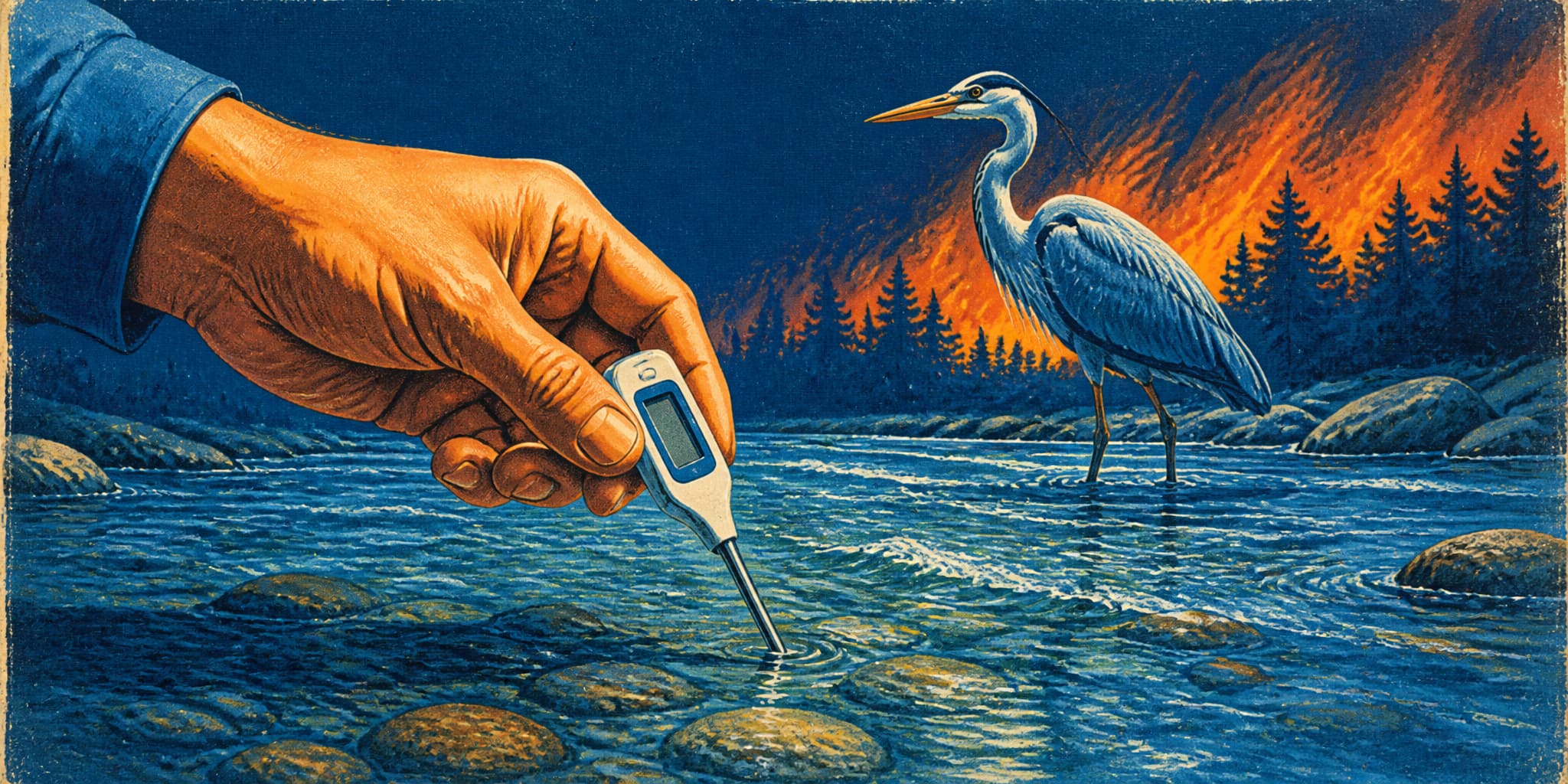
I drove south on 298 past the hay fields Wednesday morning, pulled off at Big Rock, walked down to the river with my coffee and my thermometer. It's a digital stream thermometer I keep in my vest. I bought it in 2031, after a summer when I lost count of the days I should have canceled and didn't. Thirty dollars.
I put it in at the head of a riffle where the current was moving. Waited fifteen seconds.
Sixty-nine point four.
Eight-thirty in the morning.
The river at Big Rock in late August is low. Maybe two hundred and fifty cubic feet a second, which is walking and wading water, not floating water. Clear over cobble and boulders, short riffles into short pools, cottonwoods along the banks providing the only shade that matters. Upstream, above Natural Bridge, the canyon and the springs keep things in the low sixties most of the summer. Down here the valley opens up, the irrigation ditches pull water off, and the river spreads out over warm rock in full sun. By afternoon that number would be seventy, seventy-one.
I've been walking Big Rock since before I started guiding. There used to be a deep slot on the far side, under a ledge, that held browns through August. Shaded in the afternoon, enough current to keep things moving. Last few summers I haven't found a fish there past the first week of the month. They push upstream to where a spring seeps in along the east bank, eight or ten trout stacked in a run the size of a truck bed, all of them on the same cold seam. The spring used to be one of a dozen places to find fish in August. Now it's the place. You learn which cold pockets still work and which ones the fish have given up on, and you learn it by walking the same water enough years to notice the difference.
I know what a trout does at sixty-nine degrees. The fish move to whatever current seam gives them a fraction of a degree. Head of a pool where faster water carries a little more oxygen. Shadow side of a boulder. They hold there. They stop feeding the way they feed at sixty-three or sixty-four. A brown that would come up for a hopper at sixty-five will sit at sixty-nine and let it drift past.
You can still catch them. A nymph dropped into their holding water, a streamer stripped past their nose. But you're not fishing to feeding trout. You're provoking a reaction out of a fish that's already working to hold its position.
Hook one and fight it two or three minutes in that water and it builds up lactic acid it can't clear. Its oxygen demand goes up while the water is carrying less oxygen than it would in June. You land it, hold it in the current, get the fly out, let it go. It swims off. It looks fine. Some percentage of those fish die downstream an hour or two later, in a pocket you'll never see. The client's back at the truck by then, looking at the photo on his phone.
I dried the thermometer on my shirt and put it back in my vest.
The smoke had been bad this time. Eight days, thick enough that the mountains disappeared and you could taste it in your coffee if you left the mug on the porch. Air quality in the two hundreds for three of those days. Most of the tourists stayed inside or drove west or went home. The guides I know lost the week. Fourth bad August in six years, which is about what August is now.
Wednesday the sky over the Crazies was that blue you forget about until you see it again. The air smelled like sage and cut hay.
The river doesn't clear on the same schedule as the sky. Eight days of hot air held close to the ground under smoke, no wind, nothing to speak of at night, and that heat soaks into the water and stays. Each day stacks on the one before. The air comes clean in an afternoon. The water gives the heat back over days, and slower at low flow, because there's less of it to cool. The sky opens up, the phone starts, and the river is two or three days behind.
I called the Billings client and told him Saturday might work but I'd need to check the water Friday afternoon. He said sure. I called the Bozeman couple and said the same thing. They were less patient. They had a narrow window, they said, and other guides were available. I said I understood.
I called the guy from Minnesota. He'd been waiting six days. He wanted to fish tomorrow. I told him the river was still warm and I'd rather wait. He asked how warm. I said high sixties, maybe seventy by afternoon. He said he'd fished in worse. I said I was sure he had. I told him I'd call him Friday.
Then I called Dale.
Dale's been guiding twenty-two years on the Boulder and the Yellowstone and the Stillwater. He's good. Knows the water, handles clients well, ties his own flies. We're not close but we're not unfriendly. We see each other at the put-ins and the gas station and the bar in Big Timber and we talk about what we talk about.
"You check the water this morning?" I asked.
"Sixty-eight at the Forks. Probably warmer at Big Rock."
"Sixty-nine and change. Eight-thirty."
"So seventy by afternoon."
"Probably."
I could hear his truck running.
"I've got three days booked Thursday through Saturday," he said. "Full days."
"Yeah."
"I'm going to fish early. Off the water by one. Short fights, barbless, net them fast."
I didn't say anything for a second. He wasn't wrong, exactly. Fish the morning and the water might still be in the mid to upper sixties from whatever the night gave back. Be disciplined about it and you reduce the risk. You don't get rid of it.
"The Yellowstone's under hoot-owl," he said. "Half my clients switched to the Boulder because it's open. If I tell them no, they'll find somebody who says yes."
"I know."
"I'm not saying it's great."
"I know, Dale."
We talked another minute about nothing. The smoke, a mutual friend's new drift boat, the rumor about the access easement south of town. Then we hung up.
I sat in my truck at Big Rock for a while. The river moved past, clear and low, catching light. A dipper worked the rocks at the edge of the riffle. Upstream a heron stood in the shallows. The river looked like a river.
The river at sixty-nine looks the same as the river at sixty-three. Water's clear, current moves, insects come off. You can't see a trout working to hold behind a boulder, and you can't see which of the ones you release is going to make it. So you carry a thermometer, and then you're the one holding the number. The state doesn't restrict the Boulder. No advisory, no closure. The sky is blue. My phone has messages from people who want to pay me eight hundred dollars a day to stand in a river and catch trout.
I drove back to town. I replaced a section of gutter that had been pulling away from the fascia since June. I drove to the hardware store. I ate lunch at the kitchen table and looked at my calendar. August twenty-fourth, 2038. Eight days left in the month. The smoke had cost me a full week, maybe five thousand dollars I wouldn't see. I had twelve days booked in September, but September rates are lower and September clients cancel for weather and September is when the season starts feeling like it's ending whether you want it to or not. Most of what I make, I make between the Fourth of July and Labor Day.
I picked up the phone to tell the Minnesota client that Thursday would work if we fished early and kept it tight. Then I set it down and didn't call.
Around four I drove back out to Big Rock. The afternoon light was on the water, long and yellow, and the river looked the way it had that morning. Same clarity, same current over the same cobble. A caddis hatch was coming off in the slower water above the riffle, little tan flies lifting, and a fish rose once in the shade of the far bank. If you didn't have the thermometer you'd think it was a perfect August evening.
I walked down to the same riffle and put it in.
Seventy point eight.
I dried it off and put it back in my vest. The dipper was gone. The heron was gone. The water kept doing what it had been doing all day.
I figured I'd check again in the morning.
- Rivers outlast the air: A July 2026 study in Nature Geoscience found that river heatwaves lasted longer than atmospheric ones in 99.6% of compound events, by an average of 2.67 days.
- Montana's hoot-owl rules: Fish, Wildlife and Parks triggers angling restrictions based on water temperature and flow thresholds, not air-quality or heat advisories, and reopening is discretionary even after temperatures drop.
- Catch-and-release at warm temperatures: A Montana field study on the Gallatin and Smith rivers found no salmonid mortality when daily water maxima stayed below 68°F, but rainbow trout deaths reached 16% in the hottest conditions tested.
- Greater Yellowstone warming projections: The Greater Yellowstone Climate Assessment projects mid-century summer warming of 3–5°F or more in the region's river valleys, with longer warm spells, earlier runoff, and increasing fire potential.
