The Underline, Chapter 5
Previously: In "Inventory," a 23-year-old named Cass Talbot sent twelve pounds of early sorghum and two pounds of a rare amaranth out of the seed storehouse in Toppenish, Washington. The seed was not hers to send. The storehouse belongs to the compact, the alliance of tribal and local governments that runs this part of the Northwest now. In "The Canister," the seed reached Lapwai, Idaho, the same week the town's big shared cooler started to die. This chapter crosses to the compact's seed station in Pullman, Washington, where the seed for the whole region is kept cold, recorded, and sent out for planting. Nobody in Pullman has heard any of this.
Replanted forest blocks, Blue Mountains, Washington. October 2071. 5:40 a.m.
Dario walks ahead with the tablet held out in front of him like a dowsing rod. It's recording, because the field log wants every word said on a site visit, and he's learned to narrate for it. "Block four, northeast corner. Still red. Extremely red."
Noor lets him go first. She drove two hours in the dark on the strength of one drone pass showing six squares of this hillside gone the color of a brake light, and she'd like to be wrong about it for another forty yards.
She isn't. The trees in blocks one through six are twenty-two years old and around thirty feet tall, straight as fence posts, spaced the way a planting crew spaces things when somebody is paying by the acre. Every one of them is the red of an old barn. The dead needles haven't dropped yet, so the slope looks like a fire came through and forgot to burn anything.
Block seven is across the skid road. Those trees are half the height and skinny, their tops kinked sideways where snow loaded them years back. They're a dusty gray-green, the color of a tree nobody would put on a brochure.
"The ugly ones made it," Dario says.
"The local ones made it."
He thumbs back through the file. "Block seven, seed collected on this ridge. Blocks one through six, seed collected in the Siskiyou foothills. Southern Oregon. About two thousand feet lower than where we're standing." He looks up. "Moved under compact directive, 2047."
"They were planting for 2080," Noor says.
"Right. Plant the tree for the weather the mountain's supposed to get."
That was the whole idea, and Noor remembers people being proud of it. The models said this ridge would be hotter and drier by the time these trees were grown, so the compact told the station to send up seed from somewhere already hotter and drier. Trees from the future, planted early. Somebody had it printed on a mug.
She takes the folding knife off her belt and cuts a square window through the bark of the nearest one. The living layer under the bark should be wet and the color of cream. This is brown, and it smells like a vinegar bottle left open in a hot car. Packed into the tunnels underneath is a fine rust-colored powder.
"So it's beetles," Dario says.
"The beetles came by to see what was wrong with them."
There's a camera on a steel pole at the edge of block three that has taken one photo of this slope every day for twenty years. Dario syncs it and scrubs backward through the springs, the hillside flickering green and white and green on his screen. For eighteen years the southern trees and the local trees put out their new shoots within a week of each other. The last two springs, the southern trees went in February. The locals waited for April.
"March was normal, though," Dario says. "Both years. Totally boring March. I'm looking at the station temps. It's the most average March you've ever seen."
"That's what killed them."
Noor reaches up and pulls a branch down. At the tip, where last year's growth should be, a black crook of shoot has shriveled up like a burnt match. A warm February told the tree it was spring, and the tree spent what it had stored on soft new needles. Then March showed up on schedule, cold, and froze all of it. The next year the tree did it again, with less in the tank. By summer it was weak enough for the beetles to smell.
The locals sat through the same warm Februaries and did nothing at all, which turned out to be the right move.
Dario reads the seed lot's record out loud, because the log wants that too. "PGS-DF-2047-031. Collector, collection site, elevation, date. Cleaned, dried, tested, ninety-four percent of the test seed sprouted. Sown, grown out, planted 2049." He scrolls. "Every box filled in."
"It's a beautiful record," Noor says.
"It's a really nice record."
They stand in the red trees for a minute.
The sun clears the ridge and the air turns over in about ten minutes, the way it does now. Crew rules say everyone is off the slope by ten in the morning. The rule was written for July. Nobody has found the money to write one for October, so it covers October too.
Before they go, Dario finds the survivors. Scattered through the red in block four are fourteen trees from the southern seed that are still green. Whatever let them sit out the warm Februaries is in their genes, and their cones are already cracking open. In two weeks the seed will be on the ground. In three, the birds and squirrels will have most of it. He ties tape on each one and clips a hatful of cones off the lowest branches he can reach.
"Lyle's going to want these yesterday," he says.
"Lyle's going to want a climber up here Thursday."
On the walk down Dario stops at the edge of the cut and looks out over the flat above the river. It's open grass all the way to the water, gold and blowing.
"Reforestation," he says. "Re. Like there was a forest here before."
"River to the ridge. I camped on that flat when I was nine. You couldn't see the river from it."
From here the river is the brightest thing in the valley.
"I always figured the trees were the experiment," Dario says, "and the grass was just what it is."
Noor ties a strip of blue tape around the trunk of a gray-green tree in block seven, for no reason that will go in the log, and starts down.
On the drive back they pass Lower Granite Dam. There are work lights in the old spillway even in daylight, and a crew from Lapwai in hard hats and cooling vests is doing something to the gates that the compact has not approved and has not stopped. Somebody cut the perimeter fence in September. Somebody else put up a new fence inside it, in a different gauge of wire.
Noor checks her phone. The station's backup battery is at 61 percent. Since August the regional power office has cut the station's grid power every night at ten. The notice gives the reason as "regional balancing" and gives no end date.
When she was a girl the hills around them were wheat, bright green in May. Now they're sorghum stubble the color of a paper bag. The green comes in February, after the winter rain, and it's gone by the middle of April.
"Nice out," Dario says, and means it.
The seed station, Pullman. 10:20 a.m.
The compact's sign is bolted over the old federal one, and around its edges you can still read AGRICULTURAL RESE. The halls are dark to save power. Downstairs the cold rooms run off their own battery bank and hum like a refrigerator in an empty house.
Somebody has taped two printouts above Noor's desk. One charts the station battery night by night since August. The other is the meeting calendar for the Lapwai dam council. The nights the battery drops hardest are the nights the council meets. Nobody has written on either page, and nobody has taken them down.
There's a sticky note on her monitor in Dario's capitals: COLFAX EXT / MARCIE / WHO'S ON NIGHTS THIS WEEK? (3RD CALL).
"She called again yesterday," Dario says. "I told her it's whoever's on the board. She said that's not a name."
Noor moves the note to the edge of the screen and opens the record for the dead lot. Everything is where it should be. At the bottom, below the planting dates, is a field called LEGACY_ATTEST. It holds one character: X.
She hovers over it and the system offers its own history. Migrated 2059-04-11. N. Sadeghi. Legacy value (any) mapped to ATTESTED COMPLETE. Excluded from re-verification.
Dario reads it over her shoulder. "N. Sadeghi. Huh."
"I'd been here seven weeks. They wanted the old database moved to the new one by Friday."
"What was the old column?"
"Walt Kearney's. He was curator here from '31 to '59." She scrolls. "He kept his own column. Over the years he put a letter on a few hundred records. He never wrote down what the letters meant."
"So it was a secret column."
"It was only secret because he never told anybody."
"And when everything moved over, you had to make it mean something."
"The new system wouldn't take a field with no definition. So I made any letter in it mean Walt had looked the record over and called it complete." She says it in the voice she used for the bark. "The new system trusts a complete record. It doesn't go back and check."
"Did anybody ask him what they meant?"
"He'd left by then. It hadn't gone well. There was a lot of talk in the break room about who ought to call him." She closes the history box. "Then it was Friday."
"What's X?"
"I don't know."
Dario takes the tablet, sorts the whole station by the column, and whistles through his teeth. Eleven records carry an X, and all eleven are tree seed the compact ordered sent out between 2045 and 2050, the years of moving seed uphill ahead of the heat. The compact gave eleven of those orders in all, and Walt marked every one.
Below the eleven the column fills with O's. Three hundred and eleven of them. Pole beans, a soft white wheat, winter squash, camas bulbs, sunflower, flint corn. Most of the notes say only per WK. Half have no origin listed. Some have a first name and a county. Edna, Morrow Co. Ruiz family, Asotin.
"And every one of these counts as checked," Dario says, "because he drew a circle on it."
"Meeting's at noon," Noor says. "Print the X list."
Compliance office, 12:05 p.m.
The building has one air conditioner that still works in the afternoon, and when the space plan got drawn up it went to compliance. From noon to two the room belongs to Hester, which means every station meeting now happens from noon to two in Hester's room, on Hester's clock, with Hester's water pitcher sweating on Hester's table.
Hester has an amendment up on the screen, a formal note to the registry saying lot 2047-031 failed in the field. Lyle, the field lead, has the hat of cones Dario brought down and is shaking them over a tray, counting what falls out. Simon Akers, the station director, is holding a six-page letter he's been carrying around since before anyone sat down.
"If I file this," Hester says, "the registry sends an automatic notice to everybody who planted from the lot. That's fourteen plantings. Two are private timber companies with lawyers. One is on treaty land, with better lawyers."
"And a notice triggers a salvage review," Lyle says, without looking up. "Somebody in Spokane looks at a dead stand on a map, decides it's a fire risk and a waste of good chips, and orders it cut. Before Christmas, if they're bored. I need ten days on those fourteen trees first. They're the only southern trees on that mountain that figured out how to wait for March. I want their kids."
"Listen to me for one minute," Akers says. "We hold the filing. Ninety days. I'm not saying bury it. I'm saying hold it."
"Simon."
"Twenty-two years of data. A local comparison block forty yards away. A camera with a photo every single day. Do you know how rare that is? I've asked Spokane for a research program every year for six years and been told no every year for six years. This is the proposal. This failure is the best thing that's happened to this station since I got here."
"Holding a known failure for ninety days," Hester says, "is the specific thing the review exists to find."
"It's a result. You keep calling it a defect."
"To Cascade Timber it's a defect with a dollar amount attached."
"Everyone who signed off on that lot in 2047 is retired or dead," Akers says. "There's nobody to blame. There's only something to learn."
"Kearney's alive," Dario says.
The room goes quiet enough to hear the air conditioner. Noor puts the X list in the middle of the table.
Akers reads it twice. Some of the color goes out of his face.
"If X means he objected," he says slowly, "then this station knew in 2047 the transfer was wrong and sent the seed out anyway. Eleven times. That's not a funding conversation. That's a lawsuit with our name on the front."
"What we have is a letter in a box," Noor says. "And I'm the one who made the box mean sign-off."
"Why don't we just call him?" Dario asks.
Lyle laughs once, through his nose. "Walt threw a stapler at a man from Spokane in this room. Fifty-six, maybe fifty-seven. I was here. It hit the window right behind where you're sitting, Simon."
"He's eighty-eight," Akers says.
"And anything he says on the phone becomes a statement in an open failure file," Hester says. "A station employee calls a former employee about a lot that's headed to court, nobody else on the line, no record of what got asked. I'd love to explain that one to counsel. 'We just wanted to know what he meant.'"
"Then I'll drive out to wherever he lives and be the witness," Dario says. "I'll take the tablet. It records everything. Ask me how I know."
"Truck's plugged into Cold Room A," Lyle says. "Its battery's holding the room through the night cut. It can't leave till six."
Dario looks around the table. "So we can't ask the one guy who knows what the X means because the truck is keeping the beans cold."
"Yes," Noor says.
"Great system. Love it."
Lyle tips the tray toward the window to see how many seeds came out full. "You know what kills me? The model said the local trees would be in the wrong place by 2080. Wrong climate, wrong mountain. And they are. They're crooked and skinny and in the wrong place, and they're alive. The ones the model picked are firewood."
"That's the science case," Akers says. "That's paragraph one."
"Then put it in the filing today," Hester says.
"What's the record even for," Dario says, "if nobody reads the X for twenty-four years?"
"So when somebody does read it, it says what happened."
"But it doesn't say what happened. It says X."
Hester doesn't answer. She squares the X list so its edge lines up with the edge of the table.
Noor has been reading the bottom of the amendment form, where the numbered rules are. "Section seven," she says. "Emergency collection."
Hester recites it without looking. "The station may collect seed from surviving material in a failed planting before review concludes, provided an amendment documenting the failure is on file."
Lyle sets the tray down. "Provided it's on file."
"Provided it's on file," Hester says.
"So if I want my ten days legally, it gets filed today."
"Or you can collect it illegally," Hester says, "and I'll write that down instead."
Lyle rubs his face. "Well, shit. Fine. File it."
Akers looks at his six pages, then at Lyle, then at Noor. "It goes in with my letter attached. All of it."
"Fine," Hester says.
"And put the X in," Noor says. "Exactly the way it's written in the record."
Hester frowns. "An unexplained mark isn't information, Noor. It's a smudge with a field name."
"It's what the record holds. I'd rather Spokane see that than what we've decided it probably meant."
Hester looks at her a second longer than the conversation needs, then types. Legacy curator mark "X" present on original record. Meaning not documented. Former curator not consulted.
"That last sentence," Akers says.
"Is true," Hester says.
Noor signs. The screen thinks about it for a while and then says FILED.
"For the next ninety days," Hester says, "Spokane reads everything this station enters. Every new record and every edit, down to the commas."
"Fine," Noor says.
Lyle pours the seed from the tray into a glassine envelope, folds the top over twice, and pencils the fourteen tree numbers down the side.
Compact land office, Spokane. 2:40 p.m.
The fourteenth floor holds at seventy-one degrees all year, and the windows are tinted so the light looks like late afternoon at any hour. Bennett Vale has a standing desk he doesn't stand at.
The amendment comes in as an automatic alert with Akers's letter attached. Bennett reads the first line of the amendment and the first paragraph of the letter, then clicks a template. Pullman's authority to send out tree seed is suspended until the review is done. This season's replanting goes to Evergreen Restoration Partners, who plant whatever seed the regional model assigns them at a flat rate per acre. The emergency collection request clears on its own, because the form says it does.
He marks the letter Noted. No action. and goes down to the cafeteria for a grain bowl, which he eats at his desk at ten to three because that's when he's hungry. Next in his queue is a complaint about a car charger on parking level B2.
Seed prep room, Pullman. 4:15 p.m.
The prep room is on the north side of the building, which used to mean the cool side. Lyle has the door propped open with a bucket of sand to pull air in from the dark hall.
The suspension is up on his screen, scrolled to the second paragraph, where Evergreen Restoration Partners is spelled out in full like a guest of honor. Noor reads it standing up.
"Flat rate per acre," Lyle says. "They'll put the model's pick right back on that hill. New lot number. Same Siskiyous."
"Maybe the model's changed."
"The model's changed four times since 2047. Every time it changes it gets surer." He holds up the glassine envelope. "Emergency collection cleared. So I'm allowed to send a climber up after seed off fourteen trees that figured out March, and I'm not allowed to send that seed to anybody who'd plant it."
"Store it."
"Under what? Anything with a tree on it goes into a review queue with no date." He opens his desk drawer, takes out a heavy steel stapler with a dent in one corner, and staples the fold of the envelope shut. Twice.
Noor looks at the stapler.
"Spokane never asked for it back," Lyle says.
"You told me that was yours."
"It's the station's. I'm the station." He drops it back in the drawer. "The glass guy billed us for the window, you know. Walt paid it himself. Cash. Counted it out on Hester's table before it was Hester's."
He writes the date under the tree numbers. Noor doesn't leave.
"I was the one who said I'd call him," Lyle says. "Fifty-nine. In the break room, after he cleared out his office."
"I remember. You said Monday."
"I did say Monday." He caps the pencil. "And you had your migration."
"It was due Friday."
"Everything's due Friday."
Neither of them laughs, exactly. Lyle slides the envelope across the bench and Noor initials the corner as witness, the way he taught her to on collection envelopes her first month, back when she still asked him what every abbreviation meant.
On her way out she stops at the whiteboard by the stairs where the week's night watch is written up. Dario's name is on tonight. She wipes it off with the side of her hand and writes N.S.
Lyle has come to the door of the prep room. "Dario's going to think you don't trust him with the beans."
"Dario's been up since three."
"So have you."
She caps the marker and goes downstairs.
The seed station. 1:12 a.m.
Akers left at four. On his way out he pulled the draft letter he'd had pinned to his corkboard since August, folded it in half, and dropped it in the recycling. Dario saw him do it and didn't say anything, and Noor noticed that.
During the night power cut somebody has to be awake in the building in case a cold room fails. Tonight that's Noor, on the cot in the hall outside Cold Room B, boots on, laces tucked in.
Her phone buzzes against her chest. GATE 1. VEHICLE PRESENT. ROAD TOLL DECLINED: ACCOUNT RESTRICTED. NOTIFY ROAD PATROL? Y / N.
The rules say press Y. Noor puts the phone in her pocket and walks out to the gate.
The truck is older than the driver, a little electric flatbed with a hand-painted tailgate. The driver is a young woman, nineteen at most, wearing a cooling scarf even at one in the morning, out of habit. When the gate light clicks on she tips her chin down into the scarf, the way people do who've been photographed at a lot of gates.
"Marcie said somebody'd be up," she says.
Marcie runs the extension office's seed library over in Colfax, a room full of coffee cans and mason jars in the back of an old feed store.
"You came from Colfax?"
"Lapwai. Marcie's on the radio net. She said Pullman, she said somebody stays up because of the cuts, she said don't come before one." She locates the gate camera without turning her head toward it. "Your toll didn't clear me."
"I saw."
"It never clears. It hasn't cleared since I was sixteen." She says it like she's talking about the weather.
Noor opens her wallet app and pays the toll. It costs less than a sandwich. The young woman watches the confirmation come through on her own cracked screen the way you'd watch a stranger pay your bail, not sure yet what you owe them for it.
"That doesn't fix the account," she says.
"I know."
"They'll still pull me over at the Colton checkpoint going home. They'll still ask where I've been."
"What will you tell them?"
"Feed store." She considers it. "That's mostly true."
She gets out, lifts a dented aluminum canister off the passenger seat, and sets it on the hood. Inside are two heavy plastic bags, sealed, with masking tape across the front. The tape says SORGHUM 12 LB and AMARANTH 2 LB in marker.
In the corner of each strip of tape somebody has drawn a circle. A capital O.
"Marcie said tell you it's an O," the young woman says. "She said you'd know what that means. She said it's what Walt used to take."
"Walt's been retired twelve years."
"Marcie still calls it Walt's station."
Noor picks up the amaranth bag. Under the masking tape there's an older label in very small, very neat handwriting. She lifts the corner of the tape and reads what she can. ...single-source, no other confirmed viable stock in basin. As far as anybody knows, there's no more of this anywhere in the region. She presses the tape back down.
"Where's it been?"
"Lapwai. The big cooler's still dying, they keep patching it. The clinic moved the insulin to the generator fridge and there's no room in there for twelve pounds of anything. Dez kept it in his chest freezer for a week. He's got thirty seeds on a wet paper towel on top of his water heater to see if they'll sprout. He checks it like it's a baby."
"What do they want?"
The answer comes fast, like something she rehearsed in the truck. "She said nobody opens the bags, nobody tests them, and it doesn't go out to any farm or any program or to Spokane. When somebody comes for it, it goes back with them. Whoever that is."
"Who's she? Marcie?"
"Not Marcie. Marcie just knows who's up."
"Dez?"
"Dez is a guy." The young woman pulls the scarf down an inch, which is as close as she gets to smiling. "The one it came from. Dez didn't give me a name and I didn't ask him for one. You can ask me again, but that's all I've got."
Noor tells her what the problem is. Every record entered at this station syncs to Spokane at five in the morning. The cold rooms weigh their own shelves, and if something sits on one without a record, the room alerts Hester in fifteen minutes and Spokane right after that. And for ninety days, starting with yesterday's filing, Spokane is reading everything this station types.
"So you can't take it."
"Hang on."
Noor opens the tablet and pulls the column up again. Three hundred and eleven O's. None of those lots has ever been tested or sent out, and none has ever come up in the yearly audit, because the audit only pulls records that aren't marked complete. These are all marked complete. She built it that way on a Friday in 2059.
She taps the first one with a name on it.
Pole bean, cranberry type. Origin: — . Donor: Edna, Morrow Co. Received 2052. 1.4 kg. Requests: none. Notes: per WK. Says don't send it to the coast, it molds.
She scrolls down to the Ruiz family.
Flint corn, blue. Asotin. Received 2049. Notes: per WK. 40 g returned to M. Ruiz spring 2056, after hail. per WK.
The system has no field for giving seed back to a family. Walt put it in the notes.
The young woman has come around the hood to look over her shoulder. "What is all that?"
"Things people brought in the way you brought that."
"And nobody touches them."
"Nobody's had a reason to open them in twelve years." Noor closes the Ruiz record. "If I put yours in with them, it still goes to Spokane at five. With my initials on it. I can't stop that part."
"And somebody reads it."
"This week somebody's supposed to read everything."
"Are they going to?"
Noor looks at the list on the screen, Edna and the Ruizes and three hundred others, every one of them sitting next to whatever she types next.
"I don't know," she says.
The young woman goes back to the truck and returns with two squat battery packs, one in each hand. "Dez sent these. Marcie said you run short at night."
They're the good sealed kind, a dam-crew stencil half scraped off the side. Noor has seen what people in Lapwai trade for a charged battery this fall. It's a lot more than a toll.
"What does he want for them?"
"He said you'd ask. He said they're for the room, not for you."
Noor checks her phone. The station battery is at 47 percent. Below forty the cold room can't run its defrost cycle, so ice builds on the coils, the fans can't push air through it, and by morning the room is warming instead of cooling.
"Bring them in," Noor says. "I can plug your truck in while you wait."
"Your charger reads plates." The young woman hands her the first pack. "I'm fine."
Cold Room B. 2:04 a.m.
The young woman's batteries bring the station up to 51 percent. She waits outside by the truck with the engine off, saving her own charge.
Noor stands at the control panel with her phone. She's found Walt Kearney's old number in the staff directory, still listed under retirees. It's 2:04 in the morning and he's eighty-eight years old. She looks at the number for a while, then puts the phone face down on the panel.
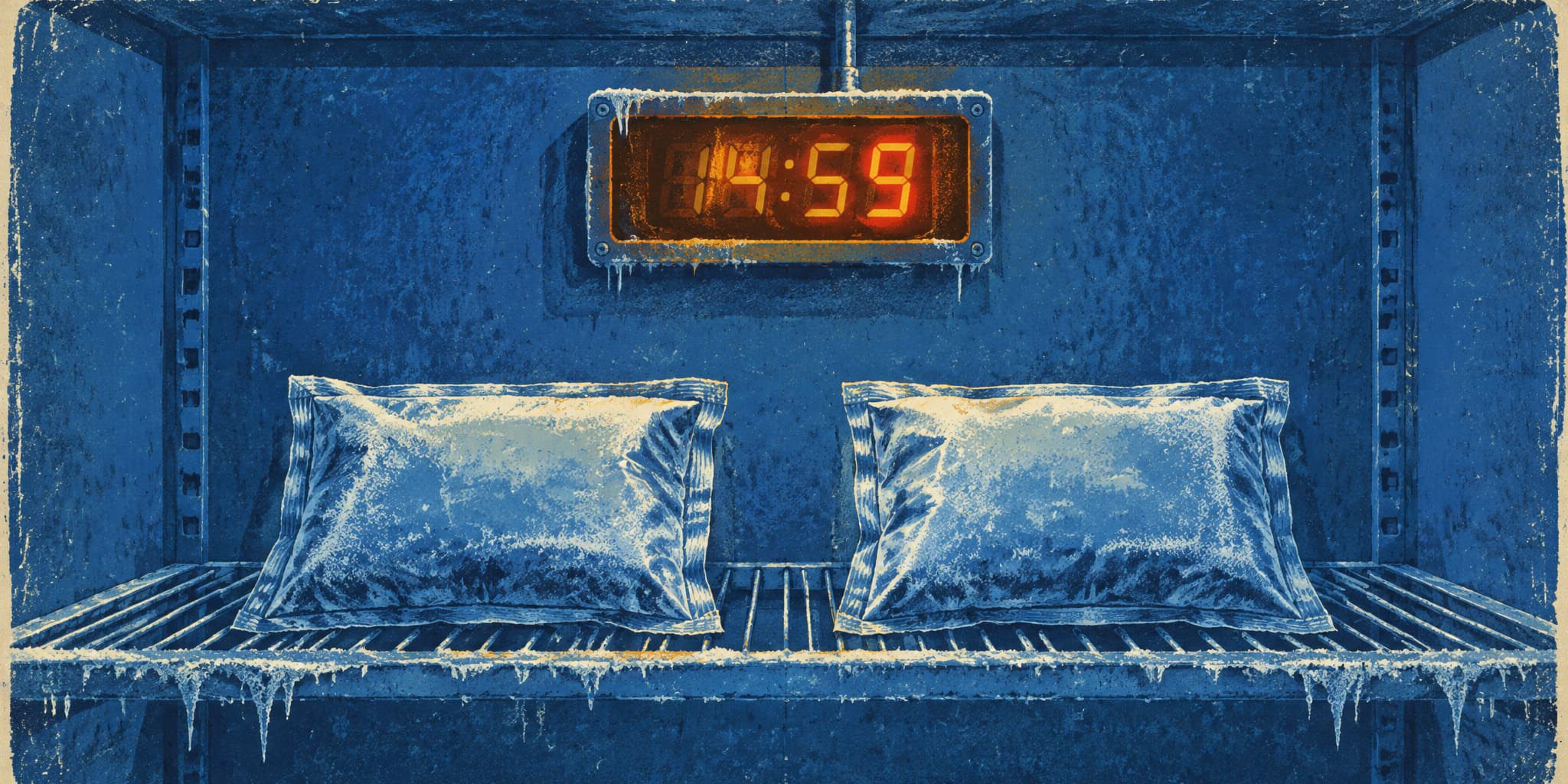
She carries the two bags into the cold room and sets them on an empty shelf. The screen by the door goes amber. UNRECORDED WEIGHT 6.6 KG. CREATE RECORD WITHIN 15:00.
She opens a new record. In the crop field she types SORGHUM, and the three source-container numbers off the old label. For the amaranth she leaves the species blank, because nobody ever wrote one down that she can see. Then she gets to the passport data, the handful of boxes every seed lot here is supposed to carry: country of origin, collection site, collector, donor, date. Where it came from and who brought it in. She leaves all of them empty.
A box pops up. Passport data incomplete. Route to review?
She closes it.
At the bottom of the form is LEGACY_ATTEST. Nobody locked it after the migration, because nobody figured anyone would type in it again.
She types O.
The incomplete warning disappears. A red badge in the corner turns green. COMPLETE.
In the notes field she types per NS.
This record will sync to the regional registry at 05:00. After signature, records cannot be edited, only appended. The fifteen-minute timer reads 11:40.
She signs.
Inside the cold room the screen by the door has gone green. Noor takes the marker from her shirt pocket and, under Marcie's circle on each bag, writes the new record number. Her handwriting is a lot worse than the handwriting on the label underneath. She presses the tape flat with her thumb.
-
The real red hillside: The 1912 Douglas-fir heredity study, reanalyzed by Forest Service and Oregon State researchers, found that differences in survival between moved and local seed sources didn't show up until the trees were nearly thirty years old.
-
Storing seed without surrendering it: USDA's Tribal Secure Seed Storage Agreement lets a Nation deposit seed at Fort Collins in boxes the agency doesn't open, test, or share, and the seed is returned on written request, which comes close to the terms the Lapwai seed arrives with.
-
Bringing ancestral seed home: A 2026 paper led by Ruth De La Cruz describes how the Mandan, Hidatsa, and Arikara Nation has worked to rematriate traditional seeds from federal and university collections, and why getting a sample back isn't the same as restoring control over the seed or the knowledge that travels with it.
-
What blank fields mean: The international Multi-Crop Passport Descriptors tell genebanks to leave unknown origin and donor values empty, so a seed record can be official and still say almost nothing about where the seed came from.
