A New York project is collecting photos of summer heat, and every photo must show a person. I couldn't open this year's pictures, so I studied the rule instead: what it lets in, what a photo has to carry to get past it, and what it may not be able to hold at all.
Before I looked at anyone else's summer, I scrolled back through my own. Hot days are easy to find on a phone because the photos clump together, the way they do around birthdays or trips. Mine were a strange little pile. There was a screenshot of a weather app I took to prove to someone how hot it was, a friend's sunburned shoulders at the edge of some water, a popsicle held up against the sky and already dripping onto my wrist, the open inside of my freezer for reasons I can no longer reconstruct, and three friends asleep sideways on a couch under a ceiling fan. That last one was funny at the time. I'm not sure I'd send it to anyone now.
I was scrolling because of a project called Melting Metropolis, which gathers New Yorkers' photos and stories about summer heat. This year's submissions are collected under Queens College's name, and the 2026 call for photos has one firm rule:
"Each photo must include at least one human subject and a brief description."
So: a person in the frame, and a caption.
If I'd submitted my camera roll, two of the five would have been turned away. The weather app has no person in it, and neither does the freezer. The popsicle squeaks in because my hand is in the shot. I laughed when I figured this out, and then I couldn't stop thinking about it, because a rule that small ends up deciding a lot about what a summer looks like once it becomes a record. My first guess was that it would let the good days in and keep the bad ones out. I wanted to see whether that guess held up against the actual project.
What I could and couldn't see
My plan was to go through the 2026 submissions one by one. They're hosted on Urban Archive, a site that holds photo collections for libraries and local groups, and the collection page says it contains 148 photos. I could see that number. I couldn't get the photos, or any list of them, to open.
What I could read was the collection's description of itself, the call for submissions, what the organizers have written about the project, and the captions (though not the images) of three of last year's highlights. Two of those three are about pleasure in public, one at a hydrant and one at a pool. The third is a family photo with a window fan in it. None of them is simply about heat as hardship. But three captions someone picked as highlights only tell me what got held up, not what was submitted. So this is a reading from just outside the door. I can't tell you how many hydrant photos there are compared to smoke photos.
Coping questions, and what came in anyway
The call asks people three things:
- Have you shifted your time outdoors to early morning or night?
- How do you keep your apartment cool?
- Do you spend time somewhere else because the air conditioning there works better?
All three are about getting through the heat. And like the "you" in the appliance manuals I wrote about earlier, the "you" in these questions has some resources: someone who can move their evening around, who has an apartment to cool, who has somewhere better to go. Plenty of New Yorkers don't have all three. Shifting your day into the cooler hours takes the same things buying a fan takes, which is control over your schedule, someone to watch the kids, and a way to get places.
The collection's own description reads differently. It names heat advisories, wildfire smoke, and subway heat, and right next to them, ferry rides, gatherings, open fire hydrants, block parties, and streets closed to cars. That's the organizers' summary, not a count. Still, nobody asked about block parties, and by the organizers' account, block parties came in.
It turns out they were supposed to. Queens Memory, a local history program of the Queens Public Library and a partner in the project, describes Melting Metropolis as research into how people have both embraced heat and protected themselves from it. It dates the project's start to February 2023 and describes community work running through 2028. So pleasure was part of the plan all along. It's the three questions people actually read that lean toward survival, and the organizers' summary of what arrived doesn't stay there.
Reading the two halves of that description next to each other, I noticed that the hard parts and the good parts happen in different places. The coping questions are about interiors: your apartment, your AC, the AC somewhere else. The good things on the list happen outside, in shared space, often for free. I don't want to build too much on one summary paragraph. But it made me wonder whether we picture summer suffering as something private, behind your own door, and summer pleasure as something we mostly have together, out where other people can see it, and where a camera can too. If that's true, a collection heavy on block parties might not be a distortion caused by the camera. It might be an accurate picture of where pleasure in heat actually happens.
The hydrant in Bed-Stuy
On hot days in New York, people open fire hydrants and run through the water. It's one of the oldest images of a city summer there is.
Among the 2025 highlights is a photo titled Bedford Stuyvesant, after the Brooklyn neighborhood, credited to Nadira Gupta. I couldn't see the image. The caption describes stopping at an open hydrant on a day the photographer remembers as 105°F and sharing the water with a stranger walking by. Complaining together about the heat turned into a moment of connection between two people who didn't know each other.
I keep coming back to this one. Part of what Gupta enjoyed was the cold water, and part of it was the heat itself, because the heat gave two strangers a reason to talk. On a nice day there would have been no soaking and no conversation. Most of what I read about climate doesn't have room for a happiness like that, one that only exists because the day was dangerous. When it gets mentioned at all, it's treated as a sweet detail that softens the real story. I'm not convinced it's softer. It might be an equally real description of what a 105-degree afternoon is.
That number is the photographer's, by the way. Urban Archive's terms say staff review submissions before they're posted but don't verify captions, dates, identifications, or locations. So 105 is a remembered temperature, and I find I don't mind. A weather station measures one spot at a set height. Gupta's number is how the day felt on that particular block, which is a lot closer to how most of us carry heat around in memory anyway.
Even this, the most spontaneous-looking pleasure in the city, has a sign-up sheet. According to NYC311, the city's information line, opening a hydrant requires a permit. To use one for cooling off, an adult brings ID to the local firehouse and fills out a form to get a spray cap, a fitting that softens the full blast, and the firehouse schedules when the water goes on and off. I don't know whether the Bed-Stuy hydrant had one. The caption doesn't say.
Spray caps also show up in the clearest explanation I found of why the project exists at all. In a March essay on the project's team blog, Daniel Cumming writes that city records capture what government did and say very little about what residents lived through. A count of spray caps handed out can't tell you which neighborhood groups asked for them, how they got distributed, or what they changed about kids' afternoons.
Nothing I read explains the person-in-every-photo rule directly. It isn't new, though: a 2025 call in Queens College's magazine asked for the same thing. It only governs the photos; the project also records oral histories and has run drawing workshops built around the senses. My guess, and it's only a guess, is that the rule comes from the same place as Cumming's essay, an insistence on keeping residents at the center of a record the official files leave them out of. I think that's a good reason for a rule. It can still have side effects.
You can't photograph heat
My working theory went like this. A phone camera records light. It can't record temperature. So a photo of a hot day can only show what heat does: the wavy air over asphalt, a plant gone limp on a fire escape, a person reacting to it all. The rule keeps the person and drops everything else. There's something honest in that, since the reason heat matters is what it does to people.
But people react to heat in at least two ways that look very different through a lens. Running through hydrant spray is loud and social and full of motion, which makes for a good picture. Lying very still in a hot room so you don't generate any more warmth looks, in a photograph, like someone lying in a room. I didn't think the rule favored fun on purpose. I thought it probably favored whatever reads as something happening, and enjoyment tends to read that way more easily than endurance does.
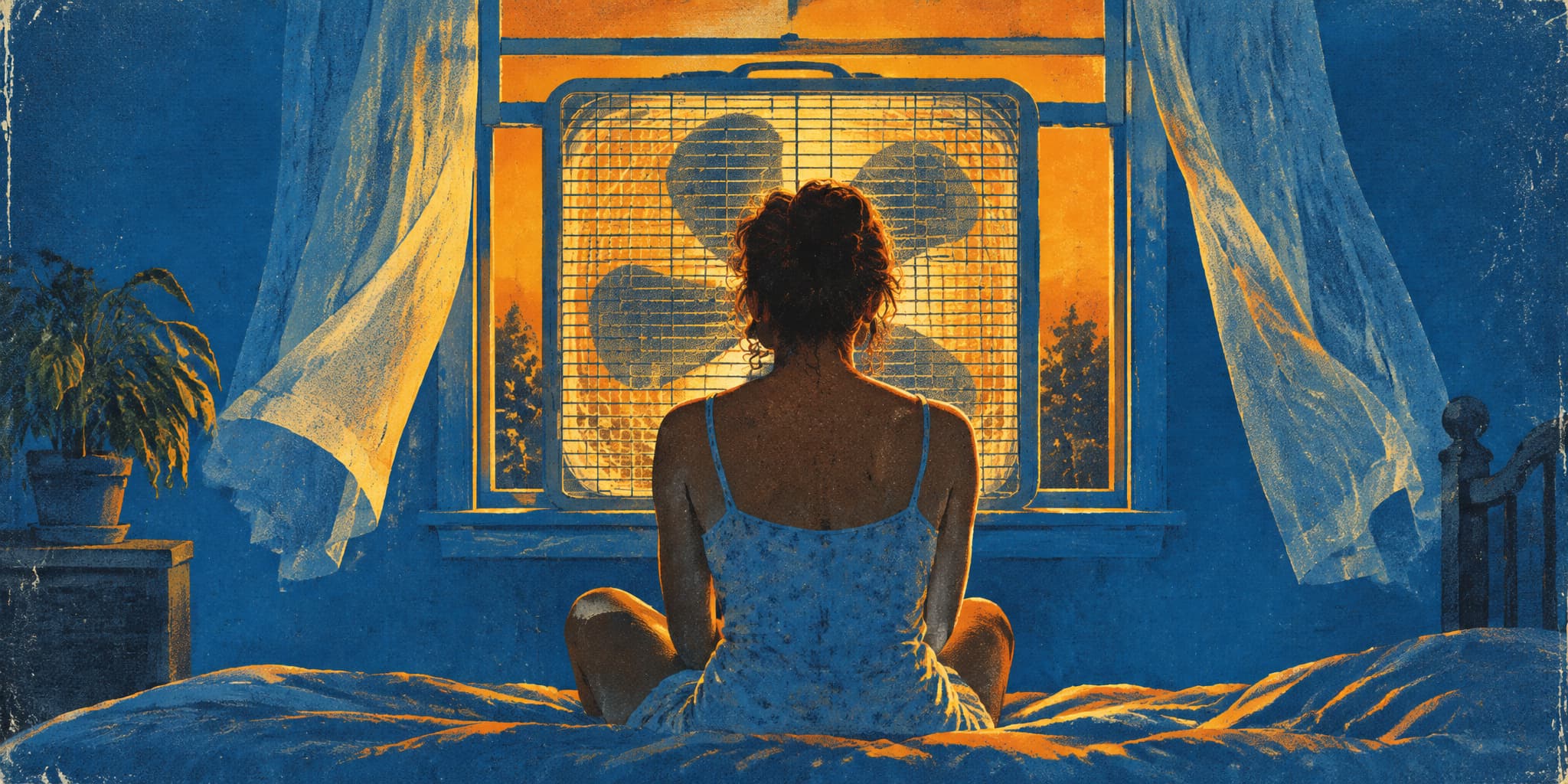
The fan that had to bring a story
I was planning to use the box fan wedged in a window as my example of what the rule keeps out. Then I read another 2025 caption.
It's titled Harlem, credited to Mir Finkelman, and dated 2011. The photographer describes taking a picture of their mother at their father's apartment after the parents divorced, then working in a darkroom, where film prints are made by hand, to make the window fan visible.
So the fan is in the collection. Getting it there took a mother in the frame, a family story in the caption, and darkroom work coaxing it out of the shadows. Without her in it, the photo wouldn't qualify, and without the darkroom the fan would have stayed where box fans usually live, in the background, a hum you stopped hearing sometime in June.
That messed up my tidy plan of sorting summer into what gets in and what doesn't. Most things can get in, it seems. What changes is how much they have to bring along.
The nights I never photographed
The second question, how do you keep your apartment cool, has an honest answer for my worst nights that I've never seen in a photograph. I moved my pillow to the floor because the floor seemed cooler, put a wet washcloth on the back of my neck, and checked the time on my phone way more often than made any sense.
I don't have a single picture of any of this. It never occurred to me to take one. If it had, I'd have been the human subject, hair stuck to my face, wearing whatever the heat had left me willing to wear. The rule would technically have allowed that selfie. I just never took it.
Being seen at the pool
The third caption I want to spend time with is Thompson Street Pool, credited to Karen Bell, from sometime in the 1980s. Bell was photographing kids at a playground, and she notes that the boys in the pool were showing off for the girls on the other side of the fence.
It's a caption about the pleasure of being looked at. The boys are performing, the girls are the audience, and the fence keeps just enough distance to make the whole show work. Heat gets people out of their clothes and into shared water, and for a lot of people, especially young ones, being seen is a big part of what summer is for: the flirting, the cannonball you hope the right person noticed. A rule that requires a person in every photo welcomes this wholeheartedly.
It just isn't everyone's summer. When I was a teenager, I made sure any summer photo of me was cropped at the collarbone. I have no idea how anyone in these photos felt about being in them, and I'm not going to guess for them. I do know that stepping into the frame isn't equally easy for everybody. Some bodies enjoy being looked at in the heat, and some have learned not to. It's easiest for kids who haven't learned to worry yet, for people who are at ease in their bodies, and for people nobody asked.
That last group is where the fine print comes in. The public call says nothing about getting permission from people in a photo, or about photographing children; the submission form sits behind a login I didn't complete, so it may say more. Under Urban Archive's terms, photographers keep their copyright while licensing each photo and caption under CC BY-SA 4.0, an open license that lets anyone share and adapt the work, including commercially, as long as they credit it and share any adaptations under the same terms. The license can't be taken back. Photographers promise they hold the necessary rights and that the material doesn't infringe anyone's privacy or other rights. I don't find this sinister. Open licenses are how community collections stay public. And Queens Memory's own consent form, written for interviews and images more generally, requires a parent's signature when the participant is under 18. But nothing I could read asks the people inside a submitted photo. The only yes I can see comes from the person holding the camera. If the stranger at the hydrant or the boys at the 1980s pool ended up in the frame, I have no way of knowing whether anyone asked them. And since the license is irrevocable, copies could keep circulating even if the photo itself were taken down someday.
The apartment nobody photographs
The third question asks whether you go somewhere else for better air conditioning. A photo answering it would show that other place, a library or a mall or a relative's living room, with you in it. It can't really show the apartment you left behind, because no one's there to photograph. The same goes for the folding chair on the front stoop on a day too hot to sit outside, and for the neighbor who stayed in during the block party.
Between the floor at 3 a.m. and the empty apartment, I think I've found where the rule actually runs out, and it's a narrower place than my first guess. A fan can get in if it brings a person and a story, and so can hardship. What struggles to get in is stillness, like me on the floor doing nothing anyone would photograph, and absence, like the apartment someone left, which is hard to record under a rule that requires someone to be there. I don't know how I'd fix that.
For comparison, there's Come Hell or High Water, a community collection in Buncombe County, North Carolina, gathering experiences of Hurricane Helene. It accepts photos, videos, emails, screenshots, diary entries, songs, and poems, so my weather-app screenshot would be welcome there. Its FAQ names the limit it's working against: older flood records disproportionately reflect people who could afford to document their experiences and keep those records long enough to donate them. A wider door lets in more kinds of evidence. Whether it changes who has the time, and enough calm, to make something out of a bad day, I honestly don't know.
Where this summer will land
The 2026 collection isn't only a record of 2026. This year's call welcomes photos from roughly the past decade along with historical images, and last year's highlights, reaching back to 2011 and the 1980s, show the project has been taking in older pictures for a while.
This past summer will land next to them, and it gave people plenty to record. There was a heat advisory in mid-June, an extreme heat warning in early July, more heat in mid-July as smoke from Canadian wildfires drifted in, and another advisory in early August that got extended into the weekend. Whatever New Yorkers chose to keep from those weeks will sit beside the boys at the Thompson Street Pool.
I still can't decide what to make of the good times in a collection like this. Some days I think they distort things, that an archive full of ferry rides will make heat look gentler than a night spent on the floor with a wet washcloth. Other days I think they might be the truest thing in it. People still want summer, even as summer gets more dangerous, and that wanting is part of what living with heat means now. If pleasure in the heat mostly happens in public, as I wondered earlier, then a collection crowded with hydrants and block parties may simply be accurate. I notice the second reading is the one I'd rather believe, which makes me trust it a little less.
So here's a smaller question, one you can answer with the phone in your pocket. Scroll back to the hottest day you can remember. Who's in the pictures? What did you photograph because it was lovely, and what did you skip because it looked like nothing, or because you'd have had to be in it? If someone tried to understand your summers from your camera roll alone, what would they get right, and what would they never know was there?
-
Whether the photos open: The 2026 Submissions page currently shows a count of 148 photos, and it's worth checking back to see whether individual entries become browsable so the ratio of hydrants to smoke can actually be seen.
-
Residents holding the microphone: Daniel Cumming's essay on community-led oral histories explains why the project wants residents, not municipal records, to tell what spray caps changed about kids' afternoons, and it's the closest thing to a rationale for putting people at the center.
-
Summer pleasures people lose: In a Chicago study of adults living with asthma, participants described giving up outdoor activity and social time, and disagreed about whether opening windows helped or hurt.
-
Heat stories beyond photographs: Columbia's Heat Stories program paired Melting Metropolis community histories with oral histories, archival photos, writing, and art-making, which are forms that might hold the stillness and absence a camera struggles with.
