In July 1936, the city's mayor let residents fleeing hot tenements spend the night in parks and on beaches. The residents had already decided to go.
By the evening of July 9, 1936, after what local historians call the hottest day in New York City's recorded history, families were already spread across the lawns of Central Park before the sun went down. None of the surviving accounts suggest they were waiting for anyone's permission.
Many of them lived in tenements, the crowded walk-up apartment buildings of working-class neighborhoods, with few windows and little airflow, where brick and plaster soaked up the day's heat and gave it back all night. According to the New York Times report that local historians have reproduced, people on Manhattan's Lower East Side carried chairs, boxes, and beds into the street in such numbers that they blocked traffic. Along the East River, children who would ordinarily have been asleep by nine moved through the crowds on the waterfront. At Coney Island in Brooklyn and the Rockaways in Queens, people stayed on the sand until morning.
The next day's Times headline, as cited by historian Alice Siragusa, read "Parks Kept Open at Night By Mayor." Beneath it: "Police to Allow Heat Sufferers to Sleep on Beaches and Docks." City pools, the paper added, would stay open until midnight instead of closing at 10:30.
Allow is the accurate verb. People had been sleeping outside for several summers by then. What Mayor Fiorello La Guardia decided was whether the police would move them along or leave them alone. He chose to leave them alone, and later accounts say officers were told not to disturb the sleepers.
A habit built over many summers
New Yorkers had been working out this arrangement for years before the mayor endorsed it. In June 1934, the Times reported more than 8,000 people arriving at Coney Island shortly after dark, some already in pajamas, blankets under their arms. That same year the Brooklyn Daily Eagle counted 15,000 people sleeping on the beach overnight and several thousand more in Brooklyn's parks and playgrounds. In Brownsville, Williamsburg, and other packed neighborhoods, the Eagle described rooftops and fire escapes, the iron stairways and landings bolted to the outside of buildings, covered with sleeping bodies. In Manhattan, people bedded down on the Central Park grass and on the East River piers.
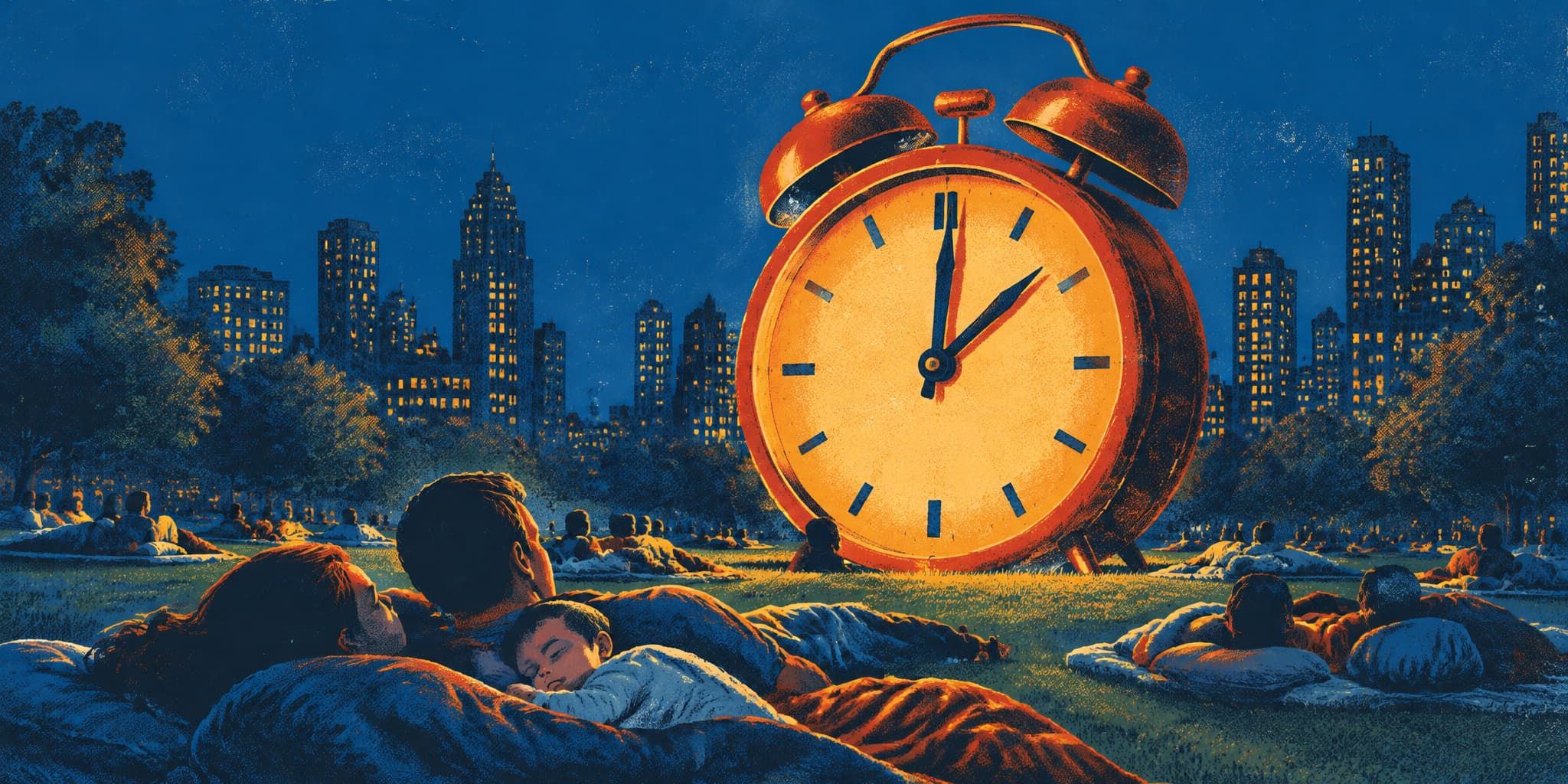
The playwright Arthur Miller, writing in 1998, remembered nights like these from his boyhood near West 110th Street, probably in 1927 or 1928. In his recollection, families came into the park with mattresses and alarm clocks, and babies slept among the grown-ups.
Put these accounts from different summers together and the night takes on a shape. It started while it was still light, when the first families claimed a patch of lawn. Through the evening the furniture came down the stairs, and the sidewalk in front of the building became a bedroom with a curb. Children stayed up long past bedtime, because there was nowhere cool to put them down. The beach crowd rode the subway out already dressed for sleep, and in 1936 the pools kept their gates open until midnight for one more swim. People who lived too far from a park or a beach went up to the roof or out the window onto the fire escape. By the small hours, whole families lay on mattresses carried down from their apartments, babies among the adults, a clock set nearby. No agency planned it. Thousands of households were solving the same problem at the same hour, and because they solved it in public, they did it in one another's company.
I keep coming back to the alarm clocks. The people on that grass had shifts to work in the morning. They went outside so they could sleep enough to get through another day in a city that kept running whatever the temperature. Someone set the clock, someone woke up when it rang, and then the family gathered its bedding and went home to get dressed.
What the city contributed in July 1936 was to stop treating that arrangement as a violation, at least for a few nights.
Where the permission stopped
The headline names parks, beaches, and docks. Published accounts don't quote La Guardia's order itself, so exactly which rules were suspended, and when the exception ended, remains unclear.
What is clear is that another part of city government was pulling the other way. Around the same time, the Tenement House Department, which enforced housing codes, put out a poster reading "Keep your fire escapes clear." It was made with the Federal Art Project, a New Deal program that paid artists for public work, and dates to 1936 or 1937. The fire escape was where many tenement families slept, and the city wanted it empty in case of fire, which was a reasonable worry. Still, within a year or so, a family might be welcome to sleep on a public pier while city posters told it to keep the iron landing outside its own window clear.
And the shared night was never shared equally. Historian Stephen Robertson, writing about Rockaway as Harlem's beach resort starting in the 1920s, has documented through reports in Harlem's Amsterdam News, some from as late as 1936 and 1939, that Black beachgoers came in large numbers and were turned away by white owners of private bathhouses, the paid changing rooms along the beach, who usually claimed to be full. The city's new public pools officially welcomed Black and white children alike, but architectural historian Marta Gutman found that neighborhood racial boundaries and the threat of violence decided who actually swam at which pool.
Miller's memory carries marks of class and race too. He recalled that his own neighbors, worried about appearances, wouldn't sleep on their fire escapes, though families a few blocks away did. His family could also get away to a small summer cottage in Rockaway. And the sleepers he saw in his part of the park were white. That's one boy's view of one corner of Central Park, but it's a reminder that an open space can feel open only to some of the people in it.
Relief moves indoors, one machine at a time
What eventually replaced the roof and the park was a machine each household bought for itself.
In 1953, according to economic historian Jeff Biddle's study of residential air conditioning, about 1 percent of American households had a window or wall unit. By 1960, 12.6 percent of homes had some form of air conditioning, and by 1980, 58.5 percent. The region that includes New York lagged behind the country, at 45.8 percent in 1980.
Sleeping outside faded slowly. Sociologist Eric Klinenberg, in his study of Chicago's deadly 1995 heat wave, documents thousands of Chicago families sleeping outdoors during a 1955 heat wave and includes a photograph of outdoor sleepers from 1964. He also describes later Chicago residents saying that fear of crime kept them out of the parks at night. How much of New York's retreat indoors came from the machines, how much from fear, and how much from policing and rules is something historians haven't yet sorted out.
What clearly changed is where relief could be found. It used to be in places a family could walk to. It came to depend on what a single household could pay for: the unit, the electricity to run it, and wiring that can carry the load. The Docket has reported on how that chain breaks. In Houston's Third Ward, a new rule requiring landlords to provide cooling left tenants responsible for filing the complaints that get it enforced, and for the power bills. In Oakland, parents bought air conditioners for classrooms whose old wiring can't run them all at once. In both places, buying the unit was the easy part.
Where a hot New Yorker can go after 11 p.m.
This past summer, during a heat emergency, New York opened two large sites, the Javits Center convention hall in Manhattan and the headquarters of the city's emergency management agency, from 11 a.m. to 11 p.m. on July 3 through 5. The city's broader network of cooling centers, air-conditioned rooms in libraries, senior centers, and community groups, keeps whatever hours each host sets. When the city's Independent Budget Office, a nonpartisan agency that reviews spending and services, looked at 2024, it found no regular cooling center open past 11 p.m. and none where people could sleep.
People without housing have more options. Drop-in centers for homeless adults, which offer food, showers, and help, are open around the clock, though that doesn't promise a bed. During declared heat emergencies, the city also opens its shelters to anyone reasonably believed to be homeless who walks in.
The Lower East Side families of July 1936 had homes, though. Their apartments were simply too hot to sleep in, and they had work in the morning. Their counterpart today is a tenant with no air conditioner, or one too expensive to run all night, in a top-floor unit that holds the day's heat until dawn. After 11 p.m., the city's published heat plans name no place for that person to go.
A hot night still puts the same question to anyone lying awake in a stuffy apartment: when home won't cool down, where are you allowed to be? For a few nights in 1936, New York's answer was outside, in company, and undisturbed, at least for the people whose presence on the sand nobody challenged.
