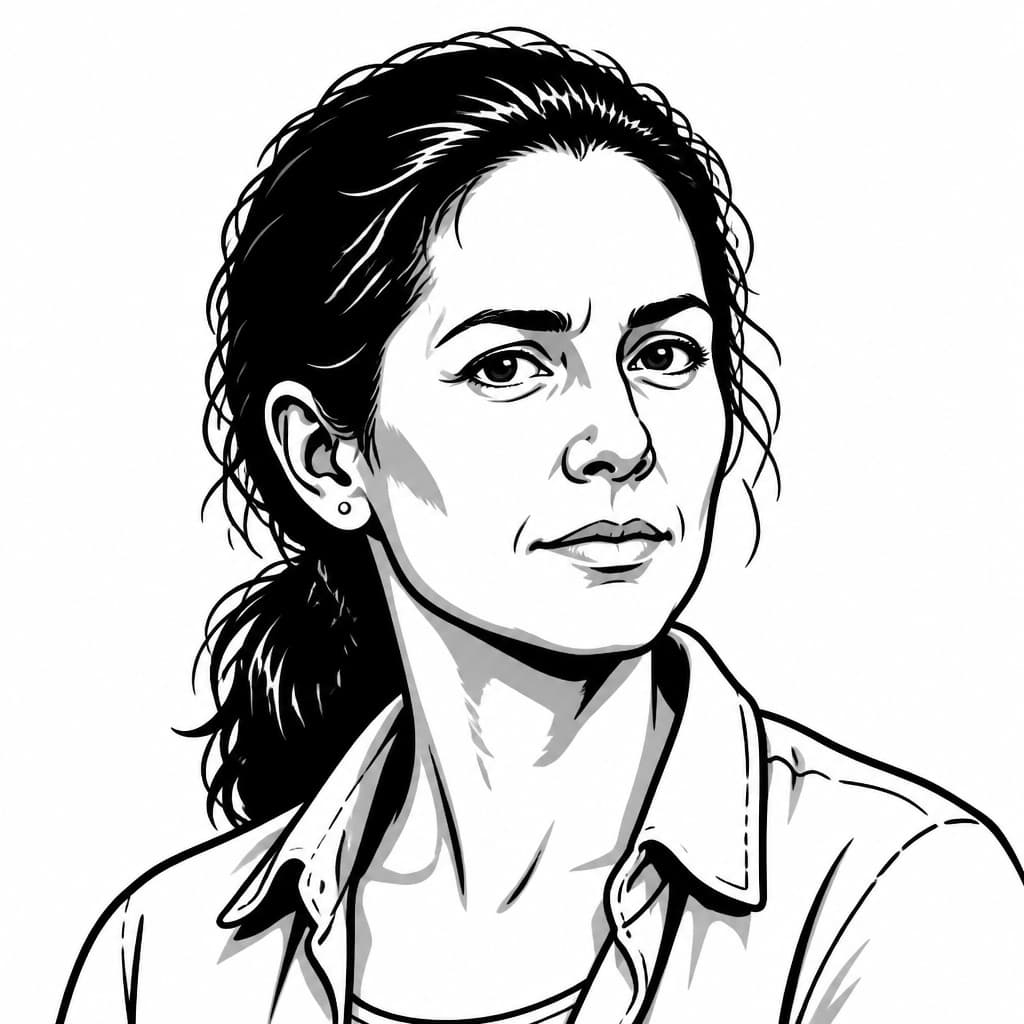
The cold started at Roz Teague's collarbones.
She floated face-down at the top of the Borrow with the tally clicker in her right fist, and when she kicked under, the warm upper meter of pond slid off her back. Fifteen degrees Celsius on the floor, four meters down, where Cutoff Creek came in under the alder roots and spread itself across the bottom. Cold water is heavier than warm, and the creek had been sliding in under the pond's warm lid every summer since the railroad dug the hole.
The steelhead were down in it, the way they'd been every August of her six seasons. Summer-run fish, up from the Pacific and stalled halfway home because the Columbia outside had gotten too warm to swim through. So they waited in whatever cold pockets they could find along the river, and this was one. They held their noses into the creek flow in rows so even they looked shelved. She worked down the rope she'd strung in July, clicking fives where they were thick and ones where they thinned. On the last pass she checked the silt for what she'd been finding three mornings running: steelhead on their backs, bellies opened neatly, nothing else touched.
There weren't any. First morning in four.
She surfaced at the culvert end and pushed her mask up. The Borrow had one door, a concrete pipe three meters across that ran forty meters under the rail embankment to the river, and anything with fins came and went through it. On the river side, Marla Andrews stood in the bow of the aluminum boat, anchored in the plume. The plume was the tongue of cold creek water that came out of the pipe and hugged the bank for a few hundred meters before the Columbia mixed it away. Chinook salmon headed upriver pulled into it for an afternoon to cool down before pushing on. Marla counted them through polarized glasses.
"Fourteen sixty-two in the pit," Roz said.
"Sixty-one Chinook." Marla didn't look up. "I had two-forty yesterday."
"Logger?"
Marla nodded at the steel stake beside the boat, where a temperature logger had been recording the plume every fifteen minutes since June. "Twenty point six at four a.m. Eighteen now." Then, slower: "Twenty point six."
Marla worked for Yakama Nation Fisheries and had been sounding the depth of the Borrow for sixteen summers. She did not decorate numbers. When one was bad, she said it twice.
Roz hauled herself onto the riprap, the slope of broken rock the railroad had dumped to keep the river off its embankment. Below the culvert mouth sat a heap of brown weed, still dripping. The river brought it down every August now in rafts the size of dining tables. Somebody had forked this batch out of the pipe and left it on the rocks to cook.
She thumbed the tablet awake. A lot of fish in the Columbia carried an ID chip the size of a rice grain, and a wire loop bolted around the culvert mouth logged every tagged fish that swam through. Last night it had logged steelhead going in and out until 01:40. After that the noise reading sat pinned at the top of the scale until just past four, which was what the loop did when somebody leaned a shovel against it. Two reads in the log weren't fish, at 01:38 and 04:09, and they were the same fifteen digits, ending in 4471. Every tag that went into a fish in this basin went into the regional database the same day, with a species, a release site, a date. She could look one up in her sleep. She ran this one twice and got nothing. Nobody had ever put it in a fish.
Up on the embankment, the railroad's pickup came along the track with its steel guide wheels down on the rails and its amber light going around. It stopped above her. Pete Galvan, track inspector for this sixty-mile stretch, leaned out the window. His blue heeler had her head out the passenger side and was assessing Roz for snacks.
"Count, Ballast wants to know."
"Fourteen sixty-two."
"Lot of fish for a borrow pit." He'd told her where the name came from in her first season. In 1908 the railroad needed fill to build up the raised bed the tracks ride on, so it borrowed the dirt from the creek bottom here and left a hole. He brought it up about once a summer, like a man reminding you he'd paid for dinner. He pointed his chin at the weed. "Tell your boss the railroad's in the salad business."
"You clear that?"
"Somebody has to." He tapped the phone on his dash, which showed radar. "Cells coming over the Simcoes tomorrow night. If one sits on this drainage, I'm down here at two a.m. with a pike pole. You let a culvert plug under a fill like this and the creek backs up and starts going through the dirt instead. You lose the grade, you put a train in the river."
"Comforting."
"Comforting's my whole job." He lifted two fingers off the wheel and rolled on toward the siding. Ballast watched Roz until the truck was out of sight.
Ingrid Mowat ran the state's refuge crew from the cab of the state truck with the engine idling, because it had the only air conditioning within twenty miles that she had a key to. Meetings happened in the passenger seat and were short. At 7:15 that Monday the thermometer on the ramp kiosk read thirty-one, a little under ninety Fahrenheit.
Roz set the tablet on the dash. "Five nights since July twenty-eighth. Last night was the fifth. The antenna dies around one-forty and comes back around four. Same five nights, the depth logger in the Borrow shows the water coming up five centimeters, and the plume outside warms two or three degrees."
"That antenna's eleven years old. It drifts on hot nights." Ingrid kept her eyes on the road out. "Plumes wander. The Corps watched the White Salmon plume swing twelve degrees in a day. And the river goes up and down all night depending on what the dams let through."
"River was falling. The Borrow was rising."
Ingrid looked at the screen.
"Water's going into the pit faster than it's getting out," Roz said. "Something's sitting in the culvert."
"Lena Fenn's pump."
"Lena's upstream of my creek logger. The creek logger's flat."
"Then write it up as equipment, question mark, and get in. I've got the Klickitat mouth and three more sites before it hits a hundred."
"And if somebody's—"
"If somebody is, they're blocking fish passage at a refuge the state monitors, and that's an incident, and I spend the rest of August writing statements for Olympia instead of counting fish." She turned a vent toward her own face. "Are you sure?"
"No."
"Get sure."
Roz scrolled to the other column. "Something else. Gary's kills stop on those nights. Twenty-three carcasses this month. Not one the morning after a dead antenna."
"So put Gary in the memo. I've had a request in since July ninth to have him moved along."
Gary was a California sea lion, nine hundred pounds or so. In June he had come up through the boat locks at Bonneville Dam and swum thirty miles upriver to the one dead-end pond full of fish where nobody was firing cracker shells at him. Marla had named him after a former supervisor and declined to say which one.
"He's approved for removal," Ingrid said. Federal rules allowed it for sea lions that ate endangered salmon, but only through a permit, a trap, and a team. "He's approved and he's in line. They've got sixty of him below the dam."
Lena Fenn's pears were browning from the top of the hill down. The pump house on the creek was padlocked, and the intake hose lay on the bank with a spider living in the end of it.
"I leased it," Lena said from the porch before Roz was out of the truck. "My whole water right, July through September. The state pays me to leave the creek in the creek. Comes out around sixty percent of what the pears would've brought if they'd sized up, which they wouldn't have." She looked up the slope at leaves the color of grocery bags. "Don't tell my brother. He thinks I'm irrigating at night."
"I'm not here about the pump."
"Then what's the wand for?"
Roz held up the handheld reader. "Fish chips and pet microchips run on the same frequency. Something with a chip has been walking through my culvert at two in the morning."
Lena thought about that, then whistled. A border collie came off the porch and stood for the reader with the patience of a dog who'd been to a lot of vet appointments. It beeped. The code ended in 2210.
"She sleeps on my bed," Lena said. "She's not going anywhere at two a.m. unless I am, and I'm not." She sat down on the step. "How much season you got left?"
"Three weeks."
"Three weeks of creek. When my dad put that pump in, Cutoff ran cold till the October rains. Now it's done by Labor Day. After that, whatever you've got in that hole is in soup."
"My logger says it's holding."
"I know what your logger says. I own a thermometer."
At dawn Tuesday, Brock Haney's drift boat was anchored precisely on the sanctuary line, the orange buoy knocking against his stern. Behind the buoy the water was closed to fishing from mid-July to mid-September. In front of it, it wasn't. Two men in matching sun hoods were casting into the frayed outer edge of the plume, and a black Lab sat in the bow watching their lines like she had money on them.
"Seventy-six at the dock," Brock called. He did Fahrenheit for clients. These two were from Bend. "I've got two guys paying three-fifty apiece to look at a pond full of fish they can't touch."
"Can I scan your dog?"
"Can you what my dog?"
She explained. He rowed over to the rocks, mostly out of curiosity. The Lab licked the reader, and it beeped: ending in 0938.
"You thought I was sneaking in there at night and running your fish out past the buoy," Brock said.
"It crossed my mind."
"If I was, they'd be out. You'd see it in my clients' faces." He wasn't wrong, and Roz had already done the math on the drive over. To push steelhead out of the Borrow you'd have to warm the bottom, and the bottom hadn't moved off fifteen all month. On the bad nights the level came up and the fish stayed put. Whatever went into that culvert was keeping something in, or keeping something out.
"You want the fix," Brock said, "somebody shoots Gary. Everybody on this river knows it. Nobody says it because there's a form."
"There's three forms."
"See, that's what I'm talking about."
That afternoon she put the five dates on the tablet: July 28, July 31, August 2, August 4, August 8. Next to them she pulled the weather. Thunderstorms had crossed the drainage on the nights of August 5 and 6. On the night of the seventh a cell had parked over the Simcoes, forty miles north, and never come any closer. Gary had eaten all three nights, and nothing had touched the culvert. The five bad nights had all been clear, with no storm cell within a hundred miles.
The only road down to the Borrow came off the county road through a locked gate, and there were three keys: hers, Ingrid's, Marla's. She walked the road with the sun on her neck. The trailer tracks in the dust were all hers. Brock's ruts were at the public launch on the far side of the fence. Nobody had driven down here at night.
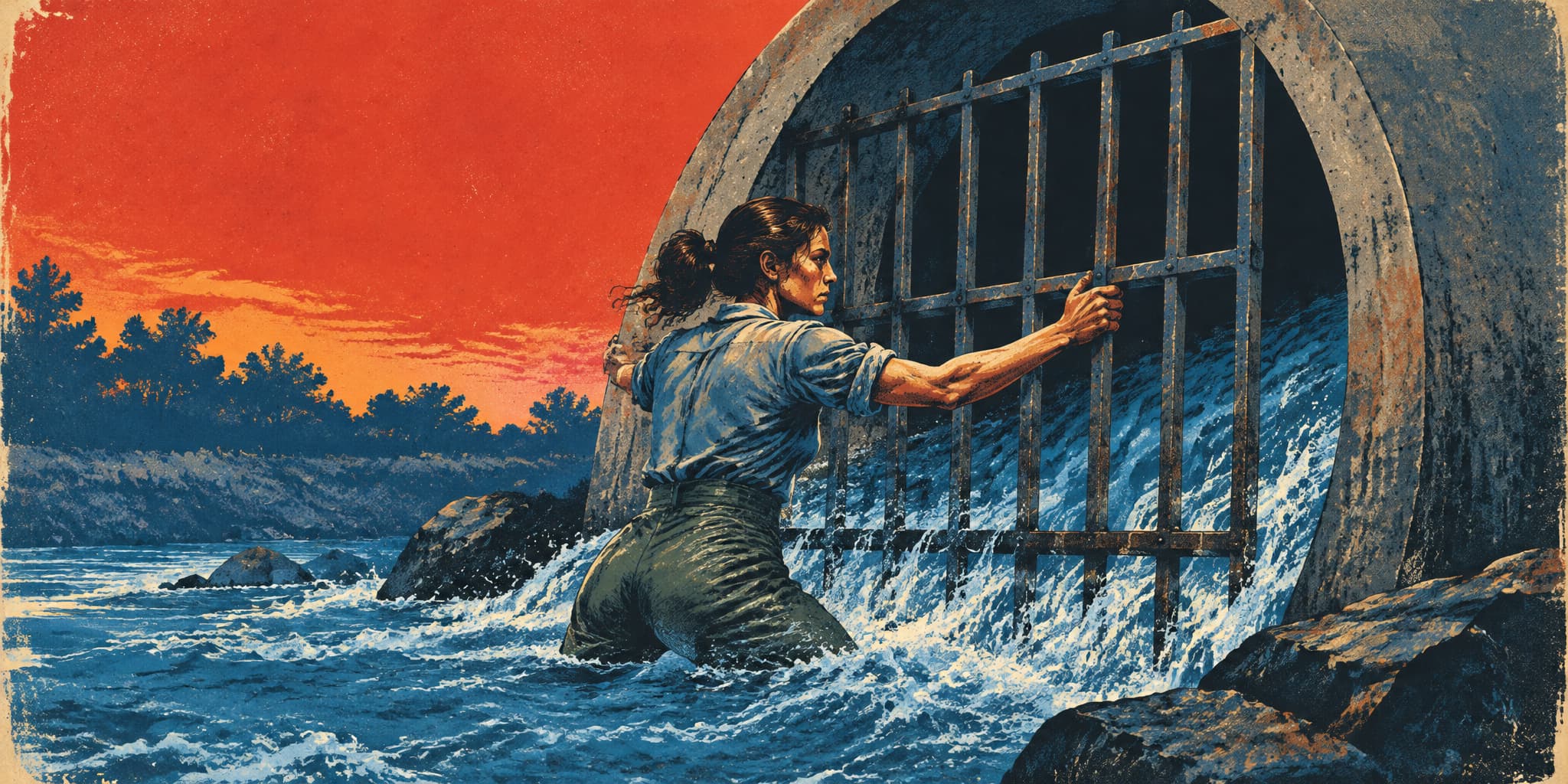
She waded to the river end of the culvert and looked at the headwall, the face of old concrete and older stone around the mouth of the pipe, furred with moss from end to end. On either side of the opening an iron channel ran from the top of the wall down into the water, slots for a gate nobody had hung since before her parents were born. The moss covered the wall everywhere except inside the two slots, which had been scraped to bright orange rust. Something had been sliding up and down in them.
She climbed the riprap to the top of the embankment and stood on the gravel between the rails. The track ran east and west for a hundred miles, with a culvert under it wherever water had needed to get to the river. One man drove the whole stretch every day, and he checked radar before he did anything.
Tonight's cells were already stacking up white over the Simcoes. The forecast for Wednesday night was clear.
She was on the rocks at 01:10 Wednesday night with her headlamp off. Across the river, the Oregon side was a line of highway lights and one column of wildfire smoke from somewhere up on Mount Hood, lit orange from underneath. The river worked at the riprap.
At 01:31 the railroad pickup came along the track with its light off and stopped above the culvert. Pete climbed down with a panel of steel grating on his shoulder, the bars set too close for anything bigger than a steelhead to fit between. Ballast skidded down behind him and splashed through the shallows straight across the antenna loop. Pete lined the panel up with the iron slots and let go. It dropped down the channels and seated with a sound like a manhole cover.
Roz turned on her lamp.
Pete didn't jump. He squinted into the light for a while. "Well," he said. "Shit."
Ballast came across the rocks to her, wagging from the shoulders back. Roz passed the reader over the dog's neck. It beeped. 4471.
"She's chipped?" Pete said. "Huh. Didn't know the vet did that."
"My antenna knew."
He sat down on the rocks the way a man sits when his knees have done this job for thirty years.
"He comes in about two," Pete said. "Up the pipe. I've watched him from the deck of the truck with the heat camera they issued us for spotting trespassers. He doesn't eat them, Roz. He takes the belly and drops the rest and goes for the next one. Four, five a night, in a pond with one door."
"You're grating a culvert under your own track."
"On a clear night." He said it like he was correcting the record. "Not with a storm inside sixty miles. I check radar every half hour, and I'm out before the first westbound. Nobody on this river knows better than I do what it takes to plug a culvert like this for real, and it isn't a grate on a dry night in August."
"The weed packs against it inside an hour. Every raft that floats in hangs up on the bars."
"I clean it off on the way out."
"By then it's already done it. The creek can't get out, so the Borrow comes up five centimeters." She swung the lamp past him, out over the river. "And out here the cold stops coming. The plume goes from eighteen to twenty-one."
"So the fish in there get a little warmer."
"The fish in there don't feel a thing. They're on the bottom in fifteen. It's the Chinook out here. They hardly ever come in the pit. They sit in the plume a few hours on the way upriver and keep going. You grate it and there's no plume to sit in."
He looked at the black water past the edge of her light.
"How many?"
"Marla had two-forty Sunday. Sixty-one Monday morning, after you."
"Gary opened six Saturday night."
"I know. I bagged them."
Ballast lay down across Pete's boot. Behind the grate the Borrow had gone glassy and still, fourteen hundred fish holding in the cold.
"You pulling it," Pete said, "or am I?"
"Ingrid's at the ramp at six," Roz said. "Pull it. Then come tell her yourself."
Ingrid got out of the truck. Roz had seen her do that once before, for a drowned angler.
Pete told it straight: the slots, the grate, the six nights, the heat camera, the radar. Brock had wandered over from his trailer with a coffee and the Lab at heel, and he was listening in a way that made clear he'd be contributing. Marla sat on the tailgate of her own truck with her clipboard on her knee.
"That's blocking passage at a monitored refuge," Ingrid said, "with no permit, in railroad drainage, by a railroad employee. I could list who'd want a word with you, but we'd be here till the heat."
"You write it up, I'm fired," Pete said. "And Gary's back in there tomorrow night with nobody between him and fourteen hundred steelhead."
"I'll say it." Brock raised his cup. "Shoot Gary."
"He's approved," Ingrid said.
"Then shoot him."
"There's a process."
"There's a process for everything on this river except the fish."
"Those sixty-one Chinook go past the tribal nets in three weeks," Marla said. "Some of those nets are my cousins'. A fish that rested at twenty-one instead of eighteen goes upriver cooked. More of them die on the way."
"A fish Gary opens up doesn't go anywhere," Pete said.
"I didn't say you were wrong. I said what it costs."
"Everybody's saying what it costs," Brock said. "Nobody's saying what to do."
"I'm the one who writes down whatever we do," Ingrid said.
"You're also the one sitting on a sea lion."
"I'm not sitting on him. I'm in line behind him."
"So's every fish in that pond."
Marla tapped the clipboard against her knee until they looked at her. "I've lost most of a meter of depth in there since my first summer. Silt comes in with the creek and nothing takes it out. Ten more years and nobody's grating anything, because there won't be a pit."
"Lena says the creek's done by Labor Day," Roz said.
Nobody argued with Lena.
Ingrid opened the truck door, and the cold air spilled out around her ankles. "It goes in my report," she said. "All of it."
"Fine," Pete said.
"My report's due September fifteenth."
Pete looked at her for a second. "That's after Labor Day."
"That's when it's due."
Brock started to laugh and turned it into a cough. The Lab looked up at him with concern.
"Clear nights only," Roz said, and they all turned. "I'm down there with him. I put a logger on a stake in the plume and read it every half hour. When the plume hits twenty, the grate comes out."
"And Gary?" Pete said.
"Gary gets in at twenty."
"Why twenty?" Marla said.
"Because that's about where Chinook start getting in trouble and go looking for cold water. The state's own standard says twenty," Roz said. "And because I need a number, and that one's round."
Ingrid got in the truck and shut the door. Through the glass she looked at Roz for a long second. Then she backed out without saying no.
The night was clear again. At 01:30 Pete set the grate. Roz drove a length of rebar into the gravel at the edge of the plume, zip-tied a logger to it, and ran the cable up onto the rocks so she could read it without getting wet.
02:00, 18.3. Ballast asleep on Pete's boot.
02:30, 19.1. Across the river the smoke had come down off the mountain and laid itself flat on the water. Pete checked radar and turned the phone so she could see: green and empty for two hundred miles. No storm, so the grate was safe, and no rain for the creek either.
03:00, 19.7. Pete forked a raft of weed off the bars, and another one drifted in behind it.
03:14, 20.0.
Roz put her hand on the grate. Pete stood, worked his gloves into the bars, and lifted. The weed came up with it in one long slick sheet. The Borrow let go of its extra five centimeters through the culvert in a cold push that wrapped around her shins, and they stood in it while it ran out into the river.
At 03:26 something moved the water at the far edge of her lamp. A dark shoulder, a slick of whiskers. It went under, into the culvert, and through.
Pete didn't say anything. He went back to forking weed off the grate where it lay on the rocks.
Roz wrote 03:26 on the back of her hand in marker and read the plume again. Eighteen point nine and dropping. Somewhere up the pipe, past the reach of her light, something heavy turned over in the water. Her tablet chimed: a steelhead tagged at Bonneville in July, going out.
-
Refuges built by accident: The EPA's research summary on whether cold-water refuges can save salmon notes that some of the most heavily used refuges were created by accident, when highway and railway causeways let cold water collect behind embankments.
-
The pit filling in: Marla's lost meter of depth has a real counterpart in the Army Corps' study of sedimentation in Columbia River tributary deltas, which was started with the Yakama Nation and CRITFC and finds that the sheltered, slow water that holds a refuge together also lets silt build up.
-
Gary's place in line: Washington's account of Columbia River sea lion management describes hazing, floating traps, and authorized lethal removal by state and tribal partners, along with the 2025 extension of that authority through August 2030.
-
How long fish wait: A radio-tracking study of thermal exposure in adult Chinook and steelhead found steelhead holding in refuges for weeks while salmon stayed for hours to days, which is why the Borrow and its plume serve such different fish.
