
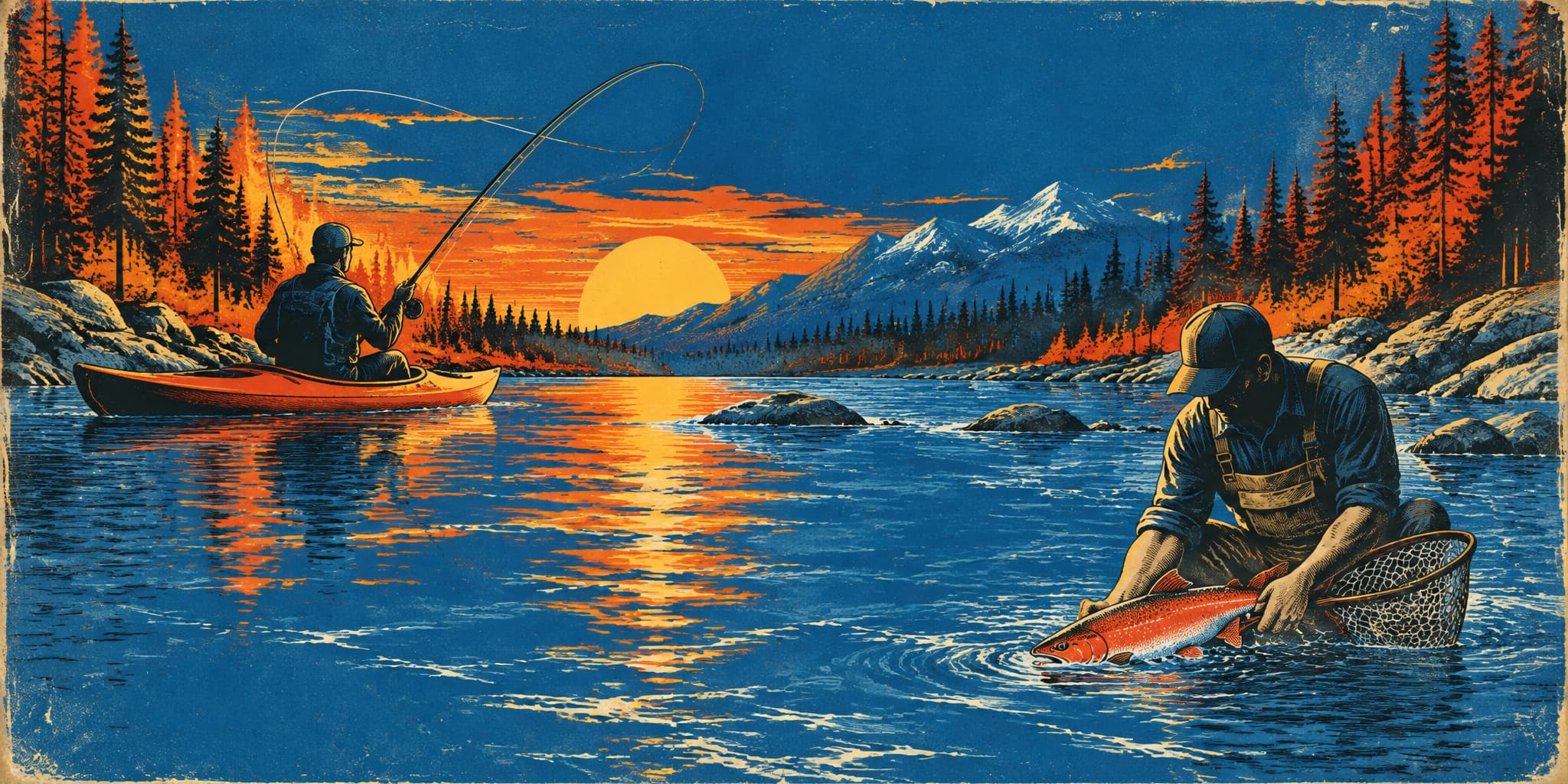
A new study shows a Washington salmon river turning into better habitat for a fish that eats young salmon, and that plenty of people love to catch. What the science measured, what it didn't, and what it's like to share a river that's changing in opposite directions for different people.
Young smallmouth bass grow faster in the years the Chehalis River runs low. That's one of three findings in a new paper published October 23 by fisheries scientists John Winkowski, Andrew Claiborne and Julian Olden. The Chehalis drains a wide stretch of southwest Washington into Grays Harbor, a bay on the Pacific coast, and it is a salmon river. Smallmouth bass come from eastern North America. They've become common across the West, and they eat young salmon.
The day after the paper appeared, a state fishing closure took effect on the Chehalis and many other western Washington rivers. Drought had left the water low, and far fewer coho salmon had come back from the ocean than managers had forecast. The closure covers salmon and every other game fish, so it shuts out state-licensed anglers whether they're fishing for salmon, for steelhead (a trout that migrates to sea) or for bass.
The paper doesn't explain this fall's coho, and the timing is a coincidence. I keep setting the two dates next to each other anyway. Salmon need cold water, and a low, warm summer river is hard on them. This research suggests it's easier on the fish that eat them. So the same dry August can be a terrible month for one set of people on a river and a decent fishing season for another. I wanted to understand what it's like to live inside that split, and how much of it the science can actually speak to.
What the scientists found
To track fish, state crews float rafts along about 40 miles of the main river with electrofishing gear. It sends a pulse of current into the water that stuns nearby fish for a moment, long enough to net, count and release them. The result is recorded as fish caught per hour of effort.
In the summer of 2007, crews caught about one smallmouth bass every two and a half hours. In 2023 they caught nearly ten an hour, and in 2025 about seven. Rock bass, a smaller fish that also comes from the East and is also new here, were caught three to four times as often as in 2007. Northern pikeminnow, a native fish that has been eating young salmon in this river for as long as there have been salmon, went the other way, dropping by about two-thirds by 2025. The paper doesn't settle why the pikeminnow declined, and it doesn't claim the bass pushed them out.
The second finding is about temperature. Smallmouth tend to show up where the water averages at least 19°C, about 66°F, in August. That's the floor for bass appearing at all, not the temperature they like best. Using a computer model, the team estimated summer temperatures across roughly 2,200 miles of the basin's slower, gently sloping streams, the kind bass can live in. Before 2007, about 6% of those miles reached that threshold. From 2014 to 2025 the figure averaged 8%, and in the hot summer of 2023 it hit 13%. August stream temperatures have been climbing by about 0.4°F per decade, which adds roughly 17 miles of bass-warm stream every ten years.
The third finding is the one I started with. Fish carry tiny ear stones that lay down growth rings, a bit like a tree does. The team measured the first-year ring in 296 young bass hatched between 2013 and 2021 and found they grew more in years when the river ran lower. In that analysis, temperature on its own didn't show a clear link to growth. What the bass seemed to respond to was a slow, shrunken summer river.
What a catch rate can't tell you
The paper doesn't count dead salmon. It doesn't estimate how many young Chinook (the largest salmon species) bass eat, or whether any run of adult salmon returning from the ocean is smaller because of them. The authors are upfront that their abundance numbers are relative. They have only one early year to compare against, so 2007 might have been unusual. And fish are easier to catch when there's less water.
Anglers already know that last part. "Less water for the fish to move in means less area to look to find them in," a southwest Washington guide, Cameron Black, told The Chronicle during a 2015 drought. A survey crew in a low-water year can catch more bass without there being more bass. What the numbers support, then, is that bass have become far more common than they were in 2007, without a precise headcount.
The case that bass eat salmon comes from an earlier study by Winkowski, Lisa Crosson and Olden, which tested predator stomachs from the Chehalis for salmon DNA in the springs of 2021 and 2022. Chinook DNA turned up in 41% of smallmouth, 34% of largemouth bass, 22% of pikeminnow and 19% of rock bass. So 41% of smallmouth had eaten some Chinook, which is a different thing from 41% of young Chinook being eaten. The researchers also found pikeminnow eating smallmouth, so the predators eat each other too.
At a larger scale the picture gets murkier. In February, the federal fisheries service found no evidence that predation in rivers threatens Washington Coast Chinook as a whole, a grouping that spans many rivers. The Chehalis spring Chinook run inside it is small: in the three most recent counted years, between about 1,350 and 2,200 adults spawned in the river, at or above managers' goal of 1,400 in two of those years and just under it in the third.
Put it together and the river is becoming better bass habitat, bass are much easier to find than they used to be, and bass eat young Chinook. Whether all that adds up to fewer salmon coming home hasn't been measured. Some people on the river can't really afford to wait for that measurement.
Bound to the salmon
Ken Corwin, a Quinault fisherman, grew up watching Chinook jump in the river at Montesano and followed his father and grandfather into fishing. These days he catches mostly coho, and making a living is harder, he told Nick Engelfried of Columbia Insight in March. "But it remains a fishery we very much depend on." The Quinault Indian Nation hasn't held a spring Chinook fishery in the Chehalis and Grays Harbor area since 2018. Nothing in that reporting blames bass for any of this, and I won't either. What it does show is how specific the attachment is: to a run of fish in a particular river, handed down through a family.
For the tribes, that attachment turns into work. Quinault fisheries staff help steer the basin's salmon restoration program and watch flood-control projects for harm to fish. In 2018, the Nation's formal comments on a proposed dam asked reviewers to consider the many threats young salmon face at once, bass among them. In 2023, it closed its own coho fishery early and urged the state to do the same, while the state stressed that the counts were uncertain. "Our shared responsibility to be good stewards of our sacred salmon requires us to be cautious and proactive before it's too late," spokesperson Cleve Jackson said at the time. That dispute was about coho, but it's the same question the bass research leaves open: how much do you act before the count is in?
Upriver, a newsletter from the Confederated Tribes of the Chehalis shows technician Jakeb Hoyle and coworkers netting hatchery coho and carrying them to a tube that releases them into the Black River. "This work is important to food sovereignty," Hoyle said, meaning the tribe's ability to feed itself with its own traditional foods. If the step from more bass to fewer salmon turns out to be real, that's what's at stake for these communities: where food comes from, and who gets to provide it.
The crews pulling bass out
This summer the state went from studying bass to removing them, along about ten miles of river near the towns of Centralia and Chehalis. Starting June 1, crews electrofished the same stretches again and again, and by August 6 they had removed 1,487 smallmouth and 2,215 rock bass, according to preliminary figures. The experiment is built to find out whether young Chinook do better afterward. That answer will take years.
Winkowski, a senior fish scientist at the state wildlife agency, has been careful about what removal can do. "There have been examples where management has come in and removed a predator and then undesired results occur," he told a basin board in March. Since pikeminnow eat smallmouth, pulling out bass could open up room for another predator.
The new paper leans toward slower fixes that work on temperature itself: cold-water inputs, shade trees along the banks, floodplains where the river can spread out, more water in summer. One decision about shade is live right now. A dam has been proposed near the town of Pe Ell to hold back floodwater from towns downstream. The state's draft environmental review projects that clearing trees for it could make daily peak water temperatures just below it 1.6 to 3.1°F warmer by late century, while the district proposing it argues that replanting and operating changes would shrink that.
The anglers who love the bass
The bass's fans rarely speak for themselves in the public record about why they love this changed river. Their attachment shows up instead in the local paper's fishing column. In August 2017, The Chronicle's Jordan Nailon relayed reports of good smallmouth fishing in the upper and middle river, with kayakers doing well around Adna and between Borst Park and Mellen Street, the fishery "still keeping lip rippers entertained." A month later he described anglers walking in under bridges and through hayfields, and kayakers drifting between Chehalis and Rochester, "chasing hidden honey holes."
The tribes leave behind formal comments, newsletters and program descriptions, because those are the forms that decisions about a river require. What the bass anglers leave behind is mostly directions: this park, that street, under the bridge. I find that list of places oddly tender. It's also a kind of love that rarely makes it into the documents that shape removal and restoration decisions, even though anglers can comment like anyone else. The vocabulary splits too. The same fish is "invasive bass" in a headline about the removal study and just the fishing in the weekend column.
Washington law has found a use for that pleasure. Since 2020, the state has set no daily or size limit on bass in rivers and streams, and the statute behind it exists so that fewer young salmon get eaten on their way to sea. An angler who keeps every bass is doing what the rule invites. An angler who lets them go, hoping for good fishing next summer, is doing what people who love a fishery usually do. As far as the rule is concerned, their fishing is a way to get bass out of the river, and whatever it means to the people doing it sits outside its purpose.
I want to give the anglers' enjoyment equal weight with the tribes' obligations. Enjoying a place as it changes is real, and it gets waved off as frivolous more often than it deserves. But I don't trust that impulse here, because the two attachments aren't the same shape. Someone who loses the Chehalis bass fishery still has lakes; Black Lake, in the same river system, holds smallmouth. A family that has fished one river's Chinook for generations has no other river where that relationship can go on. And still, the kayaker drifting past hayfields between Chehalis and Rochester loves this particular water, and that doesn't relocate neatly either. I can't make those weigh the same. On the Chehalis, gain and loss mostly land on different people, so whether this counts as a loss gets two sincere answers, depending on who's standing on the bank.
Reading your own changing place
Most readers don't live near the Chehalis, but plenty live somewhere picking up new species, new seasons or new ways to have fun as it warms. A few habits from this river travel well.
- When someone says there's far more of something than there used to be, it's worth asking whether there really is more, or whether low water, heat or a new trail just made it easier to find.
- When a study comes out, look for the distance between what it measured and the harm people are afraid of. Here, the evidence covers habitat, catch rates, growth and diet, and the step that would turn those into salmon lost is the one the removal experiment is only starting to test.
- Notice who is bound to the old version of a place, who is enjoying the new one, and which of them has a way to be heard when the decisions get made.
Since October 24, the state has closed the Chehalis to anglers after salmon and bass alike. The water is low. The removal counts so far are preliminary, and the first evidence on whether young Chinook do better where the bass were taken out is still a few seasons away.
-
Whether removal helps Chinook: The state's bass suppression study update lays out how crews compared stretches cleared of both bass species with stretches cleared of smallmouth only, which is where any first signal about young salmon survival should appear.
-
The Pe Ell dam's shade: The flood-control district's February 2026 technical submission models smaller warming near the proposed facility than the state's review does, so comparing the two shows how mitigation assumptions change the temperature picture for bass and salmon.
-
Testing whether restoration cools: The Office of Chehalis Basin's 2025 restoration progress report describes Schafer Creek, where crews built brush bundles and log structures and are now monitoring whether the work can cool and slow the water.
-
Paying anglers to remove predators: On the Columbia and Snake rivers, the Northern Pikeminnow Sport-Reward Program pays anglers for large individuals of the same native predator whose numbers have fallen in the Chehalis surveys, which shows another way a state has enlisted recreational fishing in salmon protection.
