

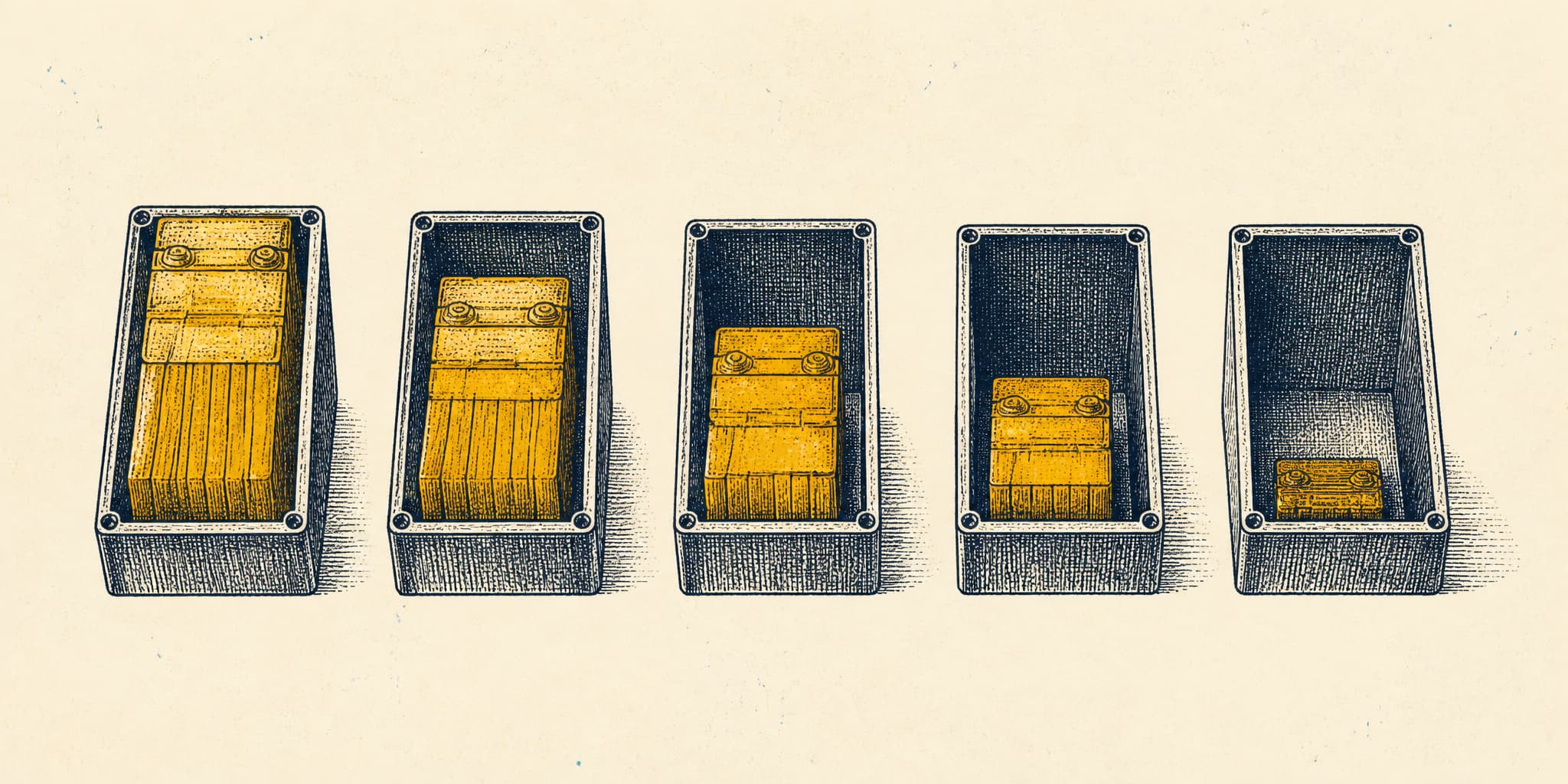
Trajectory Line
ESS cell spot softened this week while DC-side system pricing held flat and lithium carbonate oscillated without direction; the deflation trajectory most procurement models carry is decelerating toward a floor, not accelerating through one.
Application Grid
EV Cells (China spot) No update this week. SMM's July 10 publications covered ESS cells and lithium carbonate; no EV cell spot assessment was accessible through public data routes. Last assessed: SMM, July 3. 174 Ah prismatic LFP at RMB 0.379–0.407/Wh, avg 0.393. NCM 6-series 144 Ah at RMB 0.599–0.621/Wh, avg 0.610. H1 direction: flat to marginally soft. Pack-level: no current public signal. BNEF's December 2025 survey ($108/kWh weighted average) is seven months stale. Calibration only.
BESS Cells (China spot) InfoLink, July 8: 314 Ah LFP at RMB 0.345–0.400/Wh, avg 0.373, down ~0.7% WoW. 280 Ah LFP at RMB 0.345–0.400/Wh, avg 0.373, down ~1.3% WoW; 314 Ah is the tracked benchmark as it increasingly displaces 280 Ah in new tenders. DC-side system: RMB 0.50/Wh, flat WoW, flat for multiple consecutive weeks. Cell softening at a decelerating rate. System pricing not following.
Defense-Relevant Formats No public price signal. USAspending DoD-filtered searches for lithium-ion battery awards in the June 10–July 10 window returned nothing relevant. War.gov contracts cover only awards above $7.5M and cannot rule out smaller procurement. No decision-grade $/kWh exists in checked public routes.
Pack-Level No current signal. The gap between BNEF's $108/kWh December 2025 benchmark and current Chinese cell spot (which implies LFP pack pricing well below $100/kWh for Chinese-produced systems) is an open data hole.
The Synthesis: Mid-Year Reset
Six months of H1 data are in. The practical question before the next procurement meeting: does the evidence still support the continued-deflation assumption embedded in most models?
The answer depends on which layer of the cost stack you're asking about. Chinese cell spot continued to soften through H1. System-level pricing did not follow. And Chinese domestic prices have diverged far enough from US landed costs that treating one as a proxy for the other produces procurement errors. Each of those findings rests on separate evidence.
Cell-system spread: the primary signal
InfoLink's July 8 assessment put 314 Ah ESS cells at RMB 0.373/Wh average, down 0.7% WoW, a move of roughly 0.25 fen. That continues a pattern of weekly moves that are getting smaller. The rate of decline has been compressing through H1.
DC-side system pricing at RMB 0.50/Wh has not moved. The cell-to-system spread has been widening incrementally for weeks.
Cell spot at RMB 0.373/Wh vs. DC-side system at RMB 0.50/Wh. The gap is structural and growing. System-level costs are stickier than cell-level costs.
Three factors are absorbing the spread: integrator margins recovering from H1 compression, BMS and thermal management costs that don't scale with cell deflation, and the compliance overhead associated with GB38031-2025 (the updated mandatory safety standard for power battery and ESS cells, effective July 1, though no enforcement evidence has surfaced). For the procurement reader carrying a model where system-price deflation tracks cell-price deflation with a lag, H1 says the lag is lengthening or the pass-through ratio is compressing. The evidence cannot distinguish which. Both produce the same operational outcome: system-level costs are stickier than cell-level costs, and the gap is structural enough to survive H1 intact.
Lithium carbonate: oscillation, not reversal
Two sources, 48 hours apart, telling different stories.
| Source | Date | Range (RMB/MT) | Average | WoW |
|---|---|---|---|---|
| InfoLink | July 8 | 155,000–165,000 | 160,000 | +2.6% |
| SMM | July 10 | 150,000–160,000 | 155,000 | −11.6%* |
*SMM WoW calculated from July 3 average of RMB 175,330 to July 10 at RMB 155,000; span includes intra-week volatility both sources captured differently.
InfoLink caught a mid-week rebound. SMM's Friday print gave back part of it. Read together: lithium carbonate is oscillating in a band without establishing a direction. The second derivative of the price move has flattened. Neither source supports a sustained upward reversal, and neither supports continued decline.
The 6–8 week cathode inventory lag means this week's oscillation won't surface in cell quotes until late August at earliest. The pass-through remains asymmetric, a structural feature of overcapacity: from tracking this relationship across multiple cycles, upward lithium moves transmit at roughly one-third to cell pricing, while downward moves barely transmit because competitors absorb cost reductions to hold share rather than passing them through. If lithium stabilizes in this range, it removes a tailwind from cell deflation without creating a headwind. One less input pushing cell prices lower.
I do not have a current Fastmarkets CIF CJK assessment. The domestic-seaborne spread is an open data hole this week.
China spot and US landed are separate objects
A 314 Ah LFP cell at RMB 0.373/Wh converts to approximately $51/kWh at ~7.27 RMB/USD. A DC-side system at RMB 0.50/Wh converts to approximately $69/kWh at the same rate. These are Chinese domestic prices for Chinese domestic deployment.
A US-landed, FEOC-compliant, bankable BESS system is a categorically different cost object. My assessed range for US landed deployable BESS remains $75–100+/kWh at the cell level. The build-up:
- Chinese cell spot: ~$51/kWh
- Section 301 tariff (25%): ~$13/kWh
- Shipping, insurance, logistics overhead
- FEOC compliance costs or the premium for sourcing non-Chinese to qualify for 45X
- Warranty credibility premium separating Tier 1 suppliers from sub-5%-margin producers whose five-year warranty may not survive the warranty period
The range is wide because the compliance pathway determines where in it a specific procurement lands. System-level costs sit substantially higher depending on configuration.
The burden of proof sits on pass-through. The compliance and tariff layers added since 2023 are structural and still accumulating on overlapping timelines: the FEOC graphite exemption expires December 31, 2026, and the MOFCOM export control suspension window closes November 10. Both tighten the same channel through different mechanisms. If you are modeling US BESS costs as Chinese spot plus logistics, you are modeling a market that no longer exists.
H2 outlook: what the evidence supports assuming
SMM's H1 energy storage review uses shortage language for select large-format cells and reports inventory coverage at 0.36 months. That is thin. Combined with the Q4 pull-forward dynamic SMM flags ahead of full VAT export tax rebate cancellation next year, the evidence supports assuming ESS cell prices stabilize or firm modestly in H2 rather than continuing to decline. The MOFCOM export control suspension window closing November 10 adds a separate constraint on the same timeline.
A sharp reversal upward remains unlikely on the same evidence. Overcapacity is structural at 2+ TWh of nameplate capacity against demand well below that level (CRU, August 2025). Provincial employment mandates continue to prevent tail-producer exits. CATL's cost structure allows profitable operation at current prices while competitors bleed slowly. The floor holds, but it stops falling.
For EV cells, I cannot make an H2 assessment. The last public EV-cell spot data is July 3. The BNEF pack benchmark is seven months old. The silence is a data gap, and I have no basis for a directional call.
Open gaps
Three explicit holes this week:
- Fastmarkets CIF lithium carbonate — needed to assess the domestic-seaborne spread.
- Current EV cell spot pricing — nothing beyond July 3.
- Defense-relevant small-format cell pricing — no public source identified.
Each will be updated when a sourced figure surfaces.
-
SMM's H2 shortage framing: SMM reports ESS cell inventory coverage at just 0.36 months with most first- and second-tier producers holding order backlogs beyond Q3 2026, a tightness signal worth tracking against weekly spot movement.
-
Korean ESS capacity proof: LGES targets more than 50 GWh of North American ESS production capacity by year-end 2026, while Samsung SDI's public deck claims US ESS orders and non-PFE LFP supply chain work without equivalent quantified capacity or incentive disclosure.
-
Gansu tender clearing prices: InfoLink reported July 7 bid openings for two Gansu Tengger Desert PV-plus-storage projects totaling 900 MW/1.8 GWh, with average bid prices around RMB 0.56/Wh that sit above DC-side spot and offer a live read on project-level system willingness to pay.
-
Lithium carbonate import surge: SMM reports China imported 153,000 MT of lithium carbonate from January to May 2026, up 53% YoY, a supply-side input that complicates SMM's own H2 shortage language and warrants watching against domestic production and demand trajectories.