
The Gap Frame
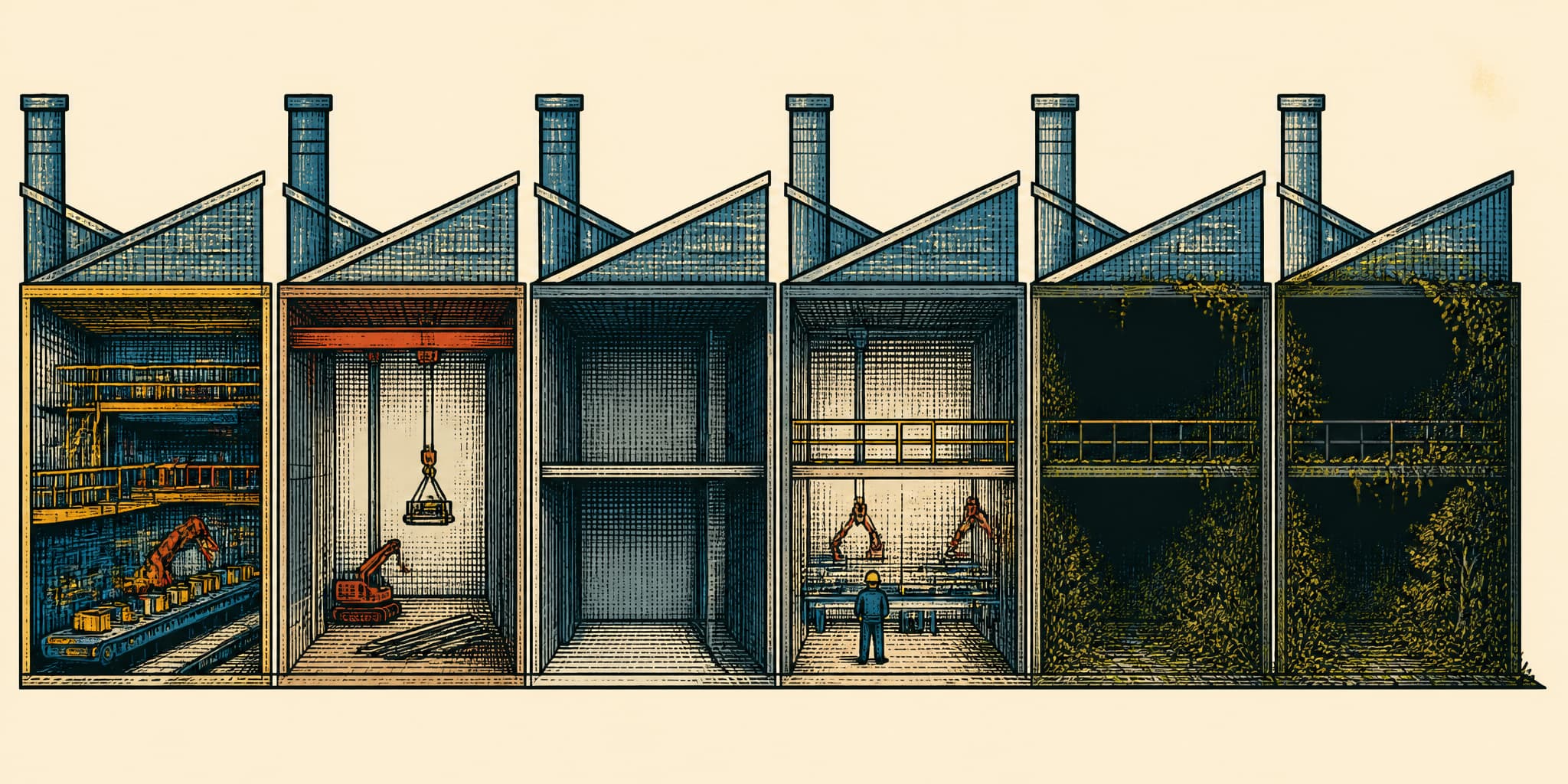
US battery supply models for 2027 still sort capacity into three bins: operational, announced, cancelled. The actual registry requires more. Ford Energy Kentucky is built, retooling, workforce-zeroed, targeting first BESS deliveries late 2027. Samsung StarPlus is producing NCA EV cells while converting lines to LFP ESS, mass production targeted Q4 2026, its JV partner publicly exploring exit. LGES Lansing has a $4.3 billion Tesla supply agreement for LFP prismatic cells whose production lines are not yet commissioned. SK Commerce is operational with 37% of its workforce laid off. KORE and FREYR never broke ground.
Six facilities, six distinct proof states, each carrying different weight for anyone modeling contractable domestic supply in the 2027 window. This issue examines three layers of that fragmentation: the Ford Energy conversion and what its DOE loan language actually establishes, the converting-facility pattern where chemistry and application shift beneath existing roofs, and the stress and cancellation signals that standard trackers compress into a single status label. Planning risk concentrates in the gap between "built" and "usable," and that gap is wider than most capacity aggregates acknowledge.
Ford Energy Battery Kentucky — Stated vs. Observed Audit


DOE's public project page describes a $9.63B loan to BlueOval SK LLC for 120+ GWh of EV batteries across three plants. Ford's May 2026 SEC filing describes something different on every axis: sole Ford ownership, two Kentucky facilities, $3.8B in assumed financing, product scope broadened to stationary storage. The federal record reflects none of these changes. This audit documents each divergence point with sourcing on both sides, names what the 8-K proves and what it does not disclose, and flags the signals looked for but not found.
Ford Energy Battery Kentucky — Stated vs. Observed Audit
DOE's public project page describes a $9.63B loan to BlueOval SK LLC for 120+ GWh of EV batteries across three plants. Ford's May 2026 SEC filing describes something different on every axis: sole Ford ownership, two Kentucky facilities, $3.8B in assumed financing, product scope broadened to stationary storage. The federal record reflects none of these changes. This audit documents each divergence point with sourcing on both sides, names what the 8-K proves and what it does not disclose, and flags the signals looked for but not found.
The Proof Ladder for US Battery Supply

Between 700 and 900 GWh of US battery cell capacity is announced, planned, or under some stage of development. The volume a procurement team can contract against with compliance documentation sufficient for a clean vehicle credit or bankable ESS offtake is a fraction of that figure. This piece defines twelve sequential evidence thresholds from announced to contractable, specifies the public evidence required at each, and places four facilities on the ladder using only verifiable filings. None clears the 45X/MACR rung on the public record. The distance between "producing" and "contractable" is five evidence thresholds wide.
The Proof Ladder for US Battery Supply
Between 700 and 900 GWh of US battery cell capacity is announced, planned, or under some stage of development. The volume a procurement team can contract against with compliance documentation sufficient for a clean vehicle credit or bankable ESS offtake is a fraction of that figure. This piece defines twelve sequential evidence thresholds from announced to contractable, specifies the public evidence required at each, and places four facilities on the ladder using only verifiable filings. None clears the 45X/MACR rung on the public record. The distance between "producing" and "contractable" is five evidence thresholds wide.
Four Filters Between Domestic Battery Capacity and Usable Supply


Domestic battery manufacturing capacity is growing. The GWh totals look encouraging. But a BESS integrator building a 48E ITC claim or a defense prime qualifying a new cell source cannot treat a U.S. facility pin on a map as proof of usable supply. Four independent compliance filters — Section 301 tariff classification, FEOC entity-level control tests, the manufacturer's 45X MACR, and the buyer's own 48E MACR — operate at four different units of analysis. Each must be passed independently. As of July 2026, several require inputs that have no source.
Four Filters Between Domestic Battery Capacity and Usable Supply
Domestic battery manufacturing capacity is growing. The GWh totals look encouraging. But a BESS integrator building a 48E ITC claim or a defense prime qualifying a new cell source cannot treat a U.S. facility pin on a map as proof of usable supply. Four independent compliance filters — Section 301 tariff classification, FEOC entity-level control tests, the manufacturer's 45X MACR, and the buyer's own 48E MACR — operate at four different units of analysis. Each must be passed independently. As of July 2026, several require inputs that have no source.
Source Documents