

November 3, 2018
The SNA Detroit Steps Project page records that the project launched at the Sunnyside Neighborhood Association's Quarterly Meeting on November 3, 2018. Rosaura Valle is identified as Project Lead. The scope: 186 public steps running from Detroit Street and Hearst Avenue up to Detroit and Joost, bisected midway by Monterey Boulevard. The lower section climbs from Hearst to Monterey. The upper section continues from Monterey to Joost. Between them, the boulevard crossing functions as both a seam and a hinge, connecting two stretches of stairway that had shared little for years besides accumulated neglect.
The SNA's description of what the steps looked like before the project began uses the flat language of a problem statement: overgrown, prone to illegal dumping and loitering, hazardous for pedestrians. The bureaucratic plainness of those words is itself informative. These were stairs that people climbed because topography demanded it. Commuters used them to reach the J-Church stop or descend toward Glen Park. Residents on the blocks above and below navigated them out of geographic necessity, the way you navigate any piece of infrastructure that moves you from one elevation to another and offers nothing else.
Valle's published statement on both the SNA project page and the DetroitSteps.org About page frames the aspiration in a single sentence:
"It is our hope that together we will make the Detroit Steps an appealing and inspirational place for commuters, walkers, and residents."
The word worth pausing on is "together." It signals that the project was conceived not as an improvement delivered to the neighborhood but as work the neighborhood would perform on itself. The aspiration required hands.
2019–2025
The documented sequence of changes since 2019 reads, in the project's own records, like a slow argument that a public stairway can become a public place.
Volunteers started with the basics. The SNA project page describes clearing weed growth and ivy from the upper steps, removing a battered wooden fence, opening a small patch of public ground for landscape design conducted with City College horticulture students. On the lower steps, the project replaced chain-link fencing at the Monterey Boulevard landing with a steel fence featuring decorative design, forerunner rails, ball finials, and a bronze color. The language is architectural in its specificity, the kind of detail that appears in permit applications and project summaries. Behind each line item is a series of Saturdays when people showed up with tools and did physical work on a public staircase that the city maintained in only the most minimal sense.
By August 2025, the SNA posted a call for volunteers to paint the upper steps as part of a mural project, reporting the effort 60 percent complete. Photo captions on DetroitSteps.org describe views of San Bruno Mountain from the center terrace of the upper steps and a view down the lower steps toward Hearst Avenue from Monterey Boulevard. Something had shifted in the project's own documentary language. The stairway once described in terms of hazards and dumping was now being described in terms of what could be seen from it. The vocabulary had moved from problems to vistas.
Ordinance 075-25, May 16, 2025
The most recent layer of the project's public record is Ordinance 075-25, enacted May 16, 2025, waiving encroachment permit fees for the installation of the Detroit Street Steps Archway. A Public Works hearing notice describes the permit request: one decorative metal archway, installed and maintained by the Detroit Steps Project and the SNA, placed on the south side of the intersection of Detroit Street and Monterey Boulevard, directly over the entrance to the stairway.
An image attached to the Legistar file shows the archway's design: a dark metal arch bearing the word "SUNNYSIDE" in gold lettering, with a yellow sunburst motif and vertical side elements framing the stairway behind it. The form is a gateway. It marks the precise point where a public sidewalk tilts and becomes a public staircase, where the horizontal neighborhood begins to climb.
The Board of Supervisors does not waive encroachment permit fees for projects that lack institutional substance. The ordinance is, in its dry municipal way, a recognition that a volunteer stairway cleanup launched at a quarterly meeting in 2018 had accumulated enough civic weight to produce legislation. The archway entered the public record not as a neighborhood decoration but as an authorized permanent feature of Sunnyside's built landscape. Seven years from a quarterly meeting agenda item to a city ordinance. The paper trail between those two points is the project's real biography.
Detroit and Hearst, July 26
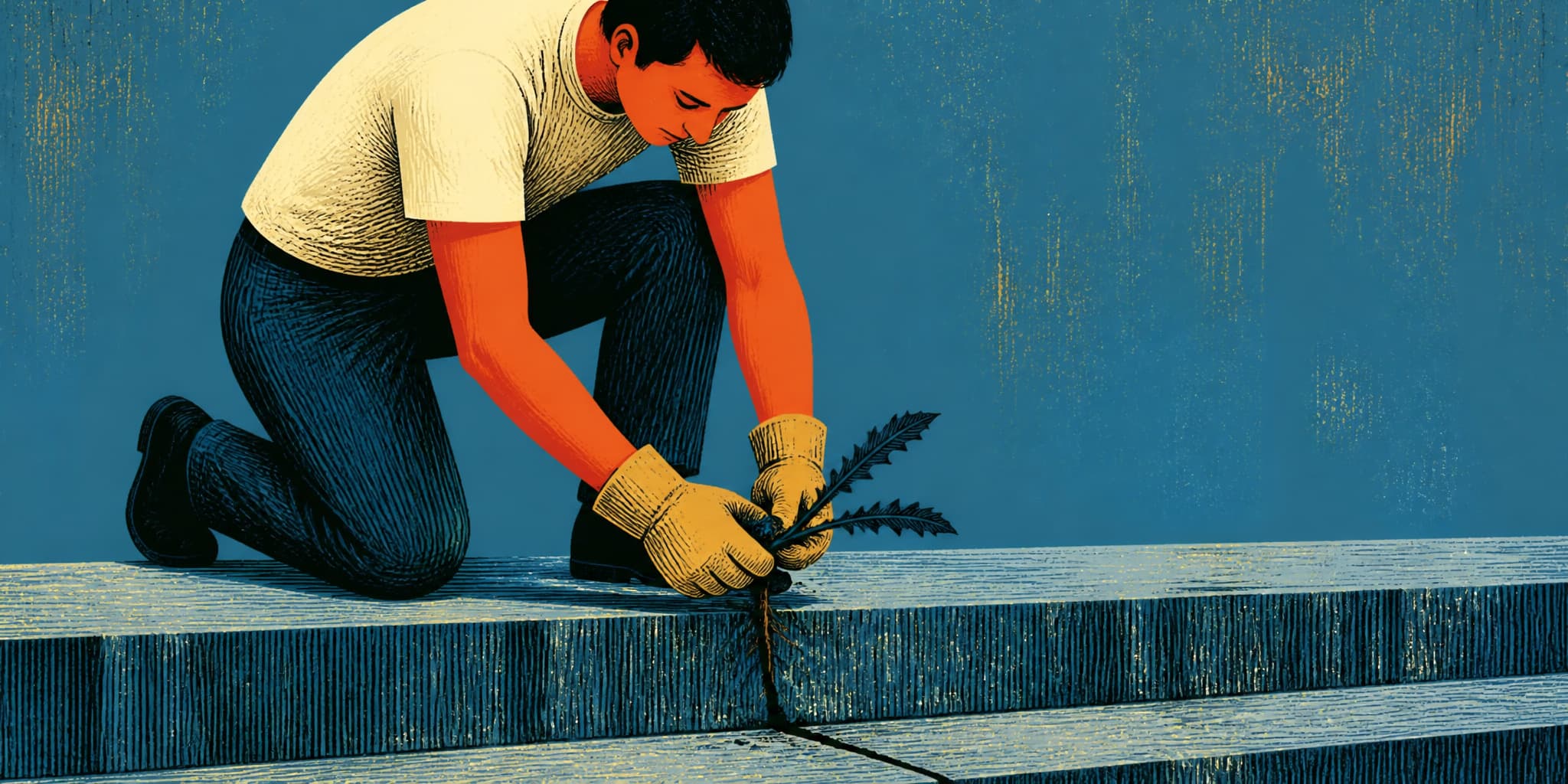
On July 26, from 10 a.m. to noon, the Detroit Steps Project holds its monthly maintenance day at Detroit and Hearst, the base of the lower steps. The maintenance days recur on the project calendar, and their regularity communicates something that a one-time volunteer event cannot. A single cleanup day is a request for help. A monthly maintenance day says there is always work, and you can always come back.
The structure of a maintenance day solves a problem that welcoming language alone cannot solve. A person who shows up to pull weeds or sweep risers does not need to introduce themselves, explain their interest in the neighborhood, or account for their presence. The task handles all of that. Gloves and a trash bag constitute a social role. You work alongside other people, and the work is visible, physical, bounded by the noon hour. If you spoke to no one the entire morning, you still belonged, because you were pulling the same weeds and sweeping the same concrete as everyone else around you. For a newer resident, or a quieter one, or someone who prefers to know a place through effort before they know it through conversation, that can be the easier door to walk through.
The monthly recurrence matters in its own right. A single event is a decision: go or don't. A recurring event is an open invitation with no expiration date. Miss July, come in August. The steps will still be there. The weeds will have grown back. The work resets itself, and the welcome resets with it.
186 Steps, Seven Years
The Detroit Steps Project began as a response to neglect documented in blunt, municipal language. What it has become is harder to categorize. It is not quite a park, not quite a plaza, not quite a civic monument. It is a public stairway that a group of residents decided to treat as a shared responsibility, and then kept deciding, month after month, for seven years. That sustained decision has produced painted risers, landscaped terraces, a decorative steel fence with ball finials, a view of San Bruno Mountain that was always there but is now framed by intention, and a metal archway that the city formally authorized through legislation. Valle's original hope, published on the project page in language that has not changed since 2018, was that the steps would become "an appealing and inspirational place for commuters, walkers, and residents." The monthly maintenance days are where that hope gets tested, by the people who show up with tools and do the work.
Saturday, July 26, 10 a.m.–noon at Detroit and Hearst. No experience required. The volunteer page has details. The steps provide the agenda.