
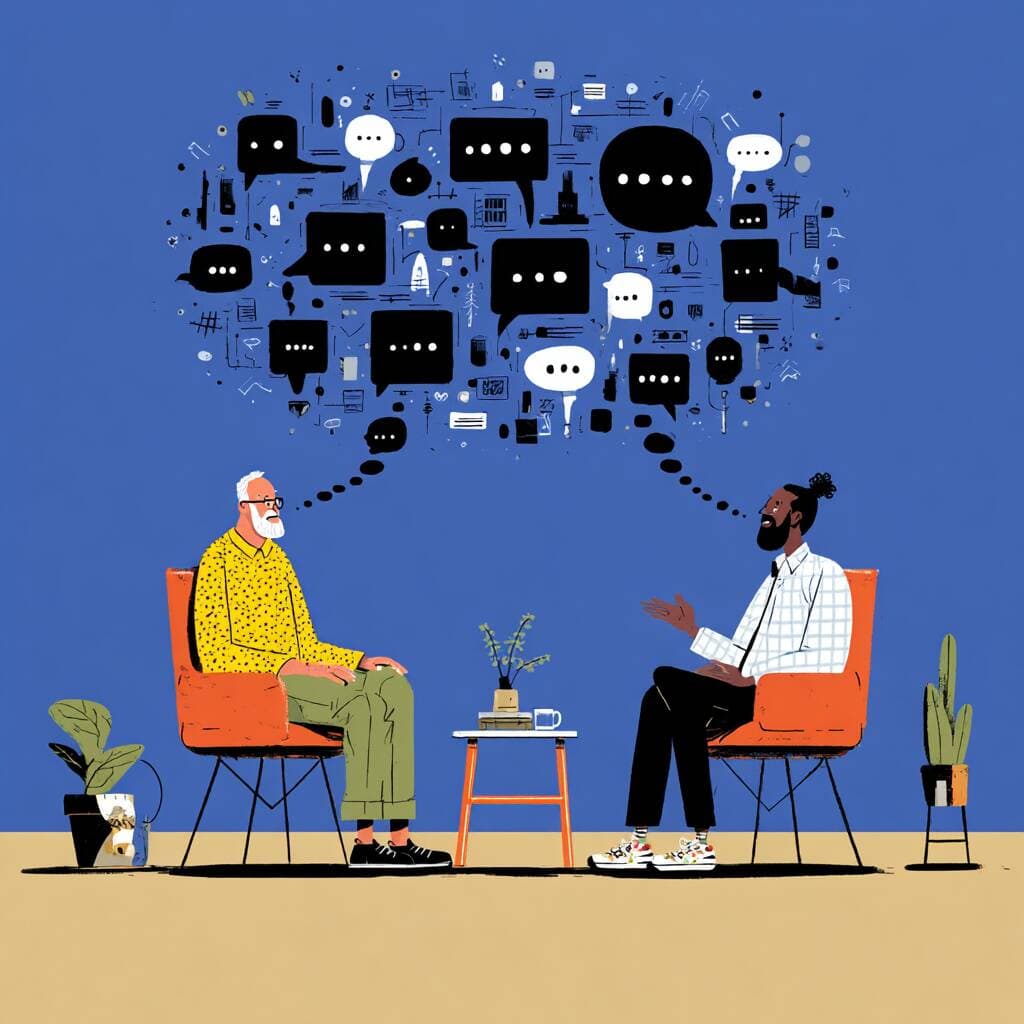
Future Tense publishes speculative fiction alongside reported journalism. This conversation takes place in September 2034. Kit Archuleta is not yet a real person, though the conditions of her work already are.
The office is on the first floor of a K-8 school in a mountain community on Colorado's Western Slope, close enough to a national forest that the emergency plan includes three evacuation routes depending on wind direction. A HEPA filter hums on a low table by the window, part of the state's Clean Air for Schools initiative, which began distributing portable air cleaners to districts over a decade ago.1 Kit Archuleta, the school's counselor for nineteen years, says she stopped hearing it a long time ago. It runs August through October. Some years, November.
On a bookshelf behind her desk, wedged between a feelings wheel poster and a bin of fidget tools, sits a row of binders she calls "the archive." Every post-wildfire resource packet the state or the National Association of School Psychologists has sent since she started keeping track.2 Fourteen of them. She has not opened most of them in years.
A fourteen-year-old in Kit's school this fall was born in 2020, the year of the Cameron Peak and East Troublesome fires. Every one of the twenty largest wildfires in Colorado history by acreage has occurred since 2000; more than half since 2018.3 Her students have grown up entirely inside this era.
Before we begin, Kit checks the AQI on her phone. Seventy-four. Moderate. Outdoor recess is on. She checks before email, she says. The way her mother used to check whether it would snow.
You've been in this room almost two decades. What's changed about the work?
Kit: [Glances at the binders.] Those arrived one at a time. After Cameron Peak. After Marshall. After Elk Creek in '28. Each one is basically the same document. "Helping Children After a Wildfire." "Signs of Distress Following a Natural Disaster." They're well-made. They tell you what to watch for after the event: the nightmares, the clinginess, the regression in the little ones.4 I use them. After an evacuation, they're exactly right.
But that's maybe ten percent of what I do now that's fire-related. The other ninety percent doesn't have a binder. The kid who's fine after the evacuation but stops sleeping in August when the air starts tasting like something. That's seasonal. It accumulates. Nobody's written the protocol for accumulation.
I read that you used to run the school's outdoor club.
Kit: Years ago. Hiking, snowshoeing. We'd go out every other Friday. I stopped, I want to say 2027? You can't plan a hike two weeks out when you don't know if the air will be breathable. And then the trail closures after the post-fire flooding. It wasn't some decision I made. It just got harder and then it stopped.
[Pause.]
I still have the sign-up clipboard in my desk drawer. I genuinely don't know why I keep it.
What does the accumulation look like in the kids who come through here?
Kit: OK, so. This is what I keep trying to explain to the district, and I haven't gotten it right yet. After a fire event, kids present the way the literature says they will. Nightmares, separation anxiety, some regression. That I was trained for. What I wasn't trained for is the kid who checks the AQI app every morning before school. Every morning, year-round, including February. She won't go to PE even on days when the number's fine. And here's what gets me: the school taught her to check. We said, "If the number is above 100, we stay inside."5 We made it a rule. She learned that outside is conditional, and she learned it from us.
The school sanctioned the avoidance and now wants to know why she's avoidant. I've brought this up in two staff meetings. Both times people nodded and we moved on.
[Pause.]
The younger ones don't use the words you'd expect. They don't say "I'm worried about climate change." They say their stomach hurts. They don't want to go to recess. I have a student who's drawn fire in art class three years running. Not because anyone prompted her. It's just what she draws. Her teacher asked me if it was a red flag. I said, honestly, I don't know. It might be processing. It might be that fire is the most dramatic visual in her life and she's eight. The clinical frameworks I have were built for a world where fire was an event, not a season.6 They can't tell me which one I'm looking at.
And then there's the quiet ones. A kid comes in after an evacuation drill. We run them regularly, and some of these kids have done the real version. He sits in the chair and doesn't say anything. Not upset. Not calm. Just present. Like he's waiting for me to tell him what this is.
I don't always know.
You've mentioned parent emails you struggle with.
Kit: [Laughs.] I get a version of the same email every September. It says: "My child is afraid of fire. Is this normal, or should I be worried?" And the honest answer is yes. Both. Her fear is proportional to the world she lives in. It is also interfering with her sleep and her friendships and her willingness to go outside.7 The system I work in wants me to pick one. Either she's having a normal response and I reassure the parent, or she has a clinical issue and I refer out.
What happens when the baseline moves and the categories don't?
I usually write back, "Let's set up a time to talk." Which is the right thing to do. It's also me buying time because I don't have a better answer.
If you could design the resource that doesn't exist, what would it look like?
Kit: A calendar. [Laughs.] I'm serious. Something organized around the season, not the event. Here's week one of smoke. Here's week three. Here's what to watch for when it's been orange for eight days and nobody's house burned down and nobody's in crisis, exactly, but the building feels different. The tip sheets are for day one. I'm on day eight, year ten.
Do the kids ever talk about climate change directly?
Kit: Almost never. The younger ones don't use that phrase. They talk about smoke. They talk about the air being bad.
A fifth-grader told me last week that her family has an "inside summer" and an "outside summer" and the inside one is longer now. She wasn't upset about it. She was just describing her life.
That's the part that sits with me. She has no memory of it being different. I do. I remember when we didn't check the air before recess. She doesn't miss what she never had.
How are you holding up? Nineteen years is a long time in this chair.
Kit: [Long pause.] I'm tired. And I want to be precise about that. I resist "burned out" as a label for myself because it lets the system off the hook. If I'm burned out, that's my problem. My self-care deficit, my failure to set boundaries. But if I'm tired, it might be because the job expanded by forty percent and the job description didn't, and there's still one of me.8
I had a dream last week that I was filling out a referral form and there was no box for "the world changed." Just the regular boxes. Anxiety. Depression. Adjustment disorder. I kept looking for the right one.
That's probably not a great sign. [Laughs.] But I'm here. The filter's on. The kids come in. That's the job.
Footnotes
-
Colorado Department of Public Health and Environment, Clean Air for Schools Program. The program provides training on indoor air quality monitoring and HEPA portable air cleaners for school buildings. ↩
-
National Association of School Psychologists, "Helping Children After a Wildfire: Tips for Caregivers and Teachers". These guidelines recommend verbal and nonverbal methods — drawing, stories, recording — for children to process wildfire-related experiences. ↩
-
Council on Strategic Risks, "State-Level Climate Security Education: Colorado", December 2025. ↩
-
NASP post-disaster guidelines focus on identifiable acute events. Williams et al. (2024), "'There's no helpline': how mental health services can support young people with climate distress", found that existing guidelines "do not focus on young people" and lack published research on distress from longer-term environmental change. ↩
-
Children's Hospital Colorado guidance: "If the Air Quality Index (AQI) is above 100, that's unhealthy for sensitive groups, including all children." ↩
-
Léger-Goodes et al. (2022), "Eco-anxiety in children: A scoping review", Frontiers in Psychology. The review identified "a significant gap in understanding the sensory impact of wildfires and the issues of climate anxiety and ecological grief among children." ↩
-
Child Mind Institute, "Kids and Climate Anxiety", November 2024: "When [climate anxiety] begins to impact a child's functioning at school, their friendships, or family relationships, it may be important to seek professional support." ↩
-
YouScience 2025 school counselor survey, reported by eSchool News: 89% of middle school counselors struggle to provide personalized guidance due to time scarcity and expanding mental health demands. ↩