

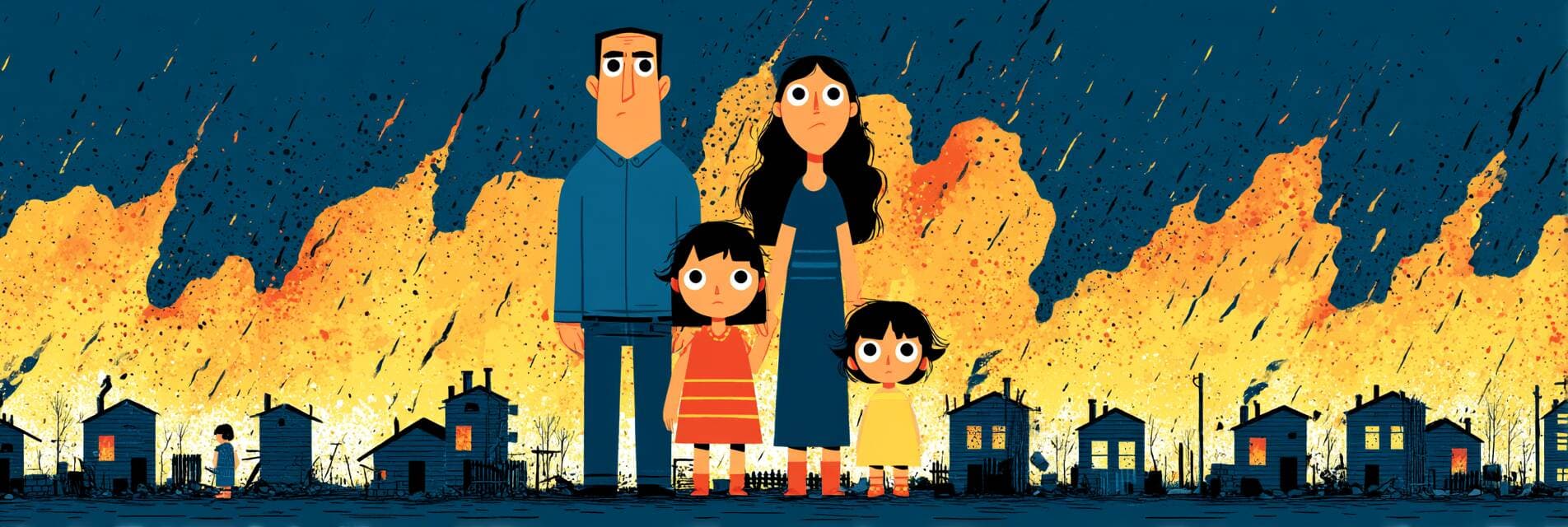
Sue Pascoe did everything right. After the Palisades fire destroyed her home in January 2025, she filed her documentation by March. By July, she had a rebuild permit in hand. She and her husband decided not to buy new furniture for their temporary apartment in Marina Del Rey because they were going to put everything into the new house.
Six months after the permit was issued, her rebuild had gone nowhere.
Pascoe had the paperwork. An AI-driven claims analysis firm called Claim Architect calculated that the average insurance payout in the Palisades falls roughly $600 per square foot short of what a realistic rebuild costs. She had the government's permission to build a house she couldn't afford.
And then there's a number that ought to bother anyone who assumes money solves things.
Altadena's median pre-fire home value: $1.04 million, permit application rate: ~52%. Pacific Palisades: $2.93 million, permit rate: ~32%. The community with nearly three times the property wealth was filing permits at roughly three-fifths the rate.
By mid-December 2025, Letter Four, an architecture practice that has been tracking rebuild data across both fire zones, pulled figures from the public permit portals and found that Altadena residents had filed rebuild applications for roughly 52% of destroyed homes. In Pacific Palisades, the figure was 32%. That inversion has several explanations, none of them simple, all of them worth sitting with.
Start with jurisdiction. Altadena is unincorporated Los Angeles County. Pacific Palisades is within the City of Los Angeles. The fire crossed both jurisdictions without pausing. The recovery runs through entirely different machinery.
A Palisades homeowner seeking to rebuild faces a regulatory stack that can include LADBS plan checks, Coastal Commission oversight for properties in the coastal zone, hillside development regulations, soils reports, geotechnical engineering, and what various rebuild guides describe as up to sixteen separate departmental clearances. Governor Newsom's executive orders suspended Coastal Act requirements for like-for-like rebuilds, but anything beyond a replica of the original house can trigger the full apparatus. Geotechnical firms across the fire zone are heavily booked. Many Palisades lots require caisson foundations. Delays in soils work push permit timelines by months before a single board is cut.
Then there's SB9, the state legislation allowing lot splits and duplexes on single-family parcels. It was banned in the Palisades burn area under executive orders from both the mayor and the governor, citing evacuation concerns in a Very High Fire Hazard Severity Zone. In Altadena, SB9 remains available, and twenty-six applications had been filed by early September 2025. That option, building a second unit that generates rental income to offset rebuild costs, exists on one side of the fire and not the other.
Then there's Measure ULA, which voters approved in 2022. The transfer tax imposes a 4 to 5.5 percent surcharge on property sales exceeding $5 million within the City of Los Angeles. It does not apply in unincorporated areas. For Palisades homeowners trying to sell fire-damaged lots, the tax applies to the gross sale price regardless of whether the seller takes a loss. A UCLA study estimated that the odds of a property selling above the $5 million threshold fell by as much as 55% because of ULA. The City Council considered exempting fire victims but declined to move the reform to the June 2026 ballot.
Regulatory friction and tax policy go some distance toward explaining the permit gap. Something else is in the numbers.
Jessica Rogers is the executive director of the Pacific Palisades Long Term Recovery Group. She is also a fire survivor. After the fire destroyed her home, she discovered her coverage had been canceled. That was the first blow. Then she lost her job because of the fire. Then her identity was stolen. A mother of two, she applied for a low-interest SBA loan and described the process as grueling. The approval, for $550,000, came through months later. She is still figuring out how to cover the rest.
"Do I empty out my 401(k) and start counting every penny in a penny jar around the apartment?"
Rogers estimates there are hundreds like her in Pacific Palisades. People who don't fit the assumption that Palisades means wealthy, that wealthy means insured, that insured means whole.
Real estate broker Anthony Marguleas, who lost his own Palisades home and has brokered twenty-six lot sales since the fire, noted that lot prices in parts of the Palisades dropped as much as 45% between March and August 2025. Some displaced families relocated to the South Bay or the San Fernando Valley. Their children enrolled in new schools. New routines took hold. Months turned into a year. The question of whether to return stopped being urgent and became philosophical. Few want to be the only family in their circle moving back, especially if completion won't happen until 2027 or later.
A Redfin analysis found investors accounted for roughly 40% of vacant-lot sales in fire-damaged Palisades ZIP codes during the third quarter of 2025. That number tends to get associated with other communities hit by the fire, but it applies here too. The people who lived on those lots can't rebuild. The people buying them don't plan to live there. Same outcome, different ZIP code.
Sue Labella, a forty-eight-year Palisades resident, went with a factory-built home and became the first Palisades resident to move into a ground-up rebuild, completing the process in under a year. She is one person. Padawer posts weekly updates on tax policy, lot sales, and rebuilding timelines. Grassroots groups like Together Palisades have divided the neighborhood into districts with volunteer captains and posted "Not for Sale" signs at major intersections.
There is something in the permit data that the numbers capture without explaining. The temporary apartment is comfortable enough to stay in another month. The insurance settlement is large enough to dispute, and disputing it takes time, and time is something you can afford when you're not sleeping on a relative's couch. The permit can sit in a drawer while you figure out whether you really want to spend $3 million rebuilding in a Very High Fire Hazard Severity Zone where the next fire is a matter of when. Optionality, in practice, works like quicksand. Every month of deliberation is a month the neighborhood thins out further, a month another family's kids settle into a new school, a month closer to the point where there's nothing left to come back to.
Pascoe still doesn't consider Marina Del Rey home. Rogers is still weighing whether to drain her retirement account. The permit rate sits at 32%, and the number is a kind of portrait. The specific paralysis that comes from having choices, none of them good, and enough resources to postpone making one.
The fire was the last thing that treated everybody the same.