

Anne Arundel County, Maryland, sits in the middle of the corridor where the grid almost broke on a Monday evening in May. The county is home to about 600,000 people, the city of Annapolis, a naval academy, and Wagner Unit 4, a gas-fired power plant that was supposed to retire but keeps getting ordered back to life by the federal government. On May 18, PJM Interconnection, the grid operator serving roughly 65 million people across thirteen states and the District of Columbia, activated pre-emergency demand response specifically for the Baltimore Gas & Electric, Dominion, and Potomac Electric Power Company service zones. Anne Arundel County is BGE territory. The problem PJM cited was "capacity deficiencies resulting from transmission constraints" limiting power imports into the region. They couldn't get enough electricity into the places where people were running air conditioners in heat that wasn't supposed to arrive for another month.
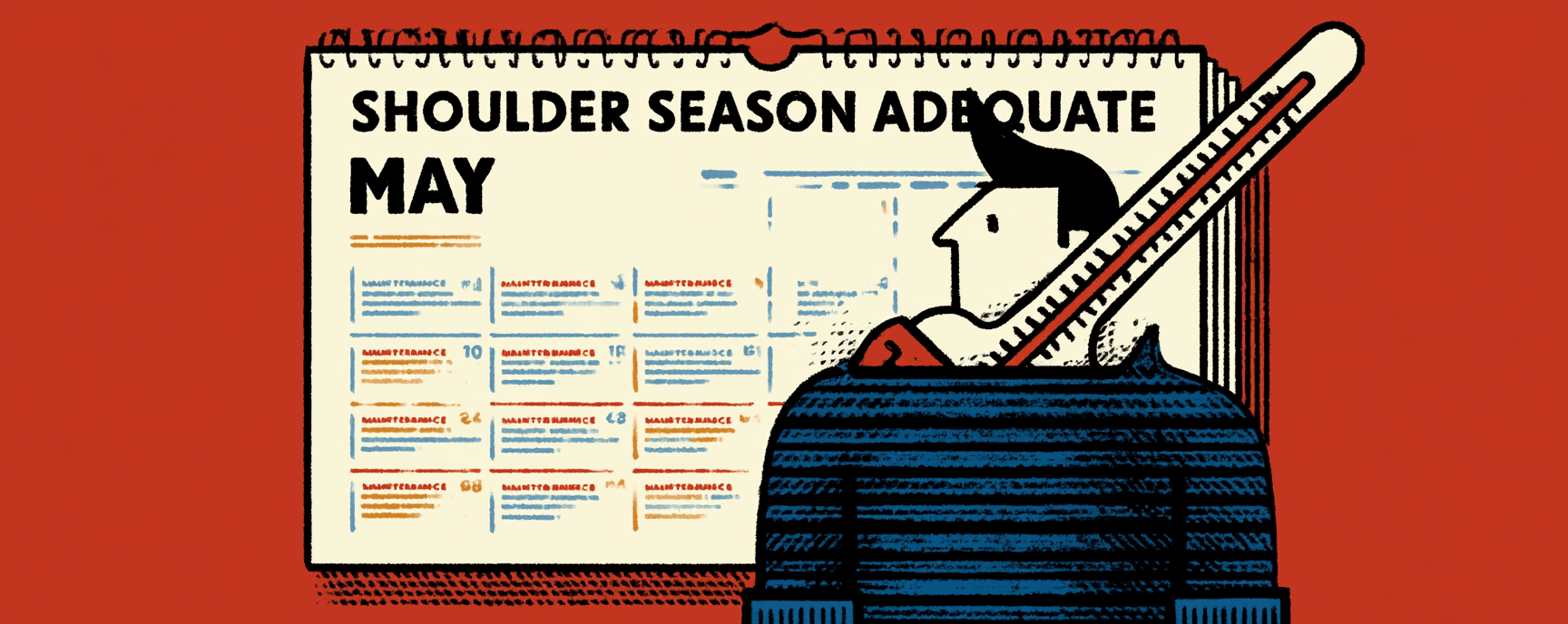
That same day, the Department of Energy issued Emergency Order No. 202-26-23, authorizing PJM to curtail large loads across its entire territory. PJM had filed its emergency application the day before, projecting fewer than 5,800 megawatts of reserves during the Monday evening peak. Temperatures were in the nineties. Forty thousand four hundred megawatts of generation sat offline for scheduled maintenance. PJM could not meet its day-ahead reserve requirement.
On May 19, the North American Electric Reliability Corporation released its 2026 Summer Reliability Assessment. PJM's classification: adequate. Twenty-six percent installed reserves against an 18.6 percent requirement. Comfortable margin.
Both of these things happened within twenty-four hours of each other. Understanding how that's possible requires looking at what "adequate" actually means when NERC says it.
What "Adequate" Actually Measures
NERC's reliability standard rests on a metric called Loss of Load Expectation: 0.1 days per year. One day in ten years when the system's generation cannot cover demand. It is a probability averaged across hundreds of simulated weather scenarios, not a promise about any particular Tuesday in May. The models run historical weather data through load forecasts and ask: across all these possible summers, how often does the system come up short?
The Summer Reliability Assessment tests whether resources can meet demand under normal conditions, June through September. PJM's 26 percent reserve margin means that if you add up all the generation capacity PJM expects to have available during a typical summer peak, it exceeds projected demand by a comfortable cushion. NERC's own documentation notes that "reserve margins are capacity-based metrics and do not provide a comprehensive assessment of performance in energy-limited systems." The capacity-based number counts what's theoretically available. Whether those resources are available at the specific moments of highest operational risk is a different question, one the metric wasn't built to answer.
"Expects" is the word carrying the adequacy finding. "Normal conditions" is the phrase carrying the assessment framework. Both deserve more scrutiny than they get.
May is what grid operators call the shoulder season. Power plant and transmission owners take equipment offline in spring for maintenance precisely because the weather is supposed to be mild. PJM's own website describes May as "the heart of the shoulder season." The entire maintenance schedule is built on the assumption that nobody needs 135,000 megawatts in mid-May.
Nineties in mid-May violated that assumption. The 40,400 megawatts offline for maintenance weren't a scheduling failure. They were scheduled correctly, according to a calendar that no longer describes the weather. In Anne Arundel County, in the BGE corridor, the collision between unseasonable heat and scheduled maintenance meant the grid couldn't import enough power to cover demand in the places where people actually live and work. The adequacy assessment, scoped for June through September, had nothing to say about it.
NERC's own assessment contains a sentence that reads like a confession timed to the emergency order issued twenty-four hours earlier:
"The early arrival of summer heat and high demand in March has highlighted the risks associated with potential overlaps between spring maintenance outages and high demand."
And a footnote worth more than the headline finding: "Even in normal risk assessment areas, extreme demand and extreme outage scenarios that are not closely linked [to the typical peak] can create reliability challenges."
The assessment says adequate. The footnotes say something else.
The Plants That May or May Not Exist
Whether the DOE-ordered plants were counted in NERC's resource tally when it declared PJM adequate matters, and available documentation doesn't fully resolve it.
Wagner Unit 4 in Anne Arundel County had already been kept alive by a DOE order in 2025, directed to operate beyond its emissions limits during reliability emergencies. Three days after the May 18 crisis, DOE issued a new order directing Wagner to run through August 19, 2026. Eddystone Units 3 and 4 in Pennsylvania, 760 megawatts of gas and oil capacity, had been running on continuous DOE emergency extensions since their scheduled retirement in May 2025. PJM itself supported the DOE orders, citing "growing resource adequacy concerns."
At least one analysis claims these plants "were not even counted in NERC's anticipated resources for summer." NERC's assessment includes a table tracking plants operating under 202(c) orders, but whether their megawatts appear in PJM's reserve margin calculation requires reading the primary document more carefully than most people covering this story have bothered to do.
If those plants are excluded from the adequacy count, the system looks adequate on paper partly because the emergency measures propping it up aren't in the spreadsheet. If they're included, the adequacy finding rests on capacity that exists only because the federal government ordered it to exist. Either way, "adequate" is doing more work than the word can bear.
The Disagreement Running Through Every Level
The disagreement about what the May emergency means is real, and it runs through every level of the institutions responsible for the grid.
Energy Secretary Chris Wright framed the May 18 order as the administration being "committed to unleashing all available power generation needed to keep Americans safe amid the heatwave." No blackouts occurred. Emergency protocols activated. The system worked.
PJM's own senior vice president of operations offered a more candid read in the 2026 summer outlook: "While we expect to operate reliably this summer, the outlook resembles last year's and reflects a new reality — continued load growth driven by data centers that is outpacing the addition of new generation. This results in tightening operating reserve margins and greater risk."
NERC's director of reliability assessments, speaking the day the Summer Reliability Assessment was released: "The improved conditions we're seeing shouldn't be interpreted as saying that overall reliability risk is declining."
At FERC, the tone was less diplomatic. Commissioner David Rosner, responding to PJM's 2027/28 capacity auction results in December 2025, called the shortfall "unacceptable." That auction was the first in PJM's history where the entire system fell short of its reliability requirement, clearing a 14.8 percent reserve margin against a 20 percent target. Commissioner Judy Chang: "We're hitting the grid reliability crisis that has been brewing for years." Six days before the May 18 emergency, FERC Chairman Laura Swett stood at PJM's annual meeting and called PJM's stakeholder process "slow where it must be fast, opaque where it must be transparent."
On the other side, the Sierra Club's Greg Wannier told a Senate roundtable in March that the administration had "twisted" its emergency authority, that industry-standard reliability analyses had "determined that the plants could retire without destabilizing the grid," and that keeping six retiring coal and gas plants online had cost ratepayers more than $230 million.
This is a genuine disagreement about whether the emergency orders address a real gap or manufacture one. The emergency authority may be used more broadly than the statute intended, and the grid may genuinely need the megawatts. The two positions aren't mutually exclusive, which is exactly why nobody wants to sit with the problem.
The Planning Gap as a Permanent Feature
What happened on May 18 was not a freak event. Summer 2025 produced PJM's third- and fourth-highest all-time peaks. PJM's load forecast for that summer predicted approximately 154,000 megawatts under normal conditions. Actual load exceeded 161,000 megawatts. A 7,000-megawatt forecast error, driven by data center demand arriving faster than anyone modeled. The twenty-year forecast now projects PJM's summer peak climbing roughly 85,000 megawatts over the next fifteen years.
The first auction in PJM's history where the entire system fell short of its reliability requirement: 14.8% reserve margin cleared against a 20% target.
Twelve days before the May 18 emergency, PJM published a white paper called Powering Reliability Through Market Design that contained a remarkable admission. It outlined something called "Path B: Differential Reliability," acknowledging that "the shared reliability compact that has defined the PJM market from inception cannot be maintained for all load under structural scarcity." Under Path B, large new loads that interconnect without bringing their own generation would go to the front of the curtailment line. The paper noted "the time available to make these decisions deliberately is measured in years, not decades."
The grid operator serving 65 million people published a document, two weeks before an emergency that nearly required rolling blackouts, contemplating a future where not everyone gets the same reliability.
In Anne Arundel County, the Maryland Office of People's Counsel has been protesting a PJM proposal it says "would unlawfully saddle Maryland customers with nearly $800 million" for infrastructure costs driven by load growth elsewhere in the system. This is what Path B looks like before anyone calls it Path B. The costs of the planning gap are already being allocated. The question is whether the people absorbing them know it.
I spent five years on cargo ships watching how systems actually work versus how they're described in the manual. The manual tells you the ship's rated capacity. The chief engineer tells you what it can actually do today, with this crew, in this weather, with that bearing making noise. Two different numbers. The distance between them is where people get hurt. The people in the BGE corridor didn't have a chief engineer. They had an adequacy assessment.
What May 18 Actually Revealed
NERC's Long-Term Reliability Assessment, published in January 2026, classifies PJM as a high-risk region beginning in 2029. The Summer Reliability Assessment, published in May, classifies PJM as normal risk for the summer of 2026. The gap between those two findings is three years. The gap between the adequacy finding and the emergency order was one day.
The assessment framework answers a question that used to be the right question: Do we have enough capacity for a normal summer? "Normal" is a historical concept applied to a system where the history no longer applies. The 1-in-10-year standard was designed for a grid where the main risks were power plant breakdowns and unusually hot Julys. The models assumed demand growth would be gradual, that spring would be spring. Every one of those assumptions has been breached. On a Monday evening in May, in the service territories where millions of people live.
For the people in Anne Arundel County, or anywhere in the thirteen states PJM covers, May 18 showed them this: the system that measures whether they'll have power this summer says yes. The system that actually delivers their power needed federal emergency intervention to avoid rolling blackouts in mid-May. Each system is functioning correctly, by its own lights, against its own assumptions about what the world looks like.
"The improved conditions we're seeing shouldn't be interpreted as saying that overall reliability risk is declining."
— NERC director of reliability assessments, May 19, 2026
The grid is adequate the way a bridge is adequate when the load rating hasn't been updated since the trucks got heavier. The math checks out. The math is about different trucks.
-
FERC's July 23 conference: FERC has scheduled a technical conference on PJM's governance and stakeholder process for July 23, 2026, after Chairman Swett publicly criticized PJM's decision-making speed at the operator's annual meeting on May 12.
-
NYISO's vanishing margin: The New York Independent System Operator warned of just 417 MW of reliability margin for summer 2026, driven by generator retirements in New York City and Long Island that are outpacing new resource additions.
-
Maryland's cost-shift fight: Maryland Senate Bill 0992 would require large load customers like data centers to bear curtailment risk and pay for new capacity their interconnection demands, a direct legislative response to the Office of People's Counsel's protest over $800 million in cost socialization.
-
El Niño's summer odds: NOAA forecasts a 61 percent chance of El Niño conditions developing later this year, with a 1-in-4 chance of a strong event that would raise extreme heat risk well beyond the conditions that triggered the May emergency.