
The steering wheel was still warm from the afternoon when she gripped it at seven-thirty. The car's AC had been running for two minutes and the air from the vents was cool enough to register on her wrists but not her face. She drove with the windows up. The sun had dropped behind the warehouse corridor along I-20 but the sky kept its heat-color, a pinkish haze that wouldn't go fully dark for another forty minutes. She passed the storage units, the Whataburger, the lot where someone had been selling watermelons from a truck bed all week. Thursday evening. Tomorrow was Juneteenth and the schedule board had shown gaps. Tamika off, DeAndre off, Luis picking up a double. Rae had looked at the board and counted. Fewer people, same freight.
She turned onto the access road. The distribution center sat behind a parking lot the size of two football fields, its flat roof and loading bays already lit by sodium lamps that turned the blacktop amber. She pulled into her spot, third row back, near the cage nobody used for carts. Cut the engine.
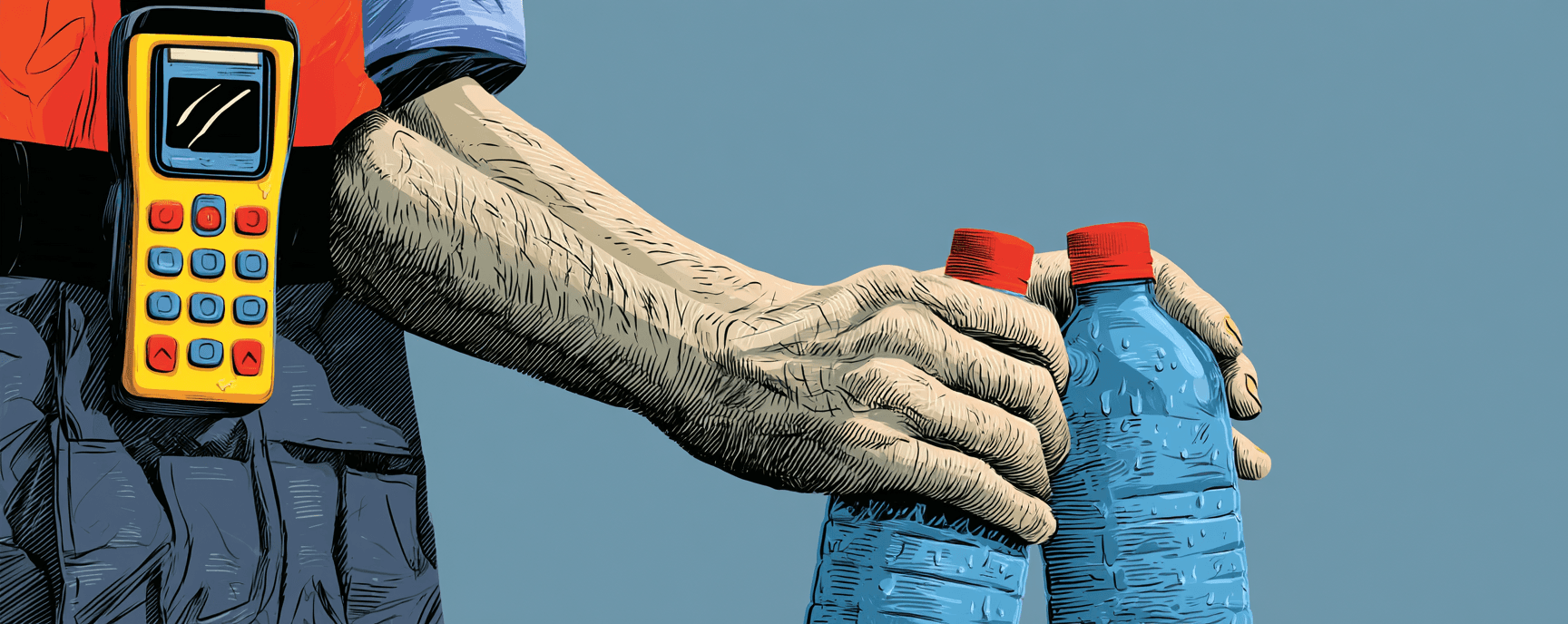
Heat filled the car before she could gather her things. A settling, like pressure equalizing. She picked up her lunch bag, her water bottle, the second water bottle she'd started carrying the summer of '33 and never stopped. Opened the door. The parking lot came up through her boot soles, warmth that was almost solid, the blacktop still giving back what it had taken in all day. The air sat on her skin and stayed there. Her forearms felt coated before she'd crossed the first row of cars.
Inside, the warehouse opened into its half-million square feet of racked inventory, ceiling invisible from the floor, just the lights up there and the big destratification fans turning, pushing air down. The break room was cool. She signed in, stowed her lunch, clipped her badge, laced her boots tighter. The pre-shift stretch circle had started near Bay 12, Carla leading, counting off hip rotations while new hires wobbled and the veterans moved through it without looking at each other.
She pulled her right heel to her glute and held it. The quad lengthened. Through the floor she felt the conveyor system already running on the far side of the building, that low hum her feet still registered though her ears had stopped hearing it years ago.
Pick tonight. B-wing, aisles 40 through 72. She strapped the scanner to her forearm, checked the battery, pulled her first cart. The scanner fed a route. She followed it, but she also knew it. Aisle 56 ran warmer because it backed the loading dock wall. The cross-aisle near 64 caught a draft from the return vent overhead. The far end of 72 was a dead zone where air pooled and thickened. Four years in this building. Her body had mapped it the way her grandmother's body had mapped the house on Marsalis Avenue, moving through dark rooms without reaching for a switch.
First water station at 8:40. She drank standing, one long pull, then a second. The water was cold enough to feel in her sternum. She refilled both bottles. Around her, something in the building shifted. The fans still turned. The vents still pushed. But the air stopped shedding heat the way it had twenty minutes earlier. The difference between a wet cloth on your neck and a dry one. Both there. Only one doing anything. The sweat on her forearms, which had been drying between aisles, stayed.
She picked, scanned, placed, moved to the next location. Her left hand reached while her right was already scanning the next item. Her rate was good. It was always good. She didn't check it the way the new hires did, every fifteen minutes, that tight look around the mouth. She was aware of her rate the way she was aware of her breathing. She noticed when it changed.
By nine-fifteen the dock doors were cycling for outbound loads and each opening let in a wall of air that hadn't cooled. She could feel it from three aisles deep, a pulse of wet heat that mixed with the conveyor warmth and settled between the racks. The new kid on dock had his shirt dark between the shoulder blades. She watched him lift a case with his back, all wrong, and almost said something. Carla would catch it.
Water station. 9:22. She checked her phone.
A text from her daughter: ac doing that thing again. set to 72 but says 76
She looked at the screen. Her thumb hovered over the keyboard. The air on the back of her neck had that particular quality, cooling that was reaching but not arriving. She could feel the warehouse around her the way you feel a room you've been in too long.
Turn the fan on in my room too, she typed. Comes back down by 11.
She put the phone in her pocket. Drank. The water was less cold now, the bottle slick in her hand.
Break at ten. Fifteen minutes. The break room hit her skin the moment she walked in, her forearms tightening, the sweat on her neck going cold. She sat. Ate half a sandwich. Carla was talking about tomorrow, the cookout her sister was having in Cedar Hill, how she'd promised the potato salad and now regretted it because it was supposed to be a hundred and four. Luis said he'd trade the potato salad for the double. Everybody laughed. Rae sat and let the cool air work on her. Above the microwave, the updated heat protocol from April listed the hydration intervals and the break-room temperature and the number to call, same poster as last year with a new compliance date. She ate. The timer on the wall showed two minutes. She stood, stretched her calves against the doorframe, and went back out.
The building had found its level. The cooling hadn't restored but it hadn't worsened. The air had settled the way water settles, pooling in the low spots near 72, thinning in the cross-aisles where the vents still reached. Her body adjusted. She picked faster in the second half. Her muscles were warm and loose and her hands knew where things were before the scanner told her. She moved through aisle 56 and the dock wall radiated against her right side. She pulled a case, twenty-two pounds according to the label, and placed it on the cart and felt her lower back register the weight without resisting it. Her sweat was steady now, the working kind, her body doing what it was supposed to do.
She drank. Refilled.
Somewhere around eleven-thirty the air shifted again. The vents pushed and this time the push had something behind it, a coolness that reached her forearms before she'd consciously registered the change. Her skin dried between aisles again. The cross-aisle near 64 felt almost comfortable, the draft from the return vent carrying real cold now instead of circulated warmth. She moved through it and out the other side.
She picked and scanned and placed. The scanner glowed on her forearm. The conveyor hummed through the concrete floor. Through the dock wall she could hear a truck idling, its engine ticking in the dark, and beyond it the distant wash of I-20 traffic thinned out for the night. Inside, the freight moved, and her body moved it, and the shift continued.
- The grid's evening gap: ERCOT projects peak demand could exceed 92,200 megawatts this summer, driven by extreme heat and surging data center load, as Axios Houston reported in June.
- Heat's stolen hours: A peer-reviewed study found that extreme heat is eliminating hundreds of hours per year that older Americans can safely spend on normal activities, reframing heat as a livability crisis rather than a survival one.
- No federal heat standard yet: OSHA's proposed rule for heat injury prevention in indoor and outdoor workplaces set specific break and hydration triggers at 80°F and 90°F heat index, but the rule remains unfinalized as of mid-2026 and is not a current administration priority.
- Warehouse workers and disputed temperatures: Amazon warehouse workers in California and New York have documented indoor readings as high as 89°F on days the company reported temperatures below 78°F, highlighting the gap between official monitoring and bodily experience.